
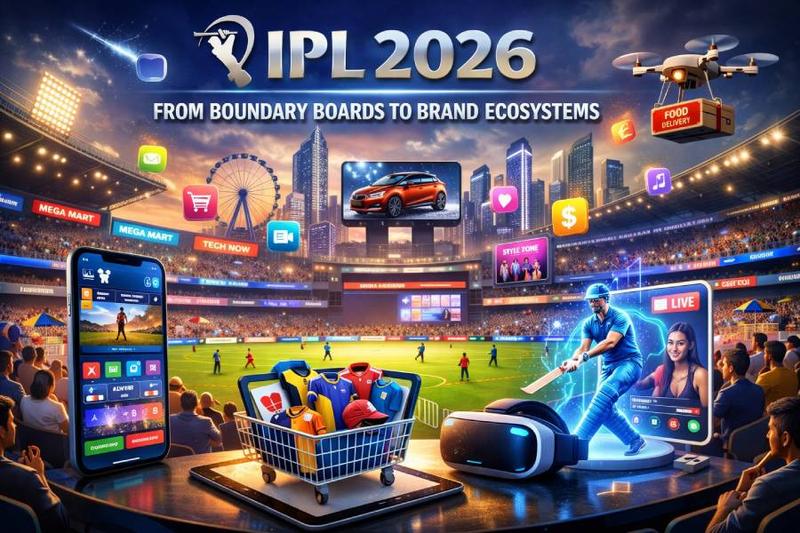
A Tournament That Outgrew Its Own Business Model
When the Indian Premier League launched in 2008, its commercial proposition was uncomplicated. Cricket had an audience. Brands wanted that audience. The transaction happened through jersey patches, stadium hoardings, and thirty-second television spots.
That arrangement worked for years because it reflected the reality of Indian media at the time — television was dominant, measurement was blunt, and reach was the primary currency of brand investment.
None of those conditions hold in 2026.
Television is no longer the only screen that matters. Reach without relevance has lost its premium. And brands with serious marketing intentions have discovered that buying space inside the IPL is a fundamentally different proposition from building a presence within it.
The league has not simply grown in scale — it has changed in kind. And the commercial strategies of the brands engaging with it most successfully have had to change accordingly.
The Scale That Reframes Everything
To understand why IPL sponsorship strategy is evolving, it helps to first appreciate the commercial dimensions that now make it a genuinely unique property in global sport.
Broadcast rights for the 2023–2027 cycle was acquired for a sum that placed the IPL among the five most valuable sports broadcast deals ever negotiated anywhere in the world. On a per-match basis, the value implied by that transaction exceeds that of most European football leagues and sits in the same conversation as NFL regular season inventory.
The cumulative value of the IPL ecosystem — encompassing central sponsorships, franchise commercial revenues, media rights, and the international league expansion being pursued by several franchises — is now estimated across industry analyses at a figure that would have been unimaginable when the league's first season attracted sponsors at a fraction of current rates.
This scale changes the nature of the commercial opportunity in a specific way: properties of this magnitude do not function as advertising vehicles. They function as cultural institutions. And brands that engage with cultural institutions differently from brands that buy advertising slots.
Why the Sponsor Mix Is Being Reshuffled
Fantasy Gaming Cedes Ground
The category that most visibly shaped IPL's sponsor identity through the late 2010s and early 2020s was online fantasy gaming. The alignment between fantasy gaming platforms and cricket's core male demographic was so direct that multiple platforms competed aggressively for the same inventory, driving prices upward and cementing the category's presence across jersey fronts, broadcast sponsorships, and digital inventory simultaneously.
That era has not ended — leading platforms retain meaningful positions within the ecosystem — but its dominance has softened. A combination of evolving regulatory treatment, consumer sensitivity to certain gaming formats, and the maturation of the category's own marketing strategies has reduced the intensity of fantasy gaming's IPL spend relative to its peak years.
The vacuum this creates is not going unfilled.
Financial Services Steps Forward
The category asserting itself most purposefully into the space created by gaming's partial retreat is financial services. Banks, insurers, asset managers, and payments companies have arrived at a common strategic conclusion: the IPL audience — urban, digitally active, income-earning, and in the age bracket where financial product adoption decisions are being made for the first time — is the most efficient single reach vehicle available for consumer financial brand building in India.
What makes this category's engagement structurally different from gaming's approach is the underlying commercial objective. Fantasy gaming brands needed transaction-level response — downloads, registrations, deposits. Financial services brands are building something slower and more durable: trust. Familiarity. The low-level brand warmth that makes a consumer choose one insurer over another when a life event forces the decision.
That objective is better served by sustained, consistent presence than by heavy short-term saturation. Which is precisely why BFSI brands are signing longer agreements, activating more deeply across franchise touchpoints, and measuring their IPL investment against brand equity metrics rather than cost-per-click.
New Consumer Brands Find a Viable Entry Point
A third shift in the sponsor mix reflects a structural change in how IPL inventory is packaged and sold. The availability of targeted digital inventory through streaming platforms — allowing brands to reach specific audience segments with measurable outcomes — has opened the IPL ecosystem to a category of advertiser that was effectively priced out under the legacy television model.
Direct-to-consumer brands in health, personal care, quick commerce, and consumer technology are buying IPL adjacency in ways that were simply not possible five years ago. Their budgets are smaller; their targeting is sharper; their measurement is more granular. They are not buying the IPL's mass reach. They are buying its cultural authority — the halo effect of cricket association — applied to a precisely defined audience segment.
This democratisation of access is, paradoxically, making the overall commercial ecosystem more valuable. A property that can monetise both ₹500 crore title sponsorships and ₹5 crore digital performance packages has unlocked a far larger total addressable market than one that could only serve the former.
The Architecture of a Modern IPL Deal
Contracts Built for Cycles, Not Seasons
Perhaps the most consequential structural change in IPL commercial agreements over the past three years is the extension of deal durations. The dominant contract length has shifted from one-to-two seasons toward three-to-five year cycles, often with built-in performance escalators and category exclusivity provisions that give both parties a long-horizon commercial relationship.
For brands, this shift reflects a strategic insight that compounding matters in sponsorship just as it does in investing. A brand that maintains consistent IPL presence across five seasons builds accumulated brand equity — fan familiarity, emotional association, subconscious trust — that a brand buying aggressive but intermittent inventory cannot replicate. The value of year five of a sustained IPL partnership is qualitatively higher than the value of year one, even if the GRP delivery is identical.
For franchises and the league itself, longer agreements provide commercial revenue predictability that enables investment decisions — in infrastructure, in digital products, in content development — that annual renewal uncertainty would otherwise preclude.
The 365-Day Activation Imperative
The second structural shift is the collapse of the idea that IPL brand activation begins when the first ball is bowled in April and ends when the trophy is lifted in May.
The most commercially sophisticated sponsors have extended their activation calendars to encompass the entire cricket year. The player auction in January generates its own media moment — and brands embedded in that conversation reach a highly engaged audience weeks before the season begins. Pre-season training camps and franchise media days create content opportunities. The off-season itself, if used intelligently, maintains brand presence in cricket fans' attention without the noise competition that peak-season inventory brings.
Brands that operate year-round are not buying more IPL advertising. They are constructing a continuous narrative — a presence in the fan's relationship with their team and their sport — that no burst campaign can manufacture.
Jersey Architecture Is Growing More Complex
The jersey has always been the most coveted piece of real estate in franchise commercial inventory. It is the item most photographed, most replicated in fan merchandise, and most visible across broadcast, digital, and physical environments simultaneously.
The traditional model — one primary sponsor occupying the jersey front — is giving way to a more modular approach. Collar sponsors, sleeve partners, trouser-waistband branding, helmet logos, and back-of-shirt placements are being packaged as distinct commercial properties, allowing franchises to multiply revenue streams while offering brands differentiated visibility tiers.
This modularisation also creates a more accessible entry point for mid-market sponsors who cannot afford the flagship front placement but can secure meaningful, high-visibility real estate within the same garment. The franchise benefits from higher aggregate jersey revenue; the brand benefits from association with a premium property at a commercially accessible price.
The Digital-Linear Split and What It Means for Buyers
The consolidation of IPL broadcast rights under a single entity — holding both linear television and digital streaming inventory — has not homogenised the market. It has, if anything, sharpened the divergence between two distinct commercial ecosystems operating under the same rights umbrella.
Linear television continues to deliver the largest absolute audience, skewing toward older demographics, tier-two and tier-three geographies, and language market segments where smartphone penetration remains incomplete. The CPM commanded by this audience reflects its scale. Television buyers are predominantly large-cap FMCG and consumer durables brands building broad national awareness — the use case for which television has no peer.
Streaming inventory, by contrast, attracts a younger, more urban, more affluent, and more digitally active viewer. The data richness of a streaming environment — where viewer identity, content consumption patterns, and behavioural signals are known — enables a targeting and measurement sophistication that television cannot offer. Performance-oriented brands — fintech companies running activation campaigns, e-commerce brands measuring cart additions, insurance companies tracking quotation requests — find streaming inventory structurally better suited to their objectives.
The brands extracting maximum value from IPL 2026 are those that have resolved to operate across both surfaces simultaneously — using television to build the widest possible brand familiarity and streaming to drive measurable response within defined audience segments. This two-surface approach is more operationally complex and requires a more sophisticated measurement framework, but it produces brand outcomes that neither surface alone can generate.
Franchise Ecosystems: When a Cricket Team Becomes a Media Company
The commercial evolution happening at the franchise level is, arguably, more significant in long-term structural terms than anything occurring at the central sponsorship level.
The most commercially ambitious franchises have stopped thinking of themselves primarily as cricket teams. They are media and entertainment companies that happen to field cricket teams in the IPL. The distinction sounds semantic. The commercial implications are material.
A media company builds audience assets. It creates content. It monetises fan attention across multiple formats, platforms, and geographies. It builds brand relationships that generate value in January as well as in April. It leverages its talent — the players on its roster — as content creators and commercial partners in ways that a sports team management structure would never prioritise.
Several major franchises have taken meaningful steps in this direction. The expansion of IPL franchises into international T20 leagues — in the UAE, South Africa, the Caribbean, and elsewhere — extends their commercial footprint to year-round, multi-geography operations. A sponsor relationship with one of these franchises now potentially encompasses three or four leagues, twelve months of content, and audiences across multiple countries.
For sponsors who are themselves building international brand presence — Indian consumer companies expanding into Southeast Asia or the Middle East, for example — the reach multiplier offered by a franchise with multi-league operations is a genuinely different commercial proposition from a domestic-only IPL partnership.
The Brands Getting This Right
TATA Group operates as one of the most architecturally sophisticated IPL commercial programme in the ecosystem. As title sponsor, the group's brand appears on every piece of official IPL communication — but the real sophistication lies in how individual group companies activate beneath the umbrella. Electric vehicle brands, insurance companies, and digital commerce platforms each run distinct activation programmes that draw from the title sponsorship's authority while delivering product-specific commercial outcomes. No other IPL sponsor deploys capital across the ecosystem with this level of coordinated strategic intent.
Fantasy gaming incumbents — specifically those that have maintained consistent IPL presence across multiple seasons — have demonstrated the compounding value of sustained investment better than any other category. Their brand recognition within the IPL's core demographic is now so deeply embedded that it would require competitors to spend at multiples of their current rates to erode it. This is the clearest evidence available that the long-game sponsorship thesis produces durable competitive advantage.
Emerging fintech platforms represent the most interesting category to watch in 2026 and beyond. Several are making their first significant IPL investments, attempting to build in three or four seasons the kind of deep audience familiarity that established sponsors have accumulated over a decade. The ones who succeed will be those who resist the temptation of maximum visibility at minimum depth, and instead invest in integration — owning a broadcast format, powering a fan engagement product, embedding their brand in the parts of the fan experience that generate emotional memory rather than passive awareness.
Three Forces That Will Define the Next Commercial Cycle
First: Data ownership will become the central competitive battleground. The franchise or platform that builds the richest, most consented, most actionable first-party data asset on IPL's fan base will possess a commercial advantage that cannot be purchased. As digital advertising markets globally move away from third-party cookie-based targeting toward first-party data environments, the IPL's ability to generate authenticated fan identity data — through ticketing, streaming subscriptions, merchandise purchases, and fantasy engagement — becomes a genuinely scarce commercial resource.
Second: International brand corridors will drive franchise valuations. As Indian consumer brands accelerate their international expansion — particularly into markets with large South Asian diaspora populations and into the rapidly growing economies of Southeast Asia, the Gulf, and East Africa — the IPL's global broadcast footprint transitions from a curiosity into a strategic distribution mechanism. The franchise that can demonstrably deliver brand recall in Dubai, Singapore, and Johannesburg as well as Delhi and Mumbai will command a commercial premium from India's most internationally ambitious companies.
Third: Micro-moment monetisation will unlock a new revenue tier. The intersection of real-time match data, connected device penetration, and UPI payment infrastructure creates a technical foundation for commercial interactions that current sponsorship models do not yet exploit. The first franchise or league entity to build a genuinely seamless, match-moment-triggered commerce experience — where a six by a star player triggers a relevant branded offer delivered to a defined fan segment within seconds — will have created something that no amount of boundary board spending can replicate.
The Verdict
IPL sponsorship is not getting more expensive for its own sake. It is getting more expensive because the property is generating more genuine brand value — and because the brands that have been inside the ecosystem long enough to measure that value are demonstrating, through their renewal behaviour, that the returns justify the investment.
The shift from ad slots to brand platforms is not a marketing trend. It is a rational response to the evidence. Historically, the brands that built deep, sustained, multi-touchpoint IPL relationships over the past decade have better consumer franchise positions than comparable brands that cycled in and out. The correlation is not coincidental.
What the next commercial cycle will determine is whether the newer entrants — the fintech companies, the D2C brands, the international players making their first significant Indian cricket investments — have learned from that history or are condemned to rediscover it expensively.
The IPL rewards patience. The long game, in cricket as in brand building, belongs to those willing to play it.