
📌 Key Highlights
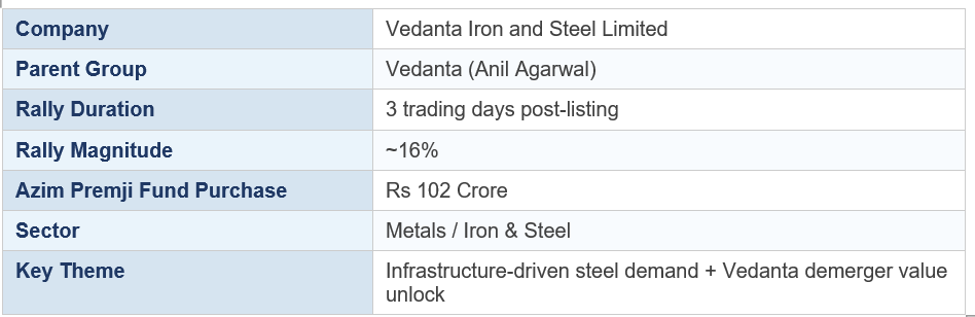
- Vedanta Iron and Steel shares hit upper circuit (5%) for three consecutive sessions post-listing
- Aggregate rally of 16% in three trading days since listing
- Azim Premji's investment fund acquired shares worth Rs 102 crore — a significant institutional endorsement
- Vedanta Iron and Steel is a recently listed entity following demerger from Vedanta Limited
- The stock's upper circuit run signals strong demand-supply imbalance in early trading
- Anil Agarwal's Vedanta Group is one of India's largest natural resources conglomerates
- Iron and steel sector benefits from India's infrastructure capex supercycle
📋 Quick Facts
📰 The Story
Shares of Vedanta Iron and Steel Limited surged 16% across three trading sessions, hitting the 5% upper circuit limit on each day following its listing — with a major catalyst being the disclosure that an Azim Premji-backed investment fund had acquired shares worth Rs 102 crore in the company. The combination of a marquee institutional buyer and the post-demerger rerating momentum created a powerful demand-supply dynamic, with buyers significantly outnumbering sellers at circuit-level prices.
Vedanta Iron and Steel was created as part of Anil Agarwal's ambitious demerger strategy to unlock value from the sprawling Vedanta Limited conglomerate, which spans zinc, aluminium, copper, oil and gas, and iron and steel businesses. By creating separate, pure-play listed entities for each vertical, the Vedanta Group aims to allow investors to price each business on its own merits rather than as a conglomerate discount-affected holding.
The iron and steel vertical encompasses Vedanta's steelmaking assets, which include electric arc furnace (EAF) capacity and downstream processing facilities. In the context of India's ongoing infrastructure supercycle — driven by the government's sustained capital expenditure on roads, railways, ports, and housing — steel demand has been robust, providing a favourable operating environment for Vedanta Iron and Steel.
The entry of Azim Premji's investment fund — the family office investment vehicle of the founder of Wipro Limited — is a significant endorsement. Premji's family office has a track record of disciplined, value-oriented investments across Indian equities and private markets. A Rs 102 crore purchase at this stage suggests conviction in the medium-to-long term value proposition of the demerged entity, likely based on fundamental analysis of asset quality, capacity utilisation, and earnings potential.
Post-listing volatility — characterised by upper circuits in the first few sessions — is not uncommon for demerger-listed entities, where price discovery takes time as the investor base migrates from the parent company's shareholders to sector-specific analysts and funds. The sustained upper circuit run, however, suggests that institutional interest (Premji fund being the most visible example) is providing consistent buying pressure that the available float cannot absorb at current prices.
📊 Financial Analysis
The 16% rally in three days needs to be contextualised against the company's post-demerger book value, earnings capacity, and steel sector benchmarks. Indian listed steel companies — JSPL, Tata Steel, SAIL, JSW Steel — trade at EV/EBITDA multiples of 6-10x depending on their capacity, product mix, and leverage profile. Vedanta Iron and Steel's fair value will crystallise over the coming weeks as analysts complete their coverage initiation and institutional price discovery deepens.
The Vedanta Group's leverage profile is a key risk factor that investors should assess carefully. Vedanta Limited has historically carried significant consolidated debt, and the demerger process may result in allocated debt loading onto individual entities including Vedanta Iron and Steel. Understanding the demerged entity's standalone balance sheet — specifically its net debt and interest coverage — is essential for fundamental analysis.
The Azim Premji fund's entry at current prices provides a credible floor for investor confidence, but does not guarantee continued upward momentum. The upper circuit mechanism is a technical function of limited float; as more shares become available for trading (promoter lock-in expiry, index inclusions), price discovery will normalise.
💹 Investor Insights
For investors evaluating Vedanta Iron and Steel, the investment thesis centres on three factors: (1) India's structural steel demand growth driven by infrastructure and manufacturing capex; (2) value unlock from the Vedanta demerger, as the pure-play steel entity should attract sector-specific institutional coverage; and (3) operational leverage — if steel prices remain firm and the company's cost structure benefits from Vedanta Group's scale in raw materials.
Key risks: Vedanta Group's historical debt and governance concerns (including related party transaction scrutiny in the past), steel price cyclicality, and execution risk in the demerger transition period. Investors should size positions conservatively until the company's standalone financials are fully published and audited.
❓ FAQs
Q. What is a demerger and how does it create value?
A. A demerger involves separating a business unit from a parent company into a distinct listed entity. It creates value by allowing the market to price each business independently — pure-play entities typically trade at higher multiples than conglomerates, where the sum of parts is often discounted by investors due to complexity.
Q. Who is behind Azim Premji's investment fund?
A. Azim Premji is the founder of Wipro Limited and one of India's most prominent philanthropists and investors. His family office manages long-term investments across public equities, private equity, and philanthropy through Azim Premji Investing and the Azim Premji Foundation.
Q. Why do newly listed demerger stocks hit upper circuits?
A. Post-demerger listings often see price discovery-driven volatility. When a stock is first listed at a price significantly below its intrinsic value (as assessed by informed buyers), buyers overwhelm sellers, triggering circuit breaker mechanisms. This continues until the price reaches a level where supply and demand balance.
Q. Is the 16% rally sustainable?
A. Sustainability depends on the company's fundamentals — particularly its balance sheet strength, capacity utilisation, and earnings visibility. The rally will stabilise as institutional research coverage increases and more shares become freely tradeable. Investors should wait for the company's first post-listing quarterly results for earnings-based validation.