

Key Highlights
- Q3FY26 revenue ₹617 crore (+54% YoY); EBITDA ₹564 crore (+57% YoY)
- BESS target upgraded to ~2 GWh doubled from prior guidance
- 220 MW solar-plus-BESS project win, Madhya Pradesh February 2026
- Debt refinancing improving project IRRs
- Stock ₹266–275; support ₹250–255; resistance ₹280–290
- Brokerage Buy initiation late March 2026
Company Overview
Acme Solar Holdings Ltd (NSE:ACMESOLAR) is one of India's largest independent renewable power producers (IPPs), with a portfolio spanning utility-scale solar, wind, and increasingly battery energy storage systems (BESS). The company operates under long-term power purchase agreements (PPAs) with state and central utilities, providing revenue visibility that is structurally attractive to institutional investors seeking exposure to India's energy transition.
What differentiates Acme Solar Holdings Ltd (NSE:ACMESOLAR) from a first-generation solar developer is its evolution into a renewable-plus-storage platform. BESS integration — the ability to store solar and wind-generated power and dispatch it when the grid needs it — addresses the intermittency problem that has historically limited the strategic value of pure-play renewable assets. A developer that can offer firm, dispatchable renewable power is a fundamentally more valuable counterparty for grid operators than one that can only offer variable generation.
Financial Performance
Q3FY26 was a landmark quarter. Consolidated total revenue of ₹617 crore represented a 54% increase year on year exceptional growth for an infrastructure-category business. EBITDA of ₹564 crore, up 57% YoY, confirms that the revenue growth is flowing through to operating profit with high efficiency, consistent with the long-term PPA model. Year-to-date commissioned capacity reached 422 MW, including partial commissioning of a 72 MW wind project tranche.
The financial quality of these numbers extends beyond the headline rates. Refinancing of operational projects at lower interest rates is reducing the cost of debt directly improving project-level IRRs and equity returns. For a capital-intensive renewable IPP, cost of debt is as important a value driver as commissioned capacity.
The BESS commissioning target upgrade from approximately 1 GWh to 2 GWh by Q4FY26 is a significant management statement. Doubling the target signals both improving battery cost economics and stronger commercial demand for storage-enhanced renewable supply.
Management Outlook
Management's strategic priorities are tightly aligned with where the Indian power market is heading. The 220 MW solar-plus-BESS project win in Madhya Pradesh in February 2026 exemplifies the combined-technology approach winning projects that require integrated solar and storage capability, rather than competing purely on solar price. This positions Acme Solar Holdings Ltd (NSE:ACMESOLAR) at the higher-value end of the renewable procurement market.
Multiple BESS commissioning milestones and ongoing wind project commissioning updates in March and April 2026 confirm that execution is keeping pace with the growth narrative the single most important deliverable for any infrastructure growth story.
A brokerage Buy initiation in late March 2026 adds external validation to the management-led case, signalling that institutional research coverage is beginning to reflect the BESS-led rerating thesis.
Recent Price Performance
The stock is trading around ₹266–275 in early April 2026. Support sits at ₹250–255, a zone that has attracted buying interest during recent pullbacks. Resistance is at ₹280–290, with ₹320 and above becoming relevant only on sustained positive momentum. The technical structure looks like a growth stock in consolidation constructive, not broken, with positive commissioning newsflow acting as repeated near-term catalysts.
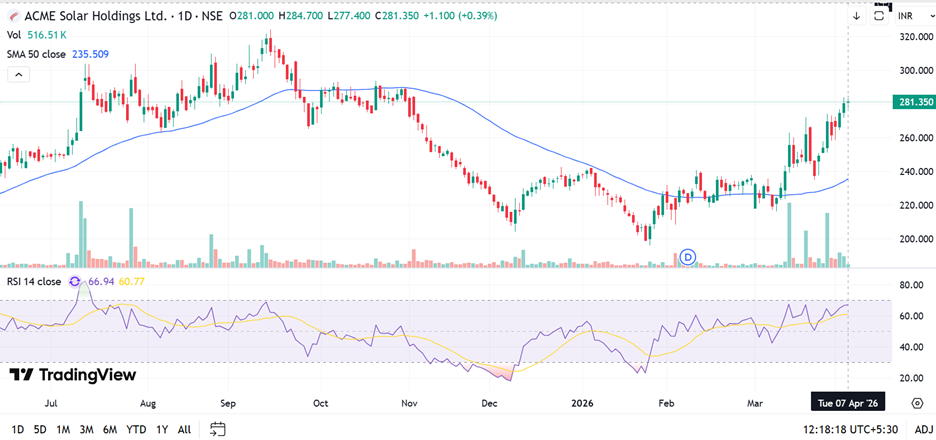
Charts by TradingView
FAQ
Why is BESS so important to ACME's valuation? Storage transforms variable renewable output into dispatchable power — a structurally more valuable product. It expands ACME's addressable market and supports higher-tariff PPAs.
How does debt refinancing improve the investment case? Lower borrowing costs on operational assets directly improve equity returns and free cash flow — the core value drivers for an infrastructure-category business.
What would drive a significantly higher stock price? Sustained 40%+ revenue and EBITDA growth, additional BESS project wins, and further evidence of cost-of-capital improvement over the next two to three quarters.