

Highlights
- Bitcoin dropped below the $75,000 mark amid uncertainty surrounding U.S.-Iran peace negotiations and rising geopolitical tensions.
- Heavy outflows from spot Bitcoin ETFs, including large institutional block trades, added pressure on crypto markets.
- Traders reassessed Federal Reserve rate-cut expectations as rising oil prices and inflation concerns weighed on risk assets.
Overview
Bitcoin witnessed sharp selling pressure after falling below the critical $75,000 level as geopolitical tensions in the Middle East and institutional outflows triggered broad weakness across cryptocurrency markets.
The world’s largest cryptocurrency slipped toward the $72,700 zone after declining more than 4% intraday, while broader digital assets including Ethereum, Solana, XRP, Cardano, and Dogecoin also traded lower.
The decline came as investors reacted to renewed uncertainty surrounding U.S.-Iran peace negotiations after conflicting reports emerged regarding a potential memorandum of understanding aimed at restoring stability in the Strait of Hormuz.
Market sentiment weakened further after the White House denied reports circulated by Iranian state media suggesting that an agreement had already been drafted.
Why Is Bitcoin Falling?
Bitcoin initially found support earlier this week after reports indicated that diplomatic discussions between the U.S. and Iran were progressing toward a possible de-escalation framework.
However, sentiment deteriorated sharply after renewed military action between both countries and comments from U.S. President Donald Trump suggested negotiations were still far from complete.
Trump stated that while a deal remained possible, the U.S. would only accept terms viewed as fully satisfactory, increasing uncertainty around the geopolitical outlook.
The latest escalation revived concerns around:
- prolonged Middle East instability,
- rising crude oil prices,
- inflation risks,
- and tighter global financial conditions.
Unlike traditional safe-haven assets, cryptocurrencies often behave like high-risk assets during periods of geopolitical uncertainty and tighter liquidity conditions.
ETF Outflows Add Selling Pressure
Institutional selling pressure also intensified the decline in Bitcoin prices.
Reports indicated that BlackRock’s iShares Bitcoin Trust ETF (IBIT) witnessed a massive block sale through dark-pool transactions, coinciding with Bitcoin’s sharp reversal from near the $78,000 region.
Recent data also showed substantial outflows from U.S. spot Bitcoin ETFs over the past two weeks, reflecting cautious institutional positioning amid rising volatility and macroeconomic uncertainty.
The latest ETF-related selling added pressure to an already fragile crypto market structure, increasing short-term downside risks.
Rising Oil Prices and Fed Concerns Weigh on Crypto
Crude oil prices surged after renewed U.S.-Iran hostilities revived fears of disruptions around the Strait of Hormuz, one of the world’s most important energy shipping routes.
Higher oil prices increase inflation concerns globally and may reduce the possibility of aggressive Federal Reserve rate cuts.
Markets are now increasingly pricing in the possibility that:
- U.S. interest rates may remain elevated for longer,
- liquidity conditions could tighten further,
- and speculative assets may continue witnessing pressure.
Cryptocurrencies typically struggle in higher-rate environments because investors shift toward safer yield-generating assets during periods of uncertainty.
Investor focus has also shifted toward upcoming U.S. Personal Consumption Expenditures (PCE) inflation data, which remains the Federal Reserve’s preferred inflation gauge.
Technical View
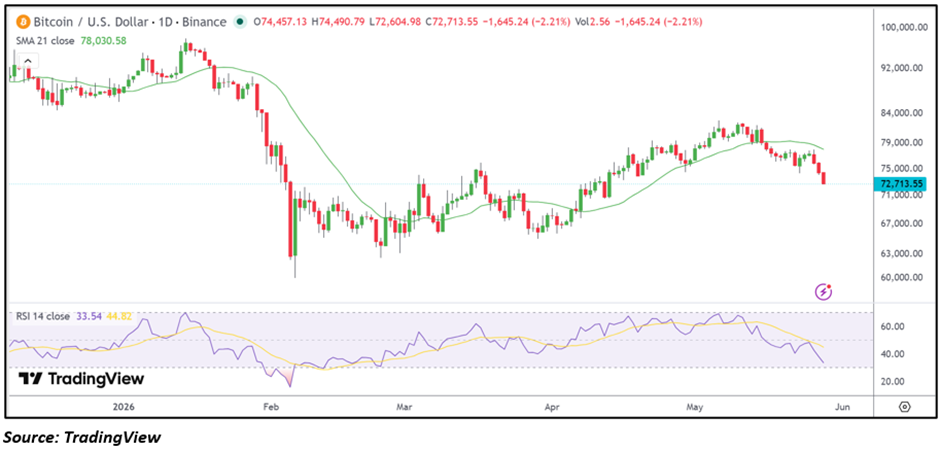
Bitcoin traded near the $72,713 level while remaining below the 21-day SMA near $78,030, reflecting a weak near-term structure. Recent price action indicates sustained selling pressure after Bitcoin failed to hold above the broader $79,000–$80,000 resistance region earlier this month.
The 14-day RSI slipped toward 33.54 and remained below its moving average, reflecting weakening momentum conditions and increasing downside pressure in the near term.
Key Technical Levels
Bitcoin continued trading below the 21-day SMA, indicating that broader momentum remains weak following the recent breakdown below key psychological levels. Immediate support is placed around the $69,000–$68,500 zone, which may act as an important short-term demand region if selling pressure persists. A deeper downside move could expose the broader support area near the $65,500–$65,000 zone.
On the upside, immediate resistance is visible near the $76,000–$76,500 region, where previous rebound attempts faced selling pressure. A sustained recovery above this zone could improve short-term sentiment and open the door toward the $80,000–$81,000 area, which remains a major higher resistance region for Bitcoin prices.
Key Risks
- Further escalation in U.S.-Iran tensions could trigger additional volatility across crypto markets.
- Continued institutional ETF outflows may intensify downside pressure on Bitcoin prices.
- Stronger-than-expected U.S. inflation data could reduce hopes of Federal Reserve rate cuts.
- Rising bond yields and tighter liquidity conditions may continue weighing on speculative assets.
Altcoins Also Under Pressure
Weakness extended across the broader cryptocurrency market:
- Ethereum declined sharply toward the $2,000 region
- XRP, Solana, and Cardano traded lower
- Meme tokens including Dogecoin also witnessed selling pressure
The broader crypto market remained cautious as traders monitored geopolitical developments, ETF flows, and macroeconomic signals.
Summary
Bitcoin prices remained under pressure after falling below the key $75,000 level amid uncertainty surrounding U.S.-Iran peace negotiations, rising oil prices, and heavy ETF outflows. With investors reassessing interest-rate expectations and risk appetite weakening globally, traders are closely watching upcoming U.S. inflation data and geopolitical developments for further direction in cryptocurrency markets.
FAQs
Why did Bitcoin fall below $75,000?
Bitcoin declined due to uncertainty surrounding U.S.-Iran peace talks, rising geopolitical tensions, and heavy institutional ETF outflows.
How do higher interest rates affect Bitcoin?
Higher interest rates reduce market liquidity and make safer yield-bearing assets more attractive compared to speculative assets like cryptocurrencies.
What are the important support levels for Bitcoin?
Immediate support is placed near the $69,000–$68,500 zone, while broader support is visible around the $65,500–$65,000 area.