

Highlights
- Dev Information Technology rose 1.51% to ₹23.56 on 2 March 2026, reflecting mild recovery momentum.
- The company operates across cloud migration, enterprise IT solutions, and government digital contracts.
- Margin sustainability improves with higher utilisation rates and cloud-based recurring billing models.
- RSI at 28.98 signals oversold conditions, with key support at ₹22–₹20 and resistance at ₹28–₹30.
Dev Information Technology (NSE:DEVIT) rose 1.51% to ₹23.56, gaining ₹0.35 on 2 March 2026.
Revenue Scalability and Client Concentration: Assessing Growth Quality
Dev IT operates in:
- Cloud migration
- Enterprise IT solutions
- Government digital contracts
Revenue scalability depends on recurring service contracts and order pipeline expansion.
Recurring Revenue Mix and Margin Sustainability
Margins improve with:
- Higher utilisation
- Larger contracts
- Cloud-based recurring billing
However, small-cap IT firms face client concentration risk.
Technical Insights
- Support: ₹22
- Resistance: ₹28
Breakout above ₹28 may signal further upside.
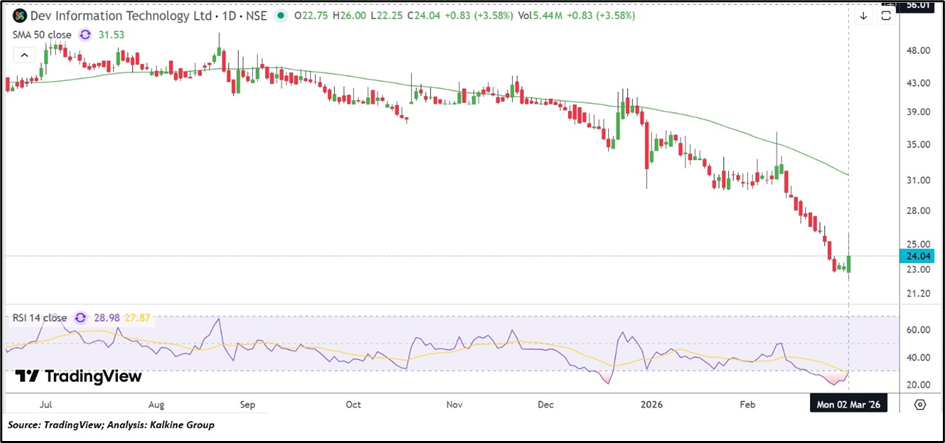
Dev Information Technology Limited (NSE:DEVIT) closed at ₹23.56, remaining below its 50-day Simple Moving Average at ₹31.53, which continues to reflect a subdued broader structure. The 14-day RSI at 28.98 indicates oversold conditions, suggesting the possibility of short-term consolidation. Immediate support is positioned in the ₹22–₹20 zone, while resistance is seen between ₹28–₹30. Movement within this range may shape the near-term price trajectory as the stock attempts to stabilise.
FAQs
- What drives growth for Dev Information Technology?
Growth depends on recurring cloud and enterprise service contracts, government digital transformation projects, and improved client utilisation rates.
- Why is the stock considered technically weak despite the recent rise?
DEVIT remains below its 50-day Simple Moving Average, indicating broader structural weakness, even though short-term oversold conditions suggest possible consolidation.
- What are the main risks for DEVIT investors?
Key risks include client concentration, order pipeline volatility, competitive pricing pressure, and small-cap liquidity constraints.