

Highlights
- Moneyboxx Finance shares declined over 17.00%, making the stock one of the biggest losers on the NSE.
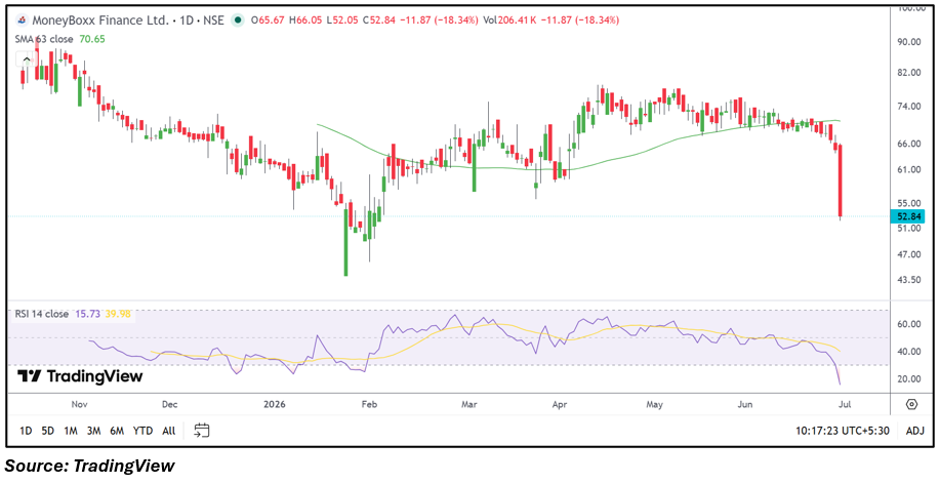
- The sharp fall pushed the stock to an intraday low of ₹53.15 after opening at ₹65.67.
- The company provides business loans to micro and small enterprises, with a focus on underserved rural and semi-urban markets.
- The latest quarterly results reflected a marginal profit despite steady revenue growth.
- The stock slipped below its 63-day moving average, while momentum indicators moved into oversold territory.
- Market participants will monitor whether the stock finds stability after the sharp correction.
Overview
Moneyboxx Finance Ltd., a non-banking financial company (NBFC) focused on providing secured business loans to micro and small enterprises, witnessed sharp selling during Tuesday's session. The stock opened at ₹65.67 but fell to an intraday low of ₹53.15 before trading around ₹53.60, reflecting a decline of more than 17.00%. The move placed the stock among the day's weakest performers as investors reacted to the sudden breakdown in price.
Fundamental View
Moneyboxx Finance primarily caters to entrepreneurs engaged in agriculture, retail, manufacturing and allied sectors across rural and semi-urban India. For the quarter ended 31 March 2026, the company reported standalone total income of ₹6,322.93 lakh. Profit before tax stood at ₹46.75 lakh, while net profit came in at ₹46.97 lakh with earnings per share of ₹0.07. The company's long-term performance will continue to depend on loan growth, asset quality, collection efficiency and funding costs in the competitive NBFC sector.
Technical View
Technically, the stock has weakened considerably after breaking below recent support levels and falling beneath its 63-day simple moving average of around ₹70.65. The sharp decline was accompanied by higher trading activity, indicating increased market participation. Meanwhile, the 14-day RSI dropped to around 15.73, suggesting the stock has entered deeply oversold territory following the latest correction. Price action over the next few sessions will be important in determining whether the stock stabilizes or extends its current weakness.
Key Technical Levels
Immediate support is placed near ₹52.00, followed by the next support around ₹49.50. On the upside, immediate resistance is seen near ₹57.50, while the next resistance is positioned around ₹61.00. The stock's ability to hold above nearby support levels may influence its short-term price structure.
Risks to Watch
- Deterioration in asset quality and higher credit costs.
- Slower loan disbursement growth.
- Rising borrowing and funding costs.
- Regulatory changes affecting NBFCs.
- Increased competition in the lending business.
- Broader market volatility.
Summary
Moneyboxx Finance came under significant pressure after recording a sharp double-digit decline during Tuesday's session. While the company continues to focus on financing underserved micro and small businesses, the latest price action reflects a notable deterioration in near-term technical strength. Going forward, investors are likely to monitor loan portfolio performance, asset quality, quarterly earnings and whether the stock stabilizes following the recent correction.
FAQs
Q: Why did Moneyboxx Finance shares fall today?
A: The stock declined more than 17.00% after witnessing a sharp technical breakdown and increased market activity.
Q: What does Moneyboxx Finance do?
A: The company is an NBFC that provides secured business loans to micro and small enterprises, particularly in rural and semi-urban India.
Q: How did the company perform in the latest quarter?
A: The company reported standalone total income of ₹6,322.93 lakh and a net profit of ₹46.97 lakh for the quarter ended 31 March 2026.
Q: What does the current technical trend indicate?
A: The stock is trading below its 63-day moving average, while the RSI has entered oversold territory following the recent decline.
Q: What factors should investors monitor going forward?
A: Investors should monitor loan growth, asset quality, collection efficiency, funding costs, quarterly financial performance and overall market conditions.