

Key Highlights
- Q3FY26 revenue ₹2,437 crore (+13.4%); EBITDA margin 19.8% (+110 bps YoY)
- Q4FY26 provisional update: revenue +19% YoY — stock fell 7%
- Domino's India LFL growth 5.0%; Popeyes delivering strong growth
- Raigad commissary commenced March 2026 — supply-chain depth building
- Exiting Dunkin' India — sharper capital allocation
- Stock ₹428–445; support ₹425–430; resistance ₹460–470
Company Overview
Jubilant FoodWorks Ltd (NSE:JUBLFOOD) is India's largest quick-service restaurant (QSR) operator, holding the master franchise rights for Domino's Pizza across India, Sri Lanka, Bangladesh, and Nepal, as well as the Popeyes franchise in India and previously Dunkin' in India. The company operates over 1,900 Domino's stores in India alone — a network built over three decades that constitutes the deepest QSR distribution infrastructure in the country.
The Jubilant FoodWorks Ltd (NSE:JUBLFOOD) investment case has always rested on three interconnected drivers: same-store sales growth reflecting brand health and consumer demand, new store additions reflecting white-space opportunity, and margin management reflecting operational efficiency. For much of the post-pandemic period, all three drivers were firing simultaneously, producing the kind of compounding growth that justified a premium equity multiple.
The current phase is more nuanced. Demand has normalised from post-pandemic peaks, consumer spending in food services is more selective, and the market has become considerably more demanding about whether growth is being generated efficiently or simply bought through store expansion.
Financial Performance
Q3FY26 delivered consolidated revenue of ₹2,437 crore, up 13.4% year on year — a double-digit growth rate that most consumer companies would regard as strong. More importantly, EBITDA of ₹482.3 crore at a margin of 19.8% — up 110 basis points year on year — confirms that top-line growth is not being generated at the expense of profitability. Net profit for the quarter was ₹72.9 crore.
India business revenue of ₹18,015 million grew 11.8% YoY, supported by 5.0% like-for-like growth in Domino's — a metric that carries particular weight because it measures sales growth at existing stores, stripping out the contribution of new openings. Positive LFL growth in the current consumer environment is a meaningful signal of brand health. Popeyes continued to deliver strong growth from its smaller base.
The provisional Q4FY26 update showed approximately 19% YoY revenue growth — a re-acceleration that should, on paper, be unambiguously positive.
Management Outlook
Management is executing a deliberate portfolio rationalisation strategy. The decision to exit the Dunkin' India franchise is the most visible expression of this — rather than continue investing capital and management attention in a brand that was not generating adequate returns, the company is concentrating resources on Domino's and Popeyes, where the unit economics and growth trajectories are stronger.
The commissioning of the Raigad commissary in March 2026 is a supply-chain investment with long-term strategic significance. Supply-chain depth — the ability to produce, distribute, and quality-control ingredients efficiently at scale — is a structural competitive advantage in QSR. It enables faster new store rollouts, tighter cost control, and more consistent product quality across a geographically distributed network.
Management's medium-term focus appears to be on improving return ratios and capital allocation quality, not just accelerating store count growth. This is the right strategic shift for a maturing franchise, even if it initially creates uncertainty for investors accustomed to a simpler growth story.
Recent Price Performance
The stock's 7% single-day decline following the Q4FY26 provisional update — despite 19% YoY revenue growth — is perhaps the clearest illustration in this entire report of how demanding the current market has become for high-multiple consumer stocks. The shares fell to approximately ₹428 intraday on April 7, from levels in the mid-₹440s.
The technical structure reflects a stock in a de-rating phase driven by expectations compression rather than fundamental deterioration. Immediate support sits at ₹425–430 — the zone that absorbed the post-update selling. First resistance is at ₹460–470, with a more significant resistance band at ₹500 and above. A sustained recovery above the near-term resistance zone would likely require either a stronger Q4 margin outcome or tangible evidence that portfolio changes are improving return ratios.
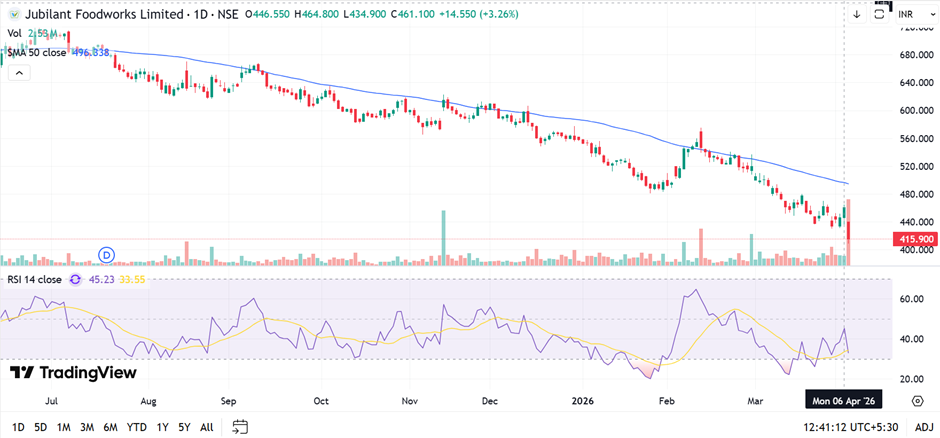
Charts by TradingView
FAQ
Why did 19% revenue growth trigger a 7% stock decline? The market had priced in more. For a stock trading at a premium multiple, beating revenue expectations is table stakes — investors wanted stronger margin delivery and evidence of return ratio improvement.
Is the Dunkin' exit a positive or negative signal? Positive for capital allocation discipline. Exiting a brand that isn't earning its keep frees resources for higher-return opportunities within Domino's and Popeyes.
What would drive a re-rating higher? Stronger same-store sales growth, evidence that portfolio rationalisation is improving return ratios, and margin expansion above the 20% EBITDA threshold sustained over two or more quarters.