

Highlights
- MCX Gold futures closed sharply lower as renewed U.S.-Iran hostilities boosted the dollar and crude oil prices.
- Rising oil prices increased inflation concerns, reducing expectations of near-term Federal Reserve rate cuts.
- Gold prices slipped toward key support levels as traders awaited U.S. PCE inflation data for further policy direction.
Overview
MCX Gold futures witnessed strong selling pressure in the latest session, declining more than 1% as escalating tensions between the United States and Iran strengthened the U.S. dollar and triggered a sharp rally in crude oil prices. The weakness in domestic bullion prices mirrored losses in international markets, where spot gold dropped toward a two-month low near the $4,380 per ounce zone.
MCX Gold futures settled near ₹1,55,627 after failing to sustain momentum near higher levels earlier this month. The decline came despite heightened geopolitical uncertainty in the Middle East, as investors increasingly focused on inflation risks and the possibility of elevated interest rates for longer.
Fresh military escalation between the U.S. and Iran kept global markets on edge after reports indicated renewed air strikes targeting Iranian military infrastructure and retaliatory action against U.S. assets in the Gulf region. The conflict renewed concerns over the Strait of Hormuz, one of the world’s most critical oil shipping routes.
Why Did Gold Prices Decline Despite Geopolitical Risks?
Normally, geopolitical tensions support safe-haven assets like gold. However, the current market environment has shifted focus toward the inflationary consequences of higher oil prices and a stronger U.S. dollar.
Crude oil prices surged more than 3% after Iran reportedly launched retaliatory strikes following U.S. military action targeting Iranian facilities. The rise in energy prices increased fears that inflationary pressures could remain elevated globally over the coming months.
Higher crude prices can raise transportation, manufacturing, and consumer costs across economies, increasing the possibility that central banks may maintain restrictive monetary policy for longer to control inflation.
This has strengthened market expectations that the U.S. Federal Reserve could delay interest-rate cuts or maintain elevated borrowing costs for a prolonged period. Higher interest rates generally pressure gold because bullion does not generate yield income, reducing its relative attractiveness compared to interest-bearing assets.
Dollar Strength Adds Further Pressure
The U.S. dollar index climbed to a one-week high following the latest Middle East developments as investors moved toward the greenback during heightened uncertainty.
A stronger dollar typically weighs on gold because dollar-denominated bullion becomes more expensive for holders of other currencies, reducing international demand.
At the same time, rising U.S. Treasury yields further weakened sentiment in precious metals markets as traders reassessed expectations surrounding future Federal Reserve policy decisions.
PCE Inflation Data in Focus
Investor attention is now cantered on upcoming U.S. Personal Consumption Expenditures (PCE) inflation data, which remains the Federal Reserve’s preferred inflation gauge.
Recent comments from Federal Reserve officials suggested policymakers remain cautious on monetary easing amid:
- elevated energy prices,
- geopolitical instability,
- resilient economic activity,
- and persistent inflation risks.
Markets increasingly expect the Federal Reserve to maintain higher interest rates for a longer period if inflation remains elevated due to rising oil prices and ongoing geopolitical tensions.
Technical View
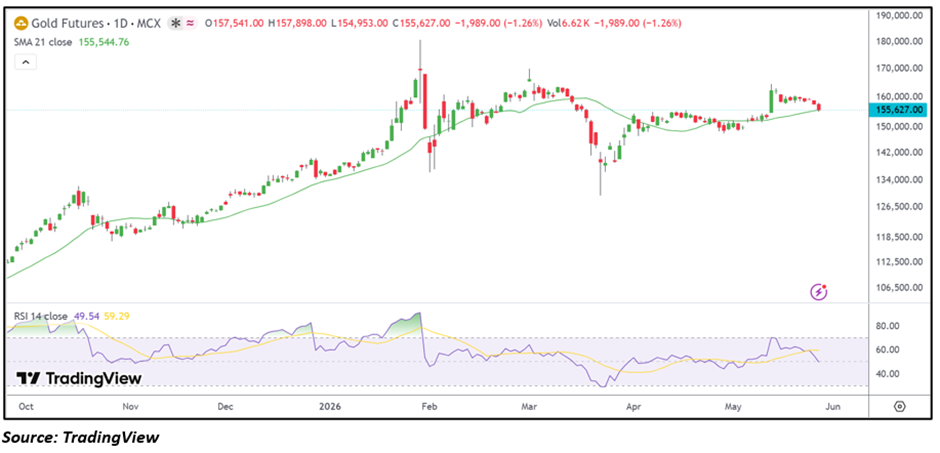
MCX Gold futures closed near ₹1,55,627 while remaining marginally above the 21-day SMA near ₹1,55,545, reflecting a broadly neutral near-term structure despite the recent decline. Recent price action indicates consolidation with a mild downward bias after the contract failed to sustain momentum near the ₹1,60,000 zone earlier this month.
The 14-day RSI eased toward 49.54 and slipped below its average line, reflecting weakening momentum conditions and moderation in short-term price strength.
Key Technical Levels
Immediate support for MCX Gold is placed around the ₹1,51,700–₹1,52,000 zone, which may act as an important short-term demand region following the recent decline. If selling pressure continues, prices could move toward the ₹1,47,800 area, which remains a broader medium-term support zone for the contract.
On the upside, immediate resistance is visible near ₹1,59,500, where recent rebound attempts previously faced selling pressure. A sustained recovery above this region could improve near-term sentiment and open the door toward the ₹1,63,400 zone, which remains a key higher resistance area for the broader trend.
Key Risks
- Further escalation in U.S.-Iran tensions may increase volatility across commodity markets.
- Sharp crude oil price spikes could intensify inflation concerns globally.
- Stronger-than-expected U.S. inflation data may reduce hopes of Federal Reserve rate cuts.
- Sustained dollar strength and elevated Treasury yields may continue weighing on bullion prices.
Other Precious Metals Also Weaken
Broader weakness extended across precious metals markets:
- Silver prices slipped toward one-month lows
- Platinum witnessed renewed selling pressure
- Rising Treasury yields and dollar strength weighed on overall bullion sentiment globally
Summary
MCX Gold prices remained under pressure as renewed U.S.-Iran tensions lifted crude oil prices and strengthened the U.S. dollar, intensifying concerns about inflation and delaying expectations of Federal Reserve rate cuts. While geopolitical uncertainty typically supports bullion demand, the current market focus remains centered on elevated interest rates, rising energy costs, and persistent inflation risks, keeping near-term pressure on gold prices intact.
FAQs
Why did MCX Gold prices fall despite geopolitical tensions?
Gold prices declined because rising oil prices and dollar strength increased inflation concerns and reduced expectations of near-term U.S. Federal Reserve rate cuts.
What are the important support levels for MCX Gold?
Immediate support is placed near ₹1,51,700–₹1,52,000, while deeper support is visible around ₹1,47,800.
What factors are currently affecting gold prices?
Key drivers include U.S.-Iran tensions, crude oil prices, Federal Reserve interest-rate expectations, U.S. inflation data, Treasury yields, and dollar movement.