

Key Highlights
- Q3FY26 revenue ₹4,421 crore (+17.71% YoY); EBITDA ₹539 crore
- Mittal Corp acquisition unlocks stainless steel capability
- Wagon manufacturing through Ramsarup — non-cyclical revenue addition
- Stock ₹792–795; support ₹760–770; resistance ₹820–840
- Weekly trend: upward; 52-week range ₹356–₹802.25
Company Overview
Shyam Metalics and Energy Ltd (NSE:SHYAMMETL) is an integrated metals producer based in eastern India, with manufacturing facilities spanning the full value chain from sponge iron and billets through to finished long steel products. The company has historically been positioned as a capital-efficient, low-cost producer in the carbon steel space — a characterisation that earned it a loyal following among domestic institutional investors who appreciate its consistent operational delivery.
The more important story today, however, is transformation. Under the leadership of a management team that has demonstrated consistent capital discipline, Shyam Metalics and Energy Ltd (NSE:SHYAMMETL) is executing a deliberate pivot toward a multi-metal, higher-value product portfolio. This includes the acquisition of Mittal Corp to enter stainless steel, expansion into specialty alloys and aluminium foil, and the entry into railway wagon manufacturing through Ramsarup Industries — a move that introduces a relatively non-cyclical, government-backed demand stream into what has historically been a pure commodity revenue base.
Financial Performance
Q3FY26 revenue of ₹4,421 crore — up 17.71% year on year — came alongside EBITDA of ₹539 crore, confirming that the growth is converting into operating profit at a meaningful rate. The company's investor presentation filed with exchanges emphasises the multi-metal expansion strategy and the progress on capacity additions in higher-margin product categories.
What the numbers reveal is a business that is growing both in scale and in strategic ambition. Revenue above ₹4,000 crore per quarter establishes Shyam Metalics and Energy Ltd (NSE:SHYAMMETL) as a mid-to-large-scale metals operator, and the EBITDA margin trajectory — while still subject to commodity cycle influence — is being supported by a product mix that is gradually shifting toward higher-value categories.
Management Outlook
Management's articulated strategy is explicit: reduce the company's reliance on plain-vanilla carbon steel and build a multi-metal platform that can generate more resilient margins across commodity cycles. The Mittal Corp acquisition for stainless steel capacity is the most consequential step in that direction — stainless steel carries structurally higher realisations and margins than carbon steel, and the domestic market remains significantly dependent on imports, creating a natural demand base for domestic producers.
The wagon manufacturing entry via Ramsarup Industries is strategically interesting for a different reason. Indian Railways is executing one of its largest fleet expansion programmes in history, creating multi-year demand visibility for wagon producers. Adding this revenue stream to a metals business creates an industrial customer base that is not sensitive to construction or infrastructure cycles in the same way as traditional steel end-markets.
Recent Price Performance
The stock is trading around ₹792–795 in early April 2026, with the recent weekly trend characterised as upward — a relative positive compared to many names in this analysis. The 52-week range extends from a low of approximately ₹356 to a high of ₹802.25, confirming the wide band typical of a cyclical stock. Support sits at ₹760–770, with first resistance at ₹820–840. A sustained hold above ₹840 would be required to build the case for a more meaningful upside move.
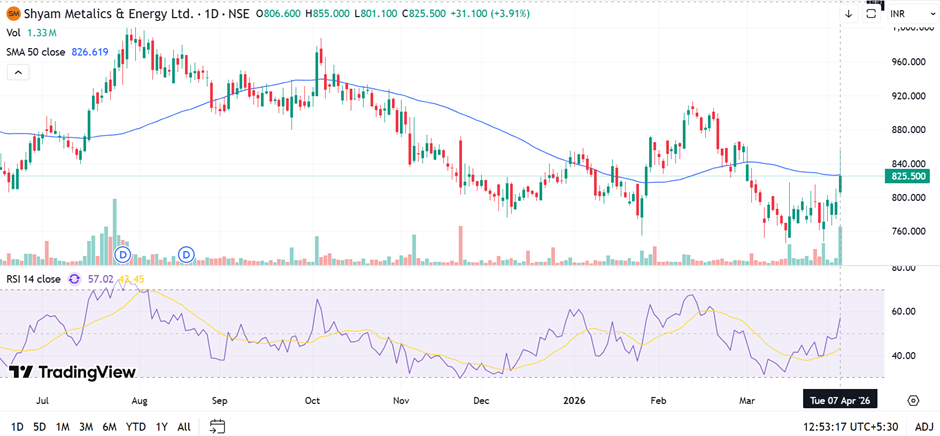
Charts by TradingView
FAQ
What makes Shyam different from other steel producers? The deliberate diversification into stainless steel, specialty alloys, and wagon manufacturing differentiates its earnings profile — though the market has yet to fully reward this with a structural multiple premium.
When will the market grant a higher multiple? When value-added products demonstrably improve through-cycle margins over at least two to three quarters of data.
What are the main risks? Steel price cyclicality, raw material cost volatility, and execution risk on the multi-metal expansion strategy.