

Highlights
- Shyam Telecom stock gained 1.34% but remains below crucial 50-day average resistance.
- Persistent lower highs and lows indicate broader downtrend despite minor recovery signs.
- RSI remains below neutral, suggesting weak momentum and limited upside strength.
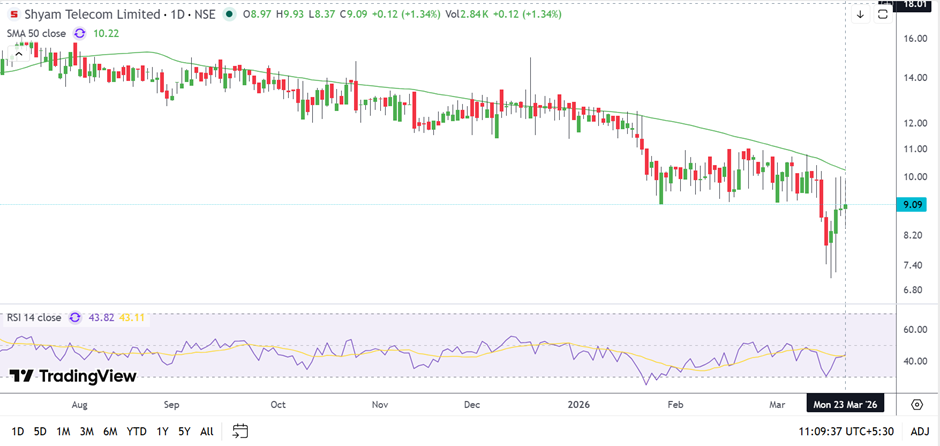
Shares of Shyam Telecom (NSE:SHYAMTEL) traded around ₹9.09 on March 23, 2026, registering a modest gain of 1.34% on the National Stock Exchange (NSE) and BSE. Despite the uptick, the stock continues to trade below its 50-day Simple Moving Average of ₹10.22, which is acting as a key resistance level. The overall trend remains weak, although recent price action shows a slight rebound from lower levels.
Sector Context and Industry Position
Shyam Telecom operates within the telecom equipment and infrastructure segment, a space that is closely tied to capital expenditure cycles of telecom operators. While the broader telecom sector in India continues to evolve with 5G rollout and digital infrastructure expansion, smaller players like Shyam Telecom often face demand inconsistency and competitive pressures. This has contributed to subdued stock performance over recent months.
Financial and Price Trend Overview
Although detailed financials are not highlighted in the latest update, the stock’s price structure reflects sustained weakness. The formation of lower highs and lower lows indicates a prolonged downtrend, suggesting that selling pressure has dominated investor sentiment.
However, the recent bounce from lower levels signals early signs of stabilisation, indicating that buyers are attempting to re-enter at discounted valuations. This recovery, though, remains fragile without strong confirmation signals.
Trading Activity and Market Participation
The marginal rise in share price suggests selective buying interest, likely driven by short-term traders looking to capitalise on oversold conditions. However, the inability to cross the 50-day SMA indicates that broader market participants remain cautious.
Volumes and participation appear moderate, reinforcing the view that the current move is more of a technical rebound rather than a strong trend reversal supported by fundamentals.
Technical Analysis
Shyam Telecom (NSE:SHYAMTEL) is trading around ₹9.09, up 1.34% as of March 23, 2026, but continues to remain below its 50-day SMA near ₹10.22, which is acting as an overhead resistance. The price structure reflects a continued downtrend, following a prolonged phase of lower highs and lower lows, although a minor rebound from recent lows indicates some short-term stabilisation.
Momentum remains moderate, with the RSI at 43.82, suggesting a gradual recovery but still below neutral strength. Immediate support is placed near ₹8.20 and ₹7.50, while on the upside, resistance is seen near ₹10.20 and ₹11.00, where price may face initial hurdles.
Source: TradingView
Outlook Considerations
In the near term, the stock’s trajectory will depend on its ability to sustain above immediate support levels and break past overhead resistance. While short-term stabilisation is visible, a confirmed reversal would require sustained buying interest and improved momentum indicators.
Risk Factors
- Continued downtrend with no confirmed reversal pattern in place.
- Weak momentum indicators limiting strong upside potential in the near term.
- Resistance near moving averages may trigger renewed selling pressure.
Shyam Telecom’s modest 1.34% gain reflects a temporary recovery within a broader downtrend. While early signs of stabilisation are emerging, the stock remains under pressure below key resistance levels. Sustained upside will depend on stronger technical confirmation and improved investor participation.
FAQs
- Why is Shyam Telecom stock rising today?
The stock is witnessing a minor rebound due to short-term buying interest near lower levels. - What are the key resistance levels for Shyam Telecom?
The stock faces resistance near ₹10.20 and ₹11.00, including its 50-day SMA. - Is the downtrend in Shyam Telecom over?
No, the broader downtrend remains intact despite early signs of short-term stabilisation.