

Highlights
- Jio Financial Services reported higher AUM growth across lending, payments, and investment segments in FY26.
- Consolidated total income increased to ₹3,274 crore for FY26 compared to ₹1,838 crore in FY25.
- Profit after tax stood at ₹1,561 crore for FY26, marginally lower compared to ₹1,613 crore in FY25.
Jio Financial Services (NSE:JIOFIN) reported consolidated total income of ₹3,274 crore for FY26, rising from ₹1,838 crore in FY25. The increase was supported by higher interest income and growth in fee and commission-based earnings across business segments.
Profit after tax for FY26 stood at ₹1,561 crore, compared to ₹1,613 crore in the previous year. The marginal decline reflects higher operating expenses and finance costs during the year.
For Q4 FY26, total income came in at ₹1,020 crore compared to ₹518 crore in Q4 FY25. Profit after tax for the quarter stood at ₹272 crore versus ₹316 crore in the corresponding period last year.
Segment-Wise Growth Trends
The company’s lending business saw assets under management (AUM) increase to ₹25,711 crore in FY26 from ₹10,053 crore in FY25. Disbursements during Q4 FY26 rose to ₹10,629 crore, reflecting continued expansion in credit offerings.
In the payments segment, deposits grew to ₹544 crore in Q4 FY26 from ₹295 crore in Q4 FY25. The business correspondent network expanded significantly, supporting transaction growth and customer acquisition.
The asset management business reported closing AUM of ₹15,218 crore in FY26, indicating initial traction following product launches. Insurance premium facilitated stood at ₹982 crore for FY26, showing moderate growth compared to FY25.
Expense and Profitability Metrics
Total expenses for FY26 increased to ₹1,916 crore from ₹484 crore in FY25. This rise was attributed to staff costs, operating expenses, and investments in scaling newer business verticals.
Pre-provisioning operating profit remained relatively stable at ₹1,357 crore in FY26 compared to ₹1,353 crore in FY25. Finance costs increased significantly to ₹745 crore during the year, impacting overall profitability.
Balance Sheet Position
Total assets increased to ₹1,63,497 crore as of March 31, 2026, compared to ₹1,33,510 crore a year earlier. Loans grew sharply, while investments also increased during the period.
Net worth stood at ₹1,33,854 crore as of March 31, 2026, reflecting growth in retained earnings. Other liabilities rose to ₹29,643 crore, indicating higher borrowings and operational expansion.
Business Developments
During FY26, the company expanded its presence across lending, payments, insurance, and investment services. Digital platforms reported higher user engagement, with 23 million unique users recorded by March 2026.
The company also entered joint ventures in asset management and reinsurance, while continuing to build its product ecosystem across financial services.
Technical Summary
Jio Financial Services Limited (NSE:JIOFIN) is trading near ₹237.76, down around 2.50% on 20 April 2026, and continues to trade below the 51-day SMA near ₹247.37, while the 14-day RSI near 47.69 with immediate support is placed in the ₹220.00–210.00 zone, while resistance is seen near the ₹260.00–280.00 range.
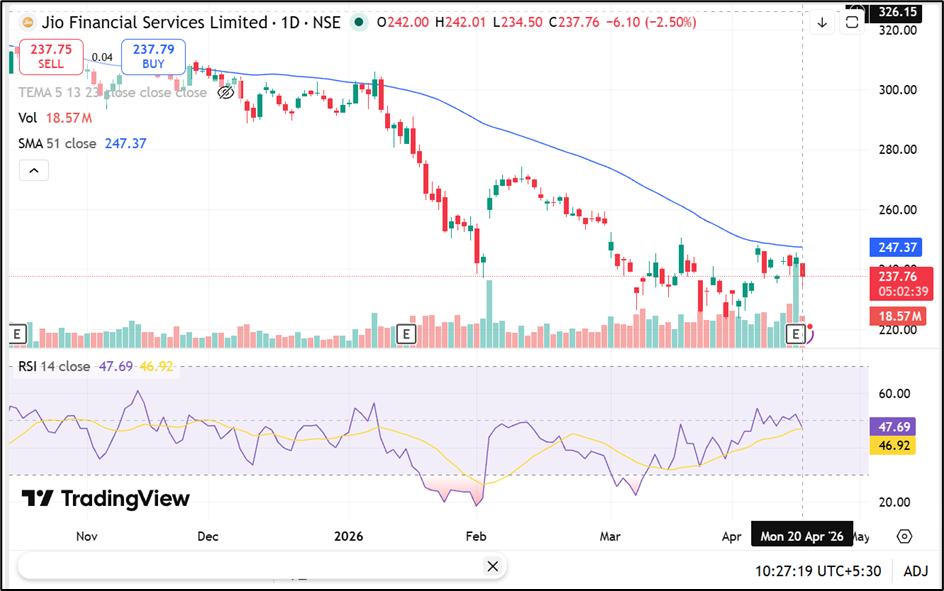
Source: TradingView
Key Risks
- Rising finance costs may continue to impact net profitability margins.
- Increased operating expenses could weigh on earnings in near term.
- Regulatory changes in financial services sector may affect business operations.
- Dependence on digital ecosystem growth may influence customer acquisition trends.
Summary
Jio Financial Services (NSE:JIOFIN) reported higher income and asset growth in FY26, supported by expansion across lending, payments, and investment segments. However, profitability remained under pressure due to rising costs and finance expenses. Balance sheet growth was driven by higher loans and investments, while digital adoption continued to expand user reach across platforms.
FAQs
- What drove Jio Financial Services’ income growth in FY26?
Income growth was mainly driven by higher interest income and increased fee-based earnings across lending, payments, and investment segments. - Why did profit decline despite higher revenue?
Profit declined due to increased operating expenses and higher finance costs associated with business expansion and scaling initiatives. - How did the lending segment perform in FY26?
The lending segment saw AUM growth to ₹25,711 crore, supported by higher disbursements and expansion across credit products.