

Highlights
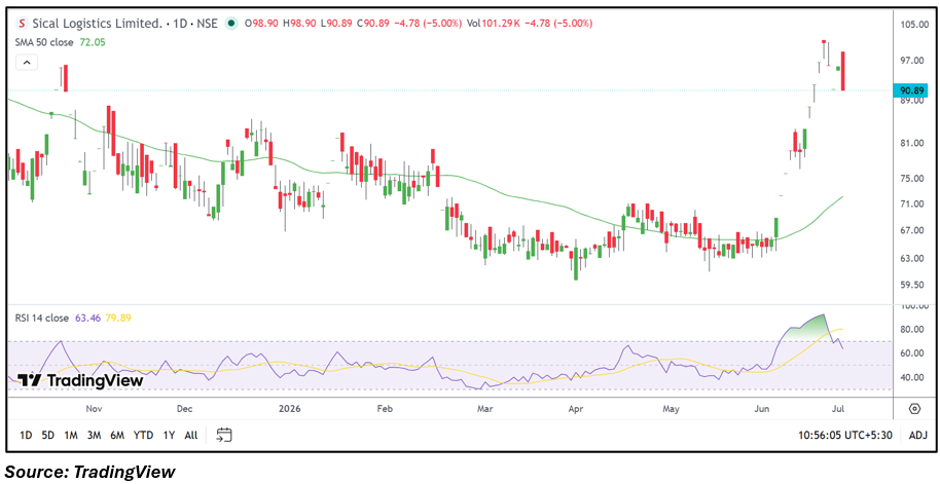
- Sical Logistics shares declined 5.00% during Thursday's session, placing the stock among the notable losers on the NSE.
- The stock opened at ₹98.90 and fell to an intraday low of ₹90.89.
- For the March 2026 quarter, the company reported standalone total income of ₹4,565.00 lakh.
- The latest quarterly results reflected a net loss of ₹1,185.00 lakh.
- The stock continued to trade above its 50-day Simple Moving Average despite the day's decline.
- The 14-day RSI eased from recent elevated levels, indicating moderation in short-term momentum.
Overview
Sical Logistics Limited came under pressure during Thursday's trading session, with the stock falling 5.00% to ₹90.89 after opening at ₹98.90. The decline followed a strong rally over the past few weeks, during which the stock had recorded significant gains. Thursday's session saw the share price retreat from recent highs as trading activity remained elevated, making it one of the notable laggards during the day.
Fundamental View
Sical Logistics operates across integrated logistics services, including port handling, warehousing, transportation, bulk cargo movement and supply chain solutions. For the quarter ended March 2026, the company reported standalone total income of ₹4,565.00 lakh. The quarter resulted in a loss before tax of ₹1,185.00 lakh, while net loss also stood at ₹1,185.00 lakh, translating into earnings per share of -₹1.74. The company's business performance remains linked to cargo volumes, infrastructure activity, operational efficiency, freight demand and overall economic conditions.
Technical View
The latest price action reflects a pause after the stock witnessed a sharp upward move in recent sessions. Although Thursday's decline pulled the stock away from its recent highs, Sical Logistics continued to trade above its 50-day Simple Moving Average of approximately ₹72.05, indicating that the broader medium-term structure remains above this key technical reference level. The 14-day RSI moderated to around 63.46 after previously moving into higher momentum territory, suggesting that short-term momentum has eased following the recent rally. Trading volumes remained active throughout the session, highlighting continued market participation.
Key Technical Levels
Immediate support is placed near ₹88.00, followed by the next support around ₹84.00. On the upside, immediate resistance is seen near ₹96.00, while the next resistance is positioned around ₹100.00. Price movement around these levels may influence the stock's near-term trading pattern.
Risks to Watch
- Weakness in freight and logistics demand.
- Lower cargo handling volumes.
- Continued pressure on profitability.
- Rising operating and fuel costs.
- Broader market volatility.
Summary
Sical Logistics witnessed a notable decline during Thursday's session after a strong rally over recent weeks. The latest quarterly financials reflected a loss, while the stock remained above its 50-day Simple Moving Average despite the day's weakness. Future earnings performance, logistics sector demand, operational execution and broader market conditions are likely to remain important factors influencing the stock's movement.
FAQs
Q: What does Sical Logistics do?
Sical Logistics provides integrated logistics services including transportation, port handling, warehousing, bulk cargo management and supply chain solutions.
Q: Why did Sical Logistics shares decline today?
The stock retreated after a recent rally, with price movement reflecting a moderation in short-term momentum during Thursday's session.
Q: How did Sical Logistics perform in the latest quarter?
For the quarter ended March 2026, the company reported standalone total income of ₹4,565.00 lakh and a net loss of ₹1,185.00 lakh.
Q: What does the technical setup indicate?
The stock remains above its 50-day Simple Moving Average, while the RSI has eased to around 63.46 following recent strength in price momentum.
Q: Which factors could influence Sical Logistics going forward?
Cargo volumes, freight demand, operating performance, quarterly financial results and overall market conditions are expected to remain key factors.