

Highlights
- Digitide Solutions shares declined 10.00% after witnessing a sharp rally in recent trading sessions.
- The stock traded between ₹108.50 and ₹117.63 before quoting around ₹108.50.
- FY26 standalone net profit stood at ₹685.30 lakh on total income of ₹53,435.10 lakh.
- The latest decline appears to reflect profit booking following the recent price surge.
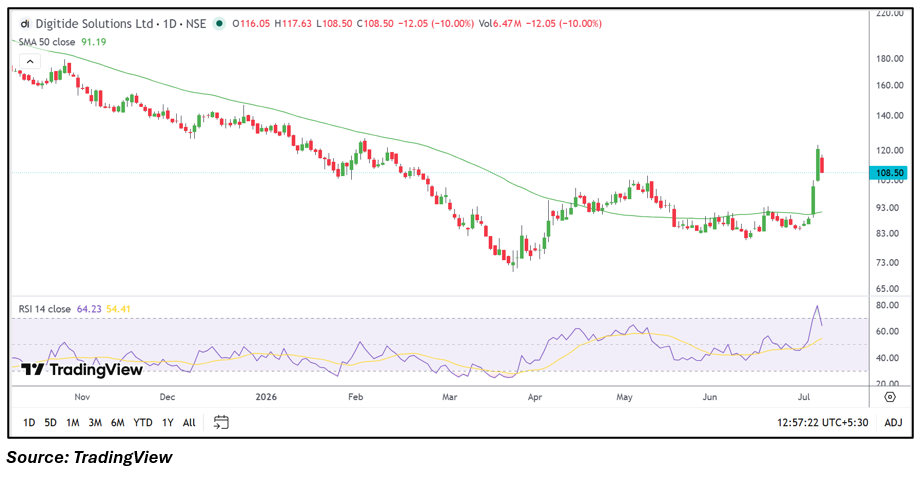
- The stock continues to trade above its 50-day moving average despite weakening short-term momentum.
- Investors may track price stability and upcoming business updates for further direction.
Overview
Digitide Solutions Limited came under sharp selling pressure on Tuesday, with the stock falling 10.00% to ₹108.50 after opening at ₹116.05. The stock touched an intraday low of ₹108.50 after reaching ₹117.63 during the session. The decline follows a strong rally over the past few trading sessions, suggesting profit booking by market participants. Despite the correction, there has been no major negative corporate announcement accompanying the move.
Fundamental View
For the quarter ended March 2026, Digitide Solutions reported standalone total income of ₹53,435.10 lakh. The company posted a profit before tax of ₹1,299.40 lakh and a net profit of ₹685.30 lakh, while earnings per share stood at ₹0.46. The company operates in the technology and digital solutions space, where business performance depends on client spending, digital transformation demand, and execution of technology projects. The latest financial results indicate that the company remained profitable, although the recent decline in the share price appears to be driven primarily by market activity rather than changes in its underlying business.
Technical View
The stock has corrected sharply after a strong upward move in recent sessions, indicating profit booking following rapid gains. Even after the decline, the price continues to trade above the 50-day moving average, suggesting that the broader medium-term structure remains relatively stable. The RSI is near 64 after retreating from higher levels, reflecting moderation in momentum while remaining above neutral territory. The next few sessions may determine whether the stock stabilizes near current levels or enters a broader consolidation phase.
Key Technical Levels
Immediate support is placed near ₹105.80, followed by the next support around ₹103.00. On the upside, immediate resistance is seen near ₹111.20, while the next important resistance is placed around ₹114.00.
Risks to Watch
- Slowdown in technology spending by enterprise clients.
- Delays in project execution or client onboarding.
- Margin pressure due to rising operating costs.
- Increased competition in the digital solutions industry.
- Overall market volatility affecting small-cap technology stocks.
Summary
Digitide Solutions' sharp decline appears to be a result of profit booking after a strong rally rather than any significant deterioration in its financial performance. The company remains profitable and continues to operate in a sector benefiting from digital transformation trends. Going forward, investors are likely to monitor earnings growth, order execution, and price stability to assess the stock's next directional move.
FAQs
Q: Why did Digitide Solutions shares fall 10%?
A: The decline largely followed a sharp recent rally and appears to reflect profit booking rather than any major negative corporate announcement.
Q: How did Digitide Solutions perform in FY26?
A: The company reported standalone total income of ₹53,435.10 lakh, net profit of ₹685.30 lakh, and earnings per share of ₹0.46.
Q: What sector does Digitide Solutions operate in?
A: The company operates in the technology and digital solutions sector, providing digital transformation and related services.
Q: What are the important technical levels for the stock?
A: Immediate support is near ₹105.80 and ₹103.00, while resistance is placed around ₹111.20 and ₹114.00.
Q: What should investors watch going forward?
A: Investors may monitor future quarterly earnings, client demand, project execution, operating margins, and overall market sentiment.