

Key Highlights
- LME one-month aluminium advanced 1.98% to USD 3,504.04 per metric ton, extending its recent upward move.
- The rally pushed aluminium close to a fresh four-year peak near USD 3,567.00.
- Iranian missile and drone attacks damaged facilities operated by Emirates Global Aluminium and Aluminium Bahrain.
- Gulf producers account for roughly 9% of global aluminium supply, increasing fears of a broader shortage.
- Europe, Japan and the United States saw physical aluminium premiums jump sharply as traders priced in tighter supplies.
- The closure of the Strait of Hormuz continues to threaten shipments from the Middle East, further tightening the market.
- A breakout above USD 3,546.50 could open the door toward levels last seen during the 2022 commodity surge.
Supply Shock Drives Aluminium Toward Fresh Multi-Year Highs
Aluminium prices have moved sharply higher after attacks on two of the Middle East’s largest smelters triggered fears of a prolonged global supply disruption. Benchmark three-month aluminium on the London Metal Exchange jumped to USD 3,492 per metric ton, its highest level in nearly four years, as markets reacted to damage at Gulf production facilities.
The biggest concern for traders is that both Emirates Global Aluminium and Aluminium Bahrain are critical suppliers to Europe, Asia and the United States. Aluminium Bahrain, one of the world’s largest single-site smelters, confirmed that it is assessing damage after the attack, while Emirates Global Aluminium said its site suffered significant destruction from missile and drone strikes. Two employees at Aluminium Bahrain were also injured.
Because Gulf countries contribute around 9% of global aluminium production, even a partial disruption can quickly tighten the market. The situation has become more severe as the Strait of Hormuz remains largely closed, making exports from the region difficult. Traders now fear that inventories could shrink rapidly if shipments are delayed for several weeks.
The pressure is already visible in regional premiums. European duty-paid aluminium premiums have climbed 16% since Friday to USD 594 per ton, while Japanese premiums have risen to USD 300 per ton. In the United States, the Midwest premium touched a record-equalling USD 1.12 per pound.
Technical View: Aluminium Tests Major Resistance Near USD 3,550
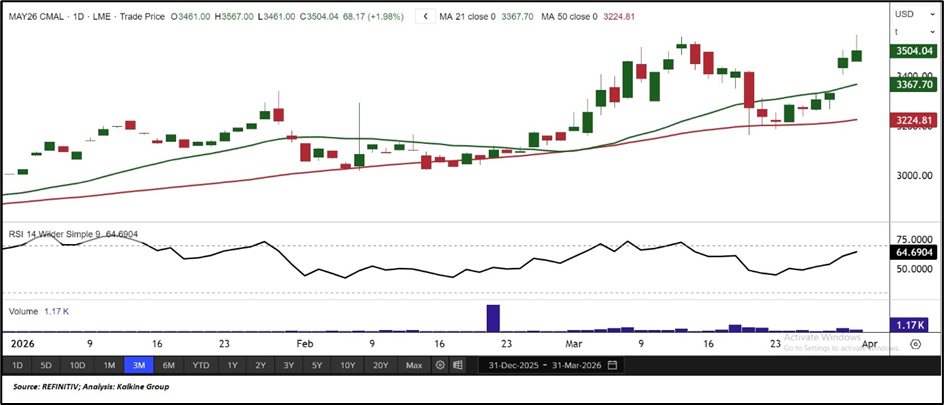
From a technical perspective, LME Aluminium (May 2026 contract) is trading near USD 3,504 per metric ton, up around 1.98%, and remains above its 21-day SMA at USD 3,367.70 and 50-day SMA at USD 3,224.81, highlighting a firm broader trend. The chart continues to show higher highs and higher lows, with prices rebounding strongly after testing the 50-day SMA in March. Aluminium is now moving close to the recent four-year peak near USD 3,567. Meanwhile, the 14-day RSI near 64.69 suggests momentum remains positive, though it is approaching overbought territory. Near-term support is placed at USD 3,250.00–USD 3,100.00, while resistance stands at USD 3,700.00–USD 4,000.00.
Bottom Line: Aluminium Nears Breakout Zone as Supply Risks Intensify
Aluminium remains close to a major breakout area near USD 3,550–USD 3,567 as supply concerns continue to support prices. A sustained move above this zone could lift aluminium toward USD 3,700–USD 4,000, while support is seen near USD 3,250–USD 3,100.