

Highlights
- Ather Energy Ltd (NSE:ATHERENERG) recorded notable price gains amid rising trading volumes and sector interest.
- Q3FY26 financial metrics indicated higher unit sales and improved margin indicators year-on-year.
- Technical breakout above trendline signaled renewed market participation and short-term momentum shift.
Price Action Triggers: What Drove the 5.33% Rise?
Ather Energy Ltd (NSE:ATHERENERG) advanced 5.33% on 10 April, trading near INR 864, supported by increased volumes and a breakout above a declining trendline visible on the daily chart. The breakout suggests renewed participation after multiple sessions of consolidation below resistance.
Another contributing factor appears to be continued investor attention toward electric two-wheelers ahead of seasonal demand months. Market activity also reflected improving technical sentiment, with price sustaining above its 50-day moving average near INR 718, indicating continuation of the prevailing medium-term trend.
Growth Catalysts: Expansion and Product Pipeline
- Network and Distribution Expansion- Ather Energy Ltd (NSE:ATHERENERG) expanded its distribution network to 600 experience centers during Q3FY26, supporting wider geographic coverage and improved customer reach. This expansion has supported market share gains across multiple regions, including emerging states where adoption of electric two-wheelers is rising.
- Product Engagement and Ecosystem Features- Recent launches and platform features include:
- Infinite CruiseTM capability on select models
- Vernacular dashboards in regional languages
- Insurance distribution services for vehicle ecosystem
Seasonal Demand Watch: Summer Demand Influence
Electric two-wheeler demand typically increases during summer months due to higher commuting activity and delivery usage. This seasonal demand cycle can influence monthly registrations and sales volumes.
Historically, festive and seasonal periods have contributed to peak registrations, including 30.9k monthly registrations recorded during earlier peak cycles, highlighting the sensitivity of volumes to seasonal demand patterns.
Risk Factors: What Could Limit Momentum?
- Competitive Landscape- The electric two-wheeler industry remains competitive, with multiple manufacturers expanding capacity and introducing new models. Pricing competition and promotional strategies across the sector may affect margins.
- Policy and Cost Variables- Government incentive structures and raw material pricing trends remain key variables. Changes in subsidy frameworks or battery component costs could influence profitability trends over future quarters.
Technical Summary
Ather Energy Ltd (NSE:ATHERENERG) shows a strong bullish breakout above descending trendline resistance, supported by rising volumes and sustained trading above the 50-day SMA near INR 719. RSI around 70 reflects strong momentum but signals possible near-term consolidation. Immediate resistance is seen at INR 875–880, while support lies at INR 830, with broader support positioned in the INR 780–700 demand zone.
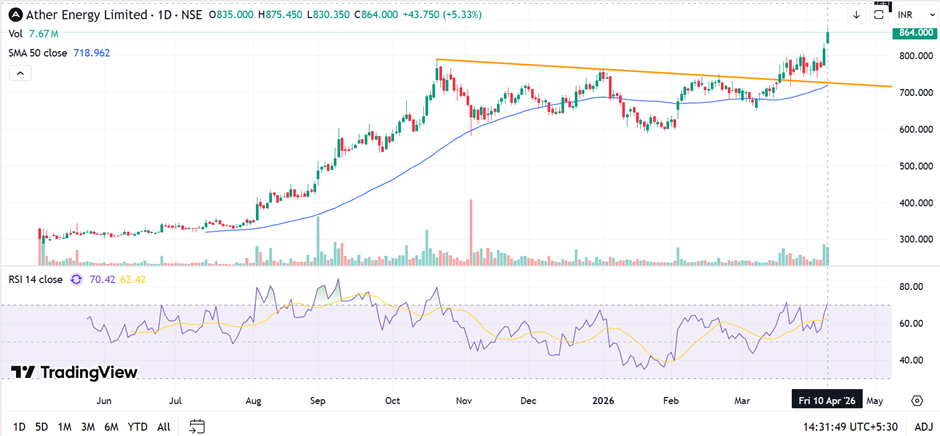
Chart by TradingView
Conclusion
Ather Energy Ltd (NSE:ATHERENERG) rose 5.33% on 10 April following a trendline breakout and sustained trading volumes. Q3FY26 reflected higher unit sales, margin expansion, and distribution growth across regions. Seasonal summer demand and product ecosystem initiatives remain key factors influencing near-term activity, while competitive intensity and policy shifts remain ongoing variables for investors to monitor.
FAQs
- What were the key financial highlights reported by Ather Energy Ltd (NSE:ATHERENERG) in Q3FY26?
Ather Energy Ltd reported INR 9,957 Mn income, 68k units sold, and EBITDA margin improvement to negative three percent. - What technical indicators are currently influencing Ather Energy Ltd (NSE:ATHERENERG) stock movement?
The stock recently crossed trendline resistance, while RSI near seventy indicates elevated momentum and potential short-term consolidation risk. - Why is summer demand considered relevant for electric two-wheeler companies?
Summer months typically increase commuting activity, which may drive higher vehicle registrations and incremental demand across urban delivery networks.