

Bombay Burmah Trading Corporation (NSE:BBTC), one of India’s oldest and most diversified conglomerates, has announced the sale of its Nilgiris tea plantations for ₹120 crore. This move is part of a broader asset monetisation strategy, reflecting a conscious shift toward optimizing its portfolio, improving capital efficiency, and sharpening focus on core businesses.
The development comes at a time when several Indian corporates are reassessing legacy assets and reallocating capital to higher-growth segments. For BBTC, this transaction is not merely a divestment—it represents a strategic recalibration in response to evolving industry dynamics and investor expectations.
Strategic Rationale: Unlocking Value Through Portfolio Optimization
Asset monetisation has increasingly become a key lever for companies looking to enhance shareholder value. In BBTC’s case, the sale of Nilgiris tea estates aligns with three fundamental strategic objectives:
- Unlocking Capital
The tea estates, while historically significant, are relatively low-return assets compared to emerging opportunities in other segments such as plantations, healthcare, or allied businesses within the Wadia Group ecosystem. By monetising these assets, BBTC converts illiquid land holdings into deployable capital, improving return on capital employed (ROCE).
- Balance Sheet Strengthening
The ₹120 crore inflow provides immediate liquidity, which can be used to:
- Reduce leverage
- Improve working capital
- Fund expansion in higher-margin businesses
This is particularly important in a rising interest rate environment, where debt servicing costs can weigh on profitability.
- Sharpening Strategic Focus
Divesting non-core or underperforming assets allows management to focus on scalable, growth-oriented verticals. This aligns with a broader corporate trend where conglomerates streamline operations to improve efficiency and valuation transparency.
Tea Industry Headwinds: Why Exit Now?
The decision to exit tea plantations is also influenced by structural challenges within the industry. The tea sector in India has been under pressure due to multiple factors:
- Rising Production Costs
- Labour-intensive operations
- Increasing wage pressures
- Higher input costs (fertilizers, energy)
These factors have compressed margins across plantation businesses.
- Changing Consumer Preferences
Urban consumers are gradually shifting toward:
- Coffee and specialty beverages
- Health-focused alternatives (green tea, herbal infusions)
This transition has impacted traditional bulk tea demand.
- Climate and Yield Risks
Tea cultivation is highly sensitive to:
- Rainfall variability
- Temperature fluctuations
- Soil conditions
Climate change has introduced uncertainty in yields, making revenue streams less predictable.
- Pricing Pressures
Global tea prices have remained volatile, with limited pricing power for producers. This further reduces the attractiveness of large-scale plantation ownership.
In this context, BBTC’s exit appears timely and pragmatic, allowing it to avoid prolonged exposure to a structurally challenged segment.
Financial Impact: Strengthening the Balance Sheet
The ₹120 crore proceeds from the sale are expected to have a positive financial impact:
Liquidity Enhancement
- Immediate cash inflow improves liquidity position
- Provides flexibility for capital allocation
Debt Reduction Potential
If deployed toward debt repayment, the company could:
- Lower interest expenses
- Improve net profit margins
Reinvestment Opportunity
The funds can be redirected into:
- High-growth verticals
- Strategic acquisitions
- Capacity expansion
Overall, the transaction is value-accretive, particularly if capital is redeployed efficiently.
Market Reaction: Typically, Positive for Asset Monetisation
Historically, markets tend to respond positively to asset monetisation announcements, especially when:
- The asset is non-core
- The transaction improves balance sheet strength
- Management signals a clear capital allocation strategy
For BBTC, investor sentiment is likely to improve due to:
- Enhanced financial flexibility
- Reduced exposure to low-margin businesses
- Improved focus on core operations
However, the sustainability of positive sentiment will depend on how effectively the proceeds are utilized.
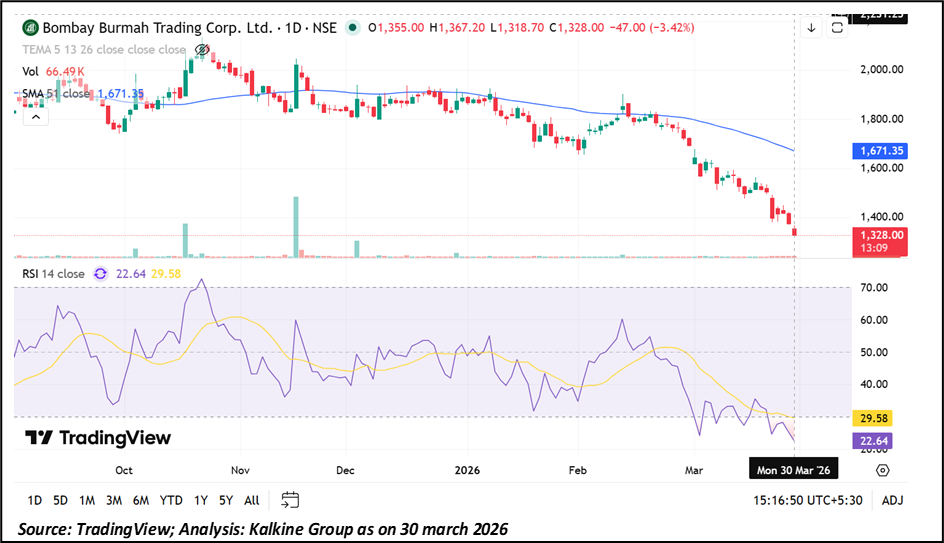
Stock Price Performance: A Mixed but Improving Structure
Bombay Burmah’s stock has shown volatile performance over the past year, reflecting both broader market conditions and company-specific factors.
Key observations:
- The stock has undergone periodic corrections, indicating supply pressure at higher levels
- It has shown episodic rallies, often driven by news flow and group-level developments
- Price action suggests institutional interest at lower levels, but lack of sustained momentum
This aligns with a stock transitioning from an “event-driven movement to potential re-rating phase”.
Bombay Burmah is currently in a broad consolidation phase after a prior uptrend. The stock has not broken down structurally but is also failing to sustain higher levels, indicating:
Supply at higher levels + accumulation at lower levels
The key support zone appears to be ₹1,700–1,750 with strong demand zone, and ₹1,600 seems to be strong structural support, while the key resistance zones appear to be ₹1,950–2,000 as immediate supply and ₹2,150–2,250 as major breakout zone.
Growth outlook: Turning point phase
Bombay Burmah appears to be entering a transition phase from legacy operations to value unlocking, supported by:
- Expected 12–18% revenue growth and 15–22% PAT growth in FY26
- Focus on margin improvement and operational efficiency