

Highlights
- Gold remains under pressure ahead of the closely watched U.S. Non-Farm Payrolls (NFP) report.
• Escalating Middle East tensions continue to support safe-haven demand but have not prevented recent declines.
• A stronger U.S. dollar and elevated interest rate expectations are weighing on bullion prices.
Markets Brace for a Major Data Catalyst
Gold prices are trading cautiously as investors await the latest U.S. NFP report, a key indicator that could shape expectations for monetary policy in the months ahead. The labor market remains one of the most closely watched areas of the economy, and any surprise in employment growth could significantly influence interest rate expectations.
A stronger-than-expected jobs report may reinforce expectations that interest rates will remain elevated for longer, while weaker data could revive hopes for a more accommodative policy outlook.
Middle East Tensions Keep Safe-Haven Demand Alive
Geopolitical developments continue to play a major role in precious metals markets. Rising tensions in the Middle East have increased uncertainty across global financial markets, encouraging some investors to seek protection in traditional safe-haven assets.
However, recent price action suggests that geopolitical concerns alone have not been enough to offset broader macroeconomic pressures. Instead, investors appear to be balancing geopolitical risks against expectations for inflation and interest rates.
Why Higher Rates Remain a Challenge for Gold
Gold does not generate interest or dividend income, making it less attractive when borrowing costs remain elevated. Expectations that central banks could maintain restrictive policies for longer have therefore reduced demand for bullion in recent sessions.
Persistent inflation concerns, partly linked to energy market volatility, have also contributed to expectations that policymakers may remain cautious about easing monetary conditions too quickly.
Dollar Strength Adds to Selling Pressure
Another key factor affecting gold is the performance of the U.S. dollar. A stronger dollar generally makes gold more expensive for international buyers, often reducing demand and limiting upside momentum.
Recent market positioning suggests that investors are favouring the dollar ahead of major economic releases, creating additional pressure on precious metals.
Technical Picture Remains Fragile
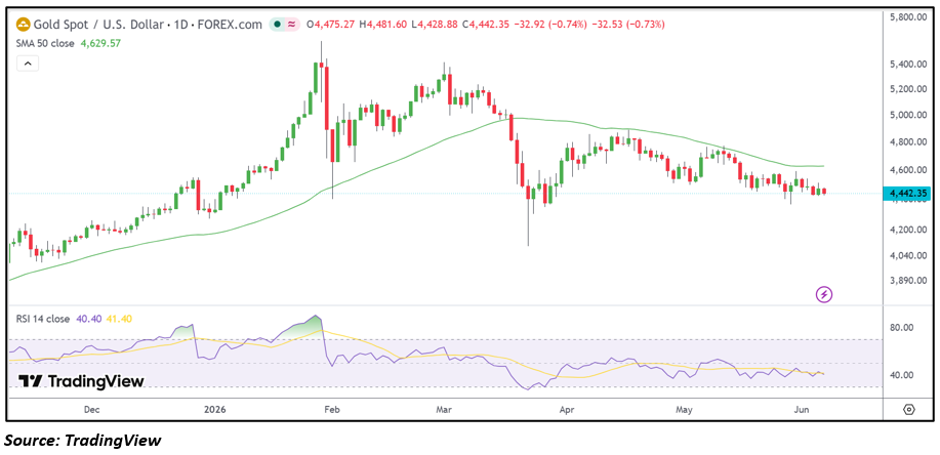
Gold is currently trading near $4,442.35, remaining below its 50-day SMA of $4,629.57, indicating a weaker near-term technical structure. Price action continues to trade beneath a declining moving average, reflecting ongoing selling pressure.
The 14-day RSI stands at 40.40, remaining below the neutral 50 level and indicating that bearish momentum remains present. While conditions are not deeply oversold, momentum currently favors caution.
Key Technical Levels
Gold faces immediate support near $4,200.00, followed by a stronger downside zone around $4,000.00.
On the upside, resistance is positioned near $4,800.00, while a broader recovery could encounter a significant hurdle around $5,200.00.
A break above resistance could improve sentiment, while a move below support may increase downside risks.
Key Risks
- Stronger-than-expected U.S. employment data.
• Further appreciation in the U.S. dollar.
• Elevated inflation and interest rate expectations.
• Escalation of geopolitical tensions.
• Increased volatility across commodity and energy markets.
Summary
Gold remains caught between competing forces as investors weigh safe-haven demand against expectations for higher interest rates and a stronger dollar. The upcoming NFP report could prove to be a major catalyst for the next directional move, while ongoing Middle East tensions continue to influence market sentiment. With prices trading below the 50-day SMA and momentum indicators remaining subdued, traders are closely watching both economic data and geopolitical developments for fresh direction.
FAQs
Why is gold falling despite geopolitical tensions?
Higher interest rate expectations and dollar strength are currently outweighing the supportive impact of safe-haven demand.
Why is the NFP report important for gold?
The employment report can influence interest rate expectations, which directly affect gold's attractiveness relative to yield-bearing assets.
What are the key levels traders are watching?
Support is located near $4,200.00 and $4,000.00, while resistance stands near $4,800.00 and $5,200.00.