

Key Highlights for March 26, 2026
- Gold slipped below the USD 4,600/oz mark, trimming its earlier rebound as markets reassessed evolving geopolitical developments
- Uncertainty around U.S.–Iran developments kept sentiment fragile, limiting clear directional moves in bullion
- Washington’s proposed 15-point framework contrasted with Iran’s cautious stance, highlighting a lack of alignment in negotiations
- Iran’s demand for sovereign control over the Strait of Hormuz added complexity, reducing the likelihood of near-term resolution
- Expanded U.S. troop deployment elevated geopolitical risk, sustaining concerns of a broader regional conflict
- Crude oil prices moved higher, adding to inflationary pressure and complicating the macro backdrop
- The higher-for-longer interest rate outlook weighed on gold, given its nature as a non-yielding asset
- Other precious metals showed mixed performance, with silver marginally higher while platinum declined, indicating uneven movement across the segment
Gold Pulls Back as Geopolitical Uncertainty Meets Higher-for-Longer Rates
Gold prices slipped below the USD 4,600 per ounce mark on Thursday, reversing part of the previous session’s rebound as investors assessed mixed geopolitical signals surrounding the U.S.-Iran conflict. While bullion had earlier recovered on a weaker U.S. dollar and cautious optimism around diplomatic progress, gains remained limited amid persistent uncertainty. Washington’s reported 15-point proposal aimed at de-escalation contrasted with Iran’s firm stance rejecting direct negotiations, although Tehran continues to review the plan without outright dismissal, keeping markets uncertain.
At the same time, rising crude oil prices intensified inflation concerns globally, reinforcing expectations that major central banks may maintain a restrictive monetary policy stance for longer, a factor that typically weighs on non-yielding assets like gold. Despite its traditional role as a safe-haven asset during geopolitical stress, gold has displayed heightened volatility in recent weeks due to shifting interest rate expectations and currency fluctuations. Broader financial markets also reflected a cautious tone, with investors awaiting clearer direction on both geopolitical developments and global monetary policy, while other precious metals delivered a mixed performance.
Technical View: Weak Structure with Emerging Stabilisation Signals
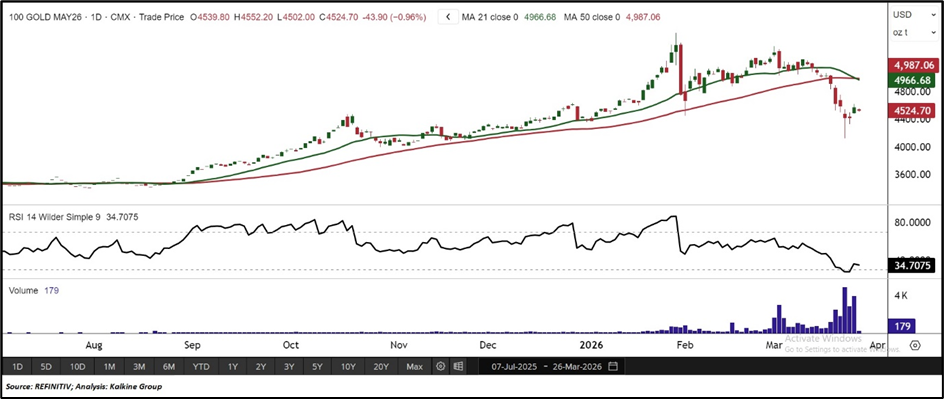
From a technical perspective, Gold (COMEX) is currently trading near USD 4,524.70, declining around 0.96%, and remains below its 21-day Simple Moving Average USD 4966.66 and 50-day Simple Moving Average USD 4,987.06, reflecting a weak broader price structure. The chart shows a sequence of lower highs and lower lows, indicating an ongoing corrective phase. However, a mild rebound from recent lows suggests early signs of stabilisation. The 14-day RSI near 34.70 indicates recovery from oversold territory, pointing to gradually improving momentum. In the near term, support is seen around USD 4,200.00–USD 4,000.00, while resistance is placed near USD 4,800.00–USD 5,000.00.
Bottom Line: Gold Holds Near Support — Stabilisation or Continuation of Weak Structure?
Gold remains under pressure below key levels, with the broader structure still tilted to the downside. While short-term momentum shows early stabilisation signs, persistent macro uncertainty and rate expectations may limit sustained upside in the near term.