

India’s small-cap segment has experienced a significant market correction over the past year, with more than 1,000 small-cap stocks losing over 50% of their value from their 52-week highs. The downturn, which intensified throughout 2025 and continued into early 2026, reflects the unwinding of inflated valuations, weakening investor sentiment, and broader economic uncertainties.
After delivering exceptional returns between 2022 and early 2024, small-cap stocks became a favorite among retail investors and mutual funds seeking higher growth potential. Massive inflows into the segment pushed valuations to record levels. However, the rally proved unsustainable, and the market has since entered one of its sharpest corrections in nearly a decade.
Over 1,000 Small-Cap Stocks Lose Half Their Value
According to market data available by March 2025, around 1,030 small-cap stocks had fallen more than 50% from their 52-week highs, highlighting the magnitude of the correction across India’s equity markets.
Several companies have witnessed even steeper losses, with declines ranging between 70% and 90% in some cases. Notable examples include:
- Supha Pharmachem Ltd (BOM:539561) – down more than 90% from its peak
- Rossell India Ltd (NSE:ROSSELLIND) – declined nearly 70–80%
- Newtrac Foods & Beverages Ltd (BOM:514060) – lost over 50% of its market value
- PS IT Infrastructure & Services Ltd (BOM:505502) – dropped sharply after speculative rallies
- Rajnish Wellness Ltd (BOM:541601) – corrected more than 90–95%
Many of these stocks had surged rapidly during the bull phase, driven by retail enthusiasm and speculative trading activity.
The correction has wiped out thousands of crores in investor wealth, particularly among retail participants who entered the market during the peak of the rally.
BSE Smallcap Index Underperforms Broader Market
The broader BSE Smallcap Index has also seen a steep decline, falling around 23% from its 52-week high during the correction phase.
In comparison, larger market benchmarks have shown relatively better resilience:
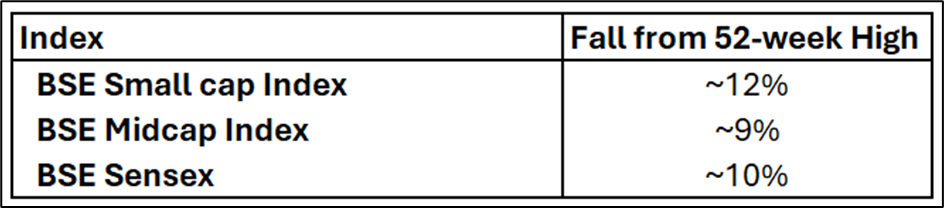
The underperformance reflects the higher volatility associated with smaller companies, which tend to experience sharper swings during both rallies and corrections.
Notably, the BSE Smallcap index had previously delivered over 70% returns between 2022 and early 2024, making the subsequent correction a classic case of a market overheating followed by valuation normalization.
Valuation Bubble and “Mid-Cap Madness”
One of the major drivers behind the correction has been stretched valuations across the small- and mid-cap universe.
At the peak of the rally:
- The BSE Smallcap index traded at valuation multiples exceeding 30–35 times earnings, significantly above historical averages.
- Several companies with limited earnings visibility were trading at price-to-earnings (P/E) ratios above 70–100.
Market experts often described this phase as “mid-cap madness,” where investors aggressively chased momentum rather than fundamentals.
Retail participation surged dramatically during this period. According to exchange data, India added more than 70 million new demat accounts between 2022 and 2024, pushing total demat accounts past 185 million.
A large portion of these investors allocated funds to small-cap and thematic stocks, fueling rapid price appreciation.
Foreign Institutional Investors Trigger Sell-Off
Another key factor behind the market downturn has been significant selling by Foreign Institutional Investors (FIIs).
Global investors turned cautious toward emerging markets amid:
- Higher global interest rates
- Geopolitical uncertainties
- Concerns about global economic slowdown
FIIs withdrew substantial capital from Indian equities during parts of 2025, particularly from mid-cap and small-cap segments that had seen excessive inflows during the rally.
Historically, foreign investors tend to exit higher-risk segments first, which amplified the correction in smaller companies.
Small-Cap Mutual Funds Also Impacted
The correction has also affected mutual funds heavily exposed to small-cap stocks.
Data shows that nearly 50% of active small-cap mutual funds delivered negative returns in the 12 months leading up to August 2025.
Some of the prominent funds that experienced declines include:
- SBI Small Cap Fund – down over 5%
- Quant Small Cap Fund – declined more than 5%
- Several other funds also struggled as underlying portfolio stocks corrected sharply.
Despite the downturn, the small-cap mutual fund category had previously generated annual returns exceeding 25–30% during the bull phase, which attracted strong retail inflows.
Retail Participation and Liquidity Risks
Retail investors played a major role in the small-cap rally, supported by the growth of online trading platforms and financial awareness campaigns.
However, small-cap stocks typically have:
- Lower liquidity
- Limited institutional coverage
- Higher volatility
These factors make them particularly vulnerable during market downturns.
Once selling pressure begins, sharp price corrections can occur due to the absence of large buyers, resulting in sudden drops of 20–40% within short periods.
One of the Worst Small-Cap Corrections in Seven Years
The ongoing decline is widely regarded as one of the worst corrections in the small-cap segment since 2018.
The sell-off has effectively reset valuations across many companies and forced investors to reassess risk exposure.
While the correction has been painful, market experts believe it may ultimately create opportunities in fundamentally strong small-cap companies whose valuations have become more reasonable.
Outlook for Indian Small-Cap Stocks
Despite the sharp downturn, India’s small-cap segment remains a critical part of the country’s capital markets. Many smaller companies are positioned to benefit from long-term structural trends such as:
- Manufacturing growth under “Make in India” initiatives
- Digital transformation
- Rising domestic consumption
- Infrastructure expansion
However, analysts caution that investors should prioritize strong balance sheets, consistent earnings growth, and sound corporate governance when selecting small-cap stocks.
The recent correction serves as a reminder that while small-cap stocks can deliver multibagger returns during bull markets, they also carry significantly higher downside risk during market corrections.
For long-term investors, disciplined investing and careful stock selection will remain crucial as the market moves beyond the current phase of volatility.