

Key Highlights
- Natural gas futures slipped to a one-month low near $2.90 per MMBtu as warmer US weather forecasts reduced heating demand and increased expectations of higher storage levels.
- Forecasts for above-normal temperatures across the eastern US are expected to further weaken consumption through early April.
- Prices remain under pressure due to strong domestic production and the end of the winter heating season.
- Natural gas has fallen nearly 28% over the past year, reflecting abundant supply and weaker seasonal demand.
- The market is considered oversold, with $2.78 per MMBtu acting as a key support level.
- A break below $2.78 could open the door toward lower support zones and extend the recent decline.
- Middle East tensions and risks around the Strait of Hormuz continue to create volatility across global energy markets.
- In India, concerns over supply security are increasing interest in piped natural gas (PNG) and domestic gas-related companies.
Natural Gas Falls to One-Month Low as Warm Weather Weakens Demand
Warmer weather forecasts across the eastern United States through early April continue to pressure natural gas prices, as lower heating demand reduces near-term consumption. The market is also moving from the winter withdrawal season into the injection season, when excess gas is stored ahead of summer. This seasonal transition is increasing expectations of larger stockpiles and keeping downward pressure on U.S. futures.
At the same time, U.S. natural gas inventories ended winter near the five-year average, providing a comfortable supply cushion and limiting the risk of a sharp domestic price spike. As a result, despite elevated volatility in broader energy markets, U.S. gas prices remain relatively subdued.
However, the situation is very different globally. European TTF natural gas prices have surged above €55/MWh as military conflict in West Asia and disruptions to LNG shipping through the Strait of Hormuz tighten international supplies. Concerns over export routes and LNG availability continue to support global prices.
In India, the government has stepped up efforts to protect domestic supply security. Households with PNG infrastructure have been asked to switch from LPG cylinders to piped natural gas within three months, while the new Natural Gas Supply Regulation Order 2026 has capped supplies to fertilizer plants at 70% of their average consumption to safeguard priority sectors.
Technical View: Weak Structure with Emerging Stabilisation Signals
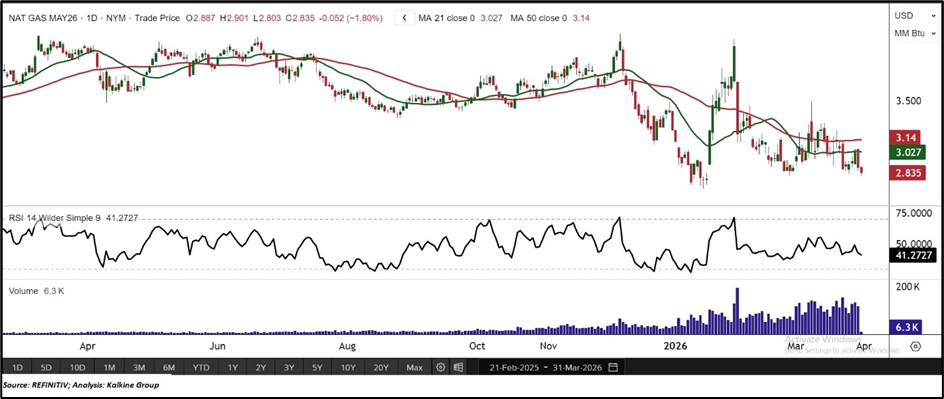
From a technical perspective, Natural Gas (NYMEX) is trading near USD 2.835 per MMBtu, down around 1.80%, and remains below its 21-day SMA near USD 3.027 and 50-day SMA near USD 3.140, indicating a weak broader trend. The chart continues to reflect an ongoing downtrend phase, with lower highs and lower lows dominating price action. Prices have again slipped toward the recent support area near USD 2.80, showing that rebound attempts remain limited. The 14-day RSI near 41.27 is still below the neutral 50 level, suggesting subdued momentum. Near-term support is seen at USD 2.80–USD 2.75, while resistance stands near USD 3.00–USD 3.15.
Bottom Line: Natural Gas Near Key Support — Stabilisation Ahead or Further Downside?
Natural gas remains under pressure below the USD 3.00 per MMBtu level, with warmer weather, ample supply and weak technical structure continuing to weigh on prices. A break below USD 2.78–USD 2.75 could deepen the downtrend, while holding this zone may support short-term stabilisation.