

Highlights
- Oil prices extended their decline as hopes of a diplomatic breakthrough reduced supply concern.
- Traders unwound part of the geopolitical premium built into crude prices during recent tensions.
- Softer demand expectations added further pressure on the market.
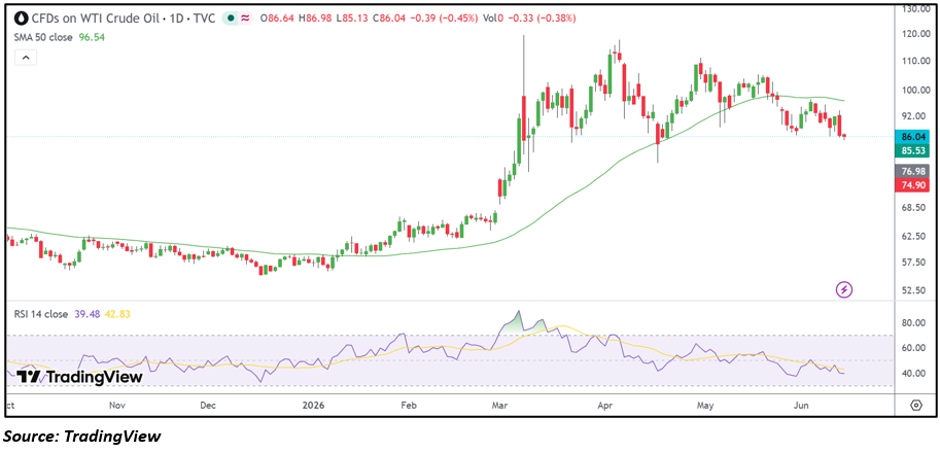
- WTI crude continues to trade below its 50-day SMA, reflecting a cautious near-term setup.
Diplomatic Hopes Shift Market Sentiment
Crude oil prices remained under pressure after improving expectations surrounding negotiations between the United States and Iran. The possibility of a diplomatic agreement has reduced immediate fears of a broader regional conflict, encouraging traders to reassess supply risks that had previously supported prices.
As concerns eased, markets began removing part of the risk premium that had accumulated during recent geopolitical uncertainty.
Geopolitical Premium Starts Unwinding
Oil had rallied sharply in previous months as investors priced in potential disruptions to global energy flows. However, signs of progress in diplomatic discussions have changed market sentiment and triggered profit-booking across energy markets.
The decline reflects expectations that supply disruptions may be less severe than initially feared if negotiations continue to advance.
Strait of Hormuz Remains a Critical Watchpoint
Despite the recent correction, traders continue monitoring developments around the Strait of Hormuz. The waterway remains one of the world's most important energy transportation routes and any disruption could quickly influence global supply expectations.
As a result, volatility is likely to remain elevated even as markets react positively to diplomatic developments.
Demand Concerns Add Another Layer of Pressure
Apart from geopolitical developments, crude oil is also facing pressure from expectations of slower demand growth. Market participants are increasingly focused on whether global consumption can remain strong enough to absorb available supply.
Any signs of weaker economic activity or slower industrial demand could continue to weigh on prices.
Technical Structure Weakens Below Key Average
WTI crude is currently trading around $86.04 while remaining below its 50-day SMA of $96.54. The price structure reflects a corrective phase after the strong rally witnessed earlier in the year.
The inability to reclaim the moving average suggests that sellers continue to hold a near-term advantage.
Momentum Indicator Reflects Cautious Trading
The RSI is positioned near 39.48, indicating subdued momentum conditions. The indicator remains below the neutral 50 mark, highlighting a cautious market environment as traders evaluate both geopolitical and demand-related developments.
A sustained recovery in momentum would be needed to support a stronger rebound.
Key Technical Levels
WTI crude is trading near $86.04. Immediate downside levels are placed around $83.89 and $81.74. On the upside, the first resistance zone is located near $88.19, while a stronger recovery could target $90.34.
Key Risks
- Breakdown in diplomatic negotiations.
- Fresh supply disruptions in key energy routes.
- Unexpected changes in global demand trends.
- Higher market volatility due to geopolitical events.
- Changes in production policies from major producers.
What Traders Should Watch Next
The next phase for crude oil will depend largely on whether diplomatic discussions continue to progress and whether supply concerns continue to ease. While recent developments have pressured prices lower, uncertainty surrounding energy transportation routes and future demand trends remains high. Market participants are likely to closely monitor geopolitical headlines and global consumption patterns for the next directional move.
FAQs
Why are oil prices falling this week?
Oil prices declined as improving diplomatic developments reduced concerns over immediate supply disruptions and encouraged profit-booking.
Why is the Strait of Hormuz important?
It is one of the world's most important energy shipping routes and plays a major role in global crude oil transportation.
What are the key levels to watch in WTI crude?
Important downside levels are $83.89 and $81.74, while upside levels are $88.19 and $90.34.