
Highlights
- Crude oil prices declined sharply after reports of progress in US-Iran peace negotiations.
- Hope for gradual reopening of the Strait of Hormuz eased global supply concerns.
- Brent crude slipped below key psychological levels after recent war-driven rallies.
- MCX Crude Oil traded near ₹8,775.00 after witnessing heightened volatility.
Overview
Crude oil prices corrected sharply after reports suggested that the United States and Iran may be moving closer toward a broader understanding aimed at easing tensions in the Middle East. The latest developments improved market expectations around a gradual reopening of the Strait of Hormuz, one of the world’s most critical energy shipping routes.
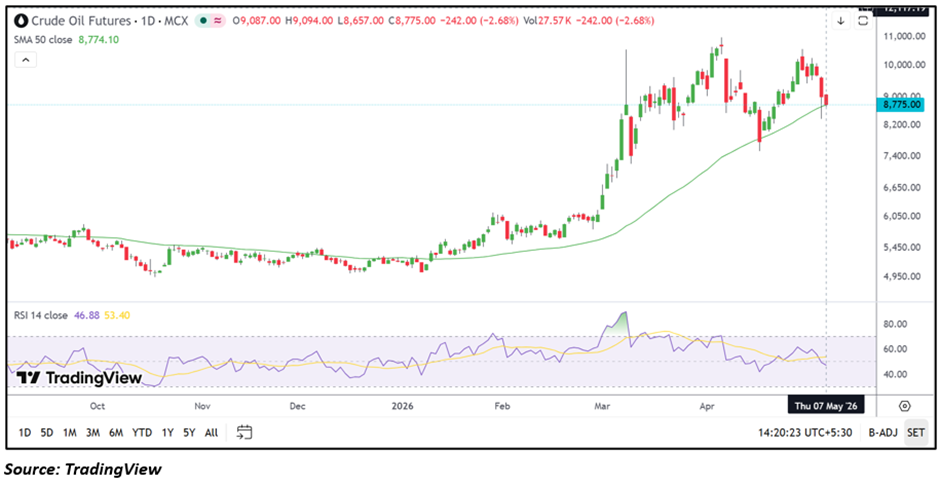
MCX Crude Oil traded near ₹8,775.00 on May 7, 2026, down 2.68% during the session after touching an intraday low near ₹8,657.00. The recent correction followed weeks of heightened volatility caused by supply disruption fears linked to the Iran conflict and shipping restrictions around Hormuz.
Global crude benchmarks also declined sharply after reports indicated that diplomatic negotiations between Washington and Tehran were progressing. Brent crude slipped near the $99.00 per barrel zone while WTI crude also witnessed a sharp pullback.
Fundamental View
Oil markets have remained highly sensitive to geopolitical developments over the last several weeks. Earlier fears of prolonged disruption in the Strait of Hormuz had triggered a sharp surge in crude prices globally because nearly one-fifth of global oil supply moves through the route.
However, sentiment shifted after reports suggested that both sides had reached preliminary understandings regarding easing restrictions and gradually reopening shipping routes. Markets interpreted the development as a possible reduction in immediate supply risks.
Brent crude had earlier rallied sharply above $120.00 per barrel during the peak of supply concerns. However, improving diplomatic signals triggered profit booking and reduced geopolitical premium across energy markets.
Investors are also watching whether any formal agreement materializes in the coming days. A sustained reopening of Hormuz could stabilize shipping activity and improve supply visibility for Asian and European energy markets.
At the same time, uncertainty remains elevated. While negotiations are progressing, traders continue to monitor developments around sanctions, nuclear discussions, and security conditions across the Gulf region.
What the Market Is Watching
The biggest factor influencing crude oil prices currently is whether diplomatic momentum continues between the US and Iran.
Markets are closely tracking:
- Progress toward a formal peace agreement.
- Any reopening timeline for the Strait of Hormuz.
- Shipping and insurance conditions in Gulf energy routes.
- Potential changes in sanctions and export restrictions.
- Inventory trends across major consuming economies.
Oil markets are also reacting to broader macroeconomic conditions. Slower global growth expectations and recession concerns have started balancing earlier fears of supply shortages.
Meanwhile, analysts continue to warn that volatility may remain elevated because geopolitical headlines can rapidly shift market sentiment. Even small disruptions in the Middle East energy supply chain can trigger sharp price swings.
Technical View
MCX Crude Oil is trading near ₹8,775.00 and remains marginally above its 50-day SMA near ₹8,774.10, indicating that the broader trend is attempting stabilization after the recent sharp rally and correction.
Price action reflects a pullback after crude oil surged toward the ₹10,000.00 region during peak geopolitical tensions. The latest correction suggests cooling momentum as diplomatic optimism improves market sentiment.
The RSI near 46.88 has slipped below its recent highs, indicating that upward momentum has moderated after the earlier sharp rally.
Immediate support is placed around ₹8,100.00–₹7,400.00. On the upside, resistance is seen near ₹9,600.00–₹10,200.00 where earlier sharp supply pressure emerged.
Latest News
Reports from multiple international media sources suggested that the United States and Iran are moving closer toward a possible agreement involving gradual reopening of the Strait of Hormuz and easing shipping restrictions.
Oil prices reacted sharply to the developments, with Brent crude and WTI crude witnessing steep declines after recent multi-week highs. Investors interpreted the developments as a possible reduction in immediate supply disruption risks.
At the same time, markets remain cautious because negotiations are still evolving and any fresh escalation in the region could quickly reverse the recent correction in crude prices.
Key Risks
- Failure of diplomatic negotiations could trigger another sharp oil rally.
- Fresh attacks on energy infrastructure may disrupt supply flows again.
- Global economic slowdown could weaken crude demand expectations.
- Shipping disruptions around Hormuz remain a major market risk.
Summary
Crude oil prices corrected sharply after reports of improving US-Iran diplomatic negotiations reduced immediate fears around supply disruption and shipping blockages in the Strait of Hormuz.
The recent decline reflects fading geopolitical premium after weeks of strong rallies triggered by Middle East tensions. However, uncertainty remains elevated as markets continue to track the progress of negotiations and the broader geopolitical environment.
Going forward, crude oil traders are likely to remain highly sensitive to headlines around Hormuz reopening, sanctions discussions, and regional security developments.
FAQs
- Why did crude oil prices fall recently?
Oil prices declined after reports suggested progress in US-Iran negotiations and possible reopening of the Strait of Hormuz.
- What is the key support zone for MCX Crude Oil?
Immediate support is placed around ₹8,100.00–₹7,400.00.
- What resistance levels are important for MCX Crude Oil?
Resistance is seen near ₹9,600.00–₹10,200.00.