

Rajesh Exports Ltd (NSE: RAJESHEXPO) has emerged as one of the most debated stocks in the Indian market after the share price collapsed nearly 70% over the past two years, pushing the stock near its 52-week lows.
Once considered a major player in the global gold refining industry, the company now faces multiple regulatory, governance, and business risks that have severely impacted investor confidence.
In this article we analyse:
- The latest regulatory risks including SEBI notices and trading suspension concerns
- The three major structural risks still threatening the stock
- Why some investors still see deep value
- Whether LIC’s ~10% stake is a bullish signal or not
Rajesh Exports Valuation Snapshot
Based on financial screening platforms:
- P/E Ratio: ~20
- Price-to-Book (P/B): ~0.22
- Market Cap: ~₹3,000crore
- Return on Capital Employed: ~1.5%
A P/B ratio below 1 means the stock trades far below its book value, which often attracts deep value investors looking for turnaround opportunities.
However, low valuations sometimes signal fundamental concerns rather than opportunity.
Latest Regulatory & Exchange Risks Investors Should Know
- NSE Trading Suspension Risk Over Compliance Issues
In early 2026, the NSE warned that trading in Rajesh Exports shares could be suspended due to non-compliance with SEBI listing regulations, specifically the failure to submit shareholding pattern disclosures for multiple quarters.
Key details:
- The company reportedly missed required filings for June and September 2025 quarters
- Exchanges warned trading could be suspended until compliance is completed
- After suspension, stocks could move to trade-to-trade (Z category) weekly trading
Such regulatory warnings often damage investor confidence and can increase volatility.
- SEBI Forensic Investigation Communication
The company also received communication related to a forensic accounting investigation assignment linked to SEBI oversight, prompting the exchanges to seek clarification from Rajesh Exports.
A forensic audit typically aims to:
- Examine financial records
- Verify accounting practices
- Identify potential irregularities
Even when investigations are routine, the presence of a regulatory probe often creates uncertainty for investors.
- Fines for Multiple SEBI Compliance Violations
Rajesh Exports has also faced regulatory fines for delays in mandatory filings and compliance reporting.
These include delays in submitting:
- Corporate governance reports
- Shareholding pattern disclosures
- Board meeting intimations
- Secretarial compliance reports
Both BSE and NSE imposed fines for these compliance lapses.
Repeated compliance issues can signal weak governance processes, which often leads to valuation discounts.
3 Structural Risks That Could Push Rajesh Exports Stock Lower
- Extremely Thin Profit Margins
Despite massive revenue figures, Rajesh Exports operates in a low-margin commodity business.
The company is primarily involved in:
- Gold refining
- Bullion trading
- Jewellery exports
These businesses typically have net margins below 1%, meaning profitability remains highly sensitive to:
- Gold price volatility
- Currency fluctuations
- Global jewellery demand
This structural weakness limits earnings growth.
- Slowing Global Jewellery Demand
High gold prices and global economic uncertainty have reduced jewellery demand in many markets.
This creates multiple challenges:
- Lower export volumes
- Reduced profitability
- Slower earnings growth
Without strong demand recovery, the company may struggle to deliver consistent growth.
- Corporate Governance Concerns
Repeated regulatory scrutiny and delayed disclosures have raised concerns about governance transparency.
In the past, exchanges have also sought clarification from the company regarding unusual stock price movements, highlighting the need for timely information disclosure.
Investor confidence often declines when governance standards appear weak.
Why Some Investors Still See Deep Value in Rajesh Exports
Despite the risks, some investors believe the stock could be deeply undervalued.
- Very Low Price-to-Book Ratio
A P/B ratio below 1 (~0.22) means the market values the company significantly below its asset value.
This can sometimes signal:
- Market overreaction
- Temporary earnings weakness
- Turnaround potential
Value investors often search for such opportunities.
- Global Gold Refining Scale
Rajesh Exports remains one of the largest gold refining companies globally, processing large volumes of gold annually.
The company also operates across the entire value chain:
- Gold refining
- Jewellery manufacturing
- Global exports
- Retail jewellery
This scale could become valuable if profitability improves.
- Potential Cyclical Recovery
The jewellery industry is highly cyclical.
If the following improve:
- Global consumer spending
- Gold price stability
- Export demand
the company could experience earnings recovery, which might trigger a stock re-rating.
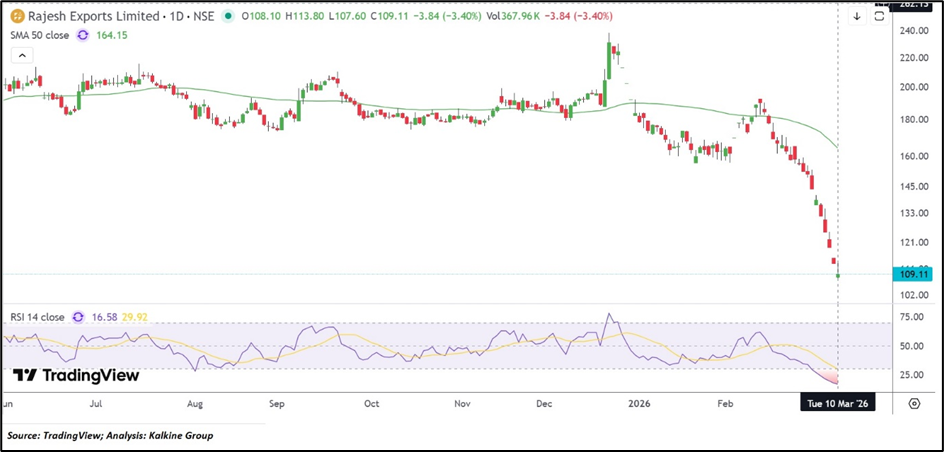
Technical Summary: Rajesh Exports is trading at ₹109.11 on March 10, 2026, down 3.40% for the day, reflecting continued selling pressure on the daily chart. The price remains below its 50-day Simple Moving Average of ₹164.15, indicating a negative short-term trend. Momentum indicators remain weak, with the RSI at 16.58, placing it in the oversold zone and suggesting subdued momentum. On the downside, the ₹98.00–₹90.00 range may act as a support area if the decline continues. On the upside, the ₹130.00–₹150.00 zone could act as a resistance band, with a move above ₹130.00 potentially improving the near-term price structure.
Is LIC’s 10% Stake a Bullish Signal?
Life Insurance Corporation of India (LIC) holds roughly 10% stake in Rajesh Exports, making it one of the largest institutional shareholders.
Why It Could Be Positive
LIC typically invests with a long-term horizon and often holds stakes in companies with large market presence.
Institutional ownership may provide:
- Market credibility
- Stability in shareholding
- Long-term investor support
Why It May Not Guarantee Upside
However, investors should not rely solely on institutional holdings.
Important considerations:
- LIC often holds legacy investments for long periods
- Institutions may not exit quickly during downturns
- Fundamentals ultimately determine stock performance
Therefore, LIC’s stake should be viewed as a supportive signal rather than a buy trigger.
Rajesh Exports: Value Trap or Turnaround Candidate?
The stock currently sits at a critical crossroads.
Bear Case
- SEBI compliance issues and exchange scrutiny
- Potential trading suspension risk
- Thin margins and weak earnings growth
- Governance concerns
Bull Case
- Extremely low valuation (P/B below 1)
- Global gold refining scale
- Institutional investor presence
- Potential cyclical recovery in jewellery demand
Whether Rajesh Exports becomes a turnaround story or remains a value trap will largely depend on how the company improves governance, compliance, and profitability over the next few years.
FAQ
Why is Rajesh Exports share price falling?
The stock has fallen due to regulatory compliance issues, weak profitability, governance concerns, and slowing jewellery demand.
Is Rajesh Exports undervalued?
Some investors believe it is undervalued because the stock trades below book value (P/B < 1).
What is the SEBI issue with Rajesh Exports?
The company has faced compliance lapses and regulatory scrutiny, including warnings related to filings and forensic investigation communication.