

Highlights
- USD/INR surged toward fresh record highs near 95.50 amid rising geopolitical tensions
• Brent crude prices climbed above $105, increasing pressure on India’s import bill
• Heavy foreign institutional selling and a stronger US dollar weakened rupee sentiment
Overview
The Indian rupee remained under intense pressure on May 12, 2026, with the USD/INR pair climbing near the 95.50 mark after renewed concerns around the fragile US-Iran ceasefire pushed crude oil prices sharply higher. The rupee weakened further as investors reacted to rising energy costs, continued foreign institutional investor outflows, and a stronger US dollar environment.
The currency opened lower and slipped to a fresh lifetime low during early trade as Brent crude oil moved higher following fears that the temporary truce between the United States and Iran could collapse. Since India imports a major portion of its crude oil requirements, higher oil prices directly increase dollar demand and weigh heavily on the rupee.
Recent market volatility has also intensified pressure on domestic financial markets, with both equities and the currency market witnessing sharp swings amid global uncertainty.
What Is Driving the Rupee Weakness?
One of the biggest triggers behind the rupee’s decline has been the sharp jump in crude oil prices. Brent crude traded near $105 per barrel after geopolitical tensions in West Asia escalated again. Traders remain worried that any disruption around the Strait of Hormuz could impact global oil supplies and further increase import costs for energy-dependent economies like India.
Another major factor has been aggressive FII selling in Indian markets. Foreign investors have continued reducing exposure to emerging markets amid uncertainty surrounding global interest rates, geopolitical instability, and rising US bond yields. Persistent equity outflows have increased dollar demand and weakened the rupee further.
At the same time, the US dollar has remained firm globally as investors moved toward safer assets amid rising risk aversion. Elevated US Treasury yields and expectations of higher-for-longer interest rates have continued to support dollar strength against emerging market currencies.
Why Crude Oil Matters So Much for India
India remains one of the world’s largest crude oil importers, making the rupee highly sensitive to energy price movements. When crude prices rise sharply, oil marketing companies need more dollars to pay for imports, increasing pressure on the currency market.
Higher oil prices also raise inflation risks because transportation, manufacturing, and logistics costs increase across the economy. A weaker rupee further amplifies these pressures by making imports more expensive in local currency terms.
Market participants are therefore closely watching developments in West Asia because any prolonged disruption in global energy supply chains could continue pushing oil prices higher and keep the rupee under pressure for an extended period.
Fundamental View
The broader macroeconomic environment has turned increasingly challenging for the Indian rupee over recent months. Rising commodity prices, weaker foreign inflows, and elevated geopolitical risks have combined to create persistent downside pressure on the currency.
Although the Reserve Bank of India has intervened periodically to smooth volatility in the forex market, traders believe the central bank may focus more on controlling disorderly movements rather than defending a fixed level. Market expectations around future RBI action continue to remain elevated as volatility increases.
At the same time, exporters have reportedly been reluctant to sell dollars aggressively, expecting further rupee weakness ahead. This imbalance between importer dollar demand and exporter supply has further tightened the currency market.
Technical View
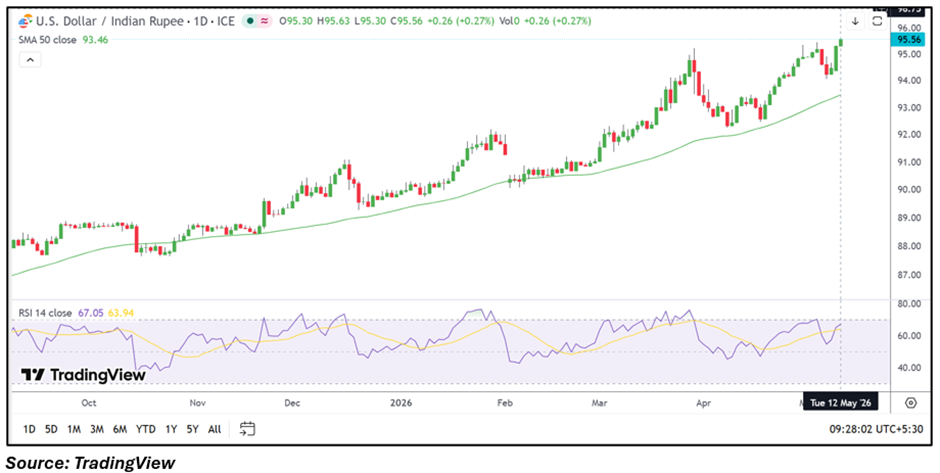
USD/INR is currently trading near 95.56 and remains well above its 50-day moving average around 93.46, indicating that the broader upward trend in the pair remains intact.
The RSI indicator is hovering near elevated territory, reflecting sustained bullish momentum in the dollar against the rupee despite intermittent pullbacks.
Immediate support is placed around 93.00–91.00. A move below this zone could indicate temporary stabilization in the rupee.
On the upside, resistance is seen near 98.00–100.00. If geopolitical tensions continue escalating and crude prices remain elevated, the pair could continue moving toward these higher levels.
What Investors Are Watching Next
Currency traders are closely tracking developments around the US-Iran conflict, global crude oil prices, and future RBI intervention signals. Any positive breakthrough in peace negotiations or sharp correction in oil prices may provide temporary relief to the rupee.
Investors are also monitoring foreign fund flows, US bond yields, and inflation data because these factors will likely shape the next major move in the currency market.
If global risk sentiment remains weak and oil prices stay elevated, pressure on the rupee could continue in the near term.
Key Risks
- Further escalation in US-Iran tensions
• Sustained rise in crude oil prices above current levels
• Continued heavy FII selling in Indian markets
• Rising inflation and widening trade deficit concerns
Summary
USD/INR moved near fresh record highs around 95.50 as geopolitical tensions, rising crude oil prices, and persistent foreign outflows intensified pressure on the Indian rupee. The currency remains vulnerable to movements in global energy markets and investor sentiment, while traders continue watching for possible RBI intervention and developments in West Asia that could influence the next phase of volatility.
FAQs
Why is USD/INR rising sharply?
The pair is rising due to higher crude oil prices, strong dollar demand, and continued FII selling in Indian markets.
How do rising oil prices affect the rupee?
Higher crude prices increase India’s import bill and create more dollar demand from oil companies, weakening the rupee.
What are the key support levels for USD/INR?
Immediate support is placed around 93.00–91.00.
What resistance levels are traders watching?
Resistance is seen near 98.00–100.00.