

Highlights
- Gold prices have extended losses and are trading near recent multi-week lows.
- A stronger U.S. dollar continues to pressure precious metals demand.
- Markets are increasingly pricing in the possibility of higher interest rates later this year.
- Improving diplomatic engagement between the U.S. and Iran has reduced safe-haven demand.
- Investors are closely monitoring upcoming inflation data and central bank commentary.
Overview
Gold prices remained under pressure during recent trading sessions as investors reassessed the outlook for global monetary policy and safe-haven demand. The precious metal has struggled to sustain buying momentum amid a stronger U.S. dollar and rising expectations that interest rates could remain elevated for longer than previously anticipated.
While geopolitical developments continue to influence sentiment, macroeconomic factors have become the dominant driver of bullion prices, pushing gold toward its third consecutive weekly decline.
Federal Reserve Signals Keep Pressure on Precious Metals
A major factor weighing on gold prices is the increasingly hawkish policy outlook from the Federal Reserve. Although policymakers kept interest rates unchanged at their latest meeting, updated projections indicated growing support for additional policy tightening to address inflation concerns.
Higher interest rates generally reduce the attractiveness of non-yielding assets such as gold because investors can earn higher returns from interest-bearing investments. As a result, expectations of tighter monetary policy have encouraged capital flows away from bullion.
Dollar Strength Continues to Challenge Gold Demand
The U.S. dollar has remained near its strongest levels in more than a year following the Federal Reserve's latest guidance. A stronger dollar makes gold more expensive for holders of foreign currencies, often reducing international demand for the metal.
This currency-driven pressure has become one of the primary obstacles for gold prices, especially as investors seek safety in dollar-denominated assets amid uncertainty surrounding future monetary policy decisions.
Easing Geopolitical Concerns Reduce Safe-Haven Interest
Recent diplomatic progress between the United States and Iran has also weighed on gold sentiment. Although negotiations remain ongoing and geopolitical risks have not completely disappeared, improving dialogue has reduced some of the safe-haven demand that previously supported bullion prices.
As investor focus shifts toward economic fundamentals and interest-rate expectations, gold has struggled to benefit from geopolitical developments that would normally support precious metals.
Inflation Data Remains the Next Major Catalyst
Market participants are now turning their attention toward upcoming inflation releases and economic indicators that could influence future policy decisions.
Persistent inflation could strengthen expectations for additional policy tightening, while softer inflation readings may help ease concerns surrounding higher borrowing costs and provide support for precious metals.
Technical Perspective: Bearish Structure Remains Intact
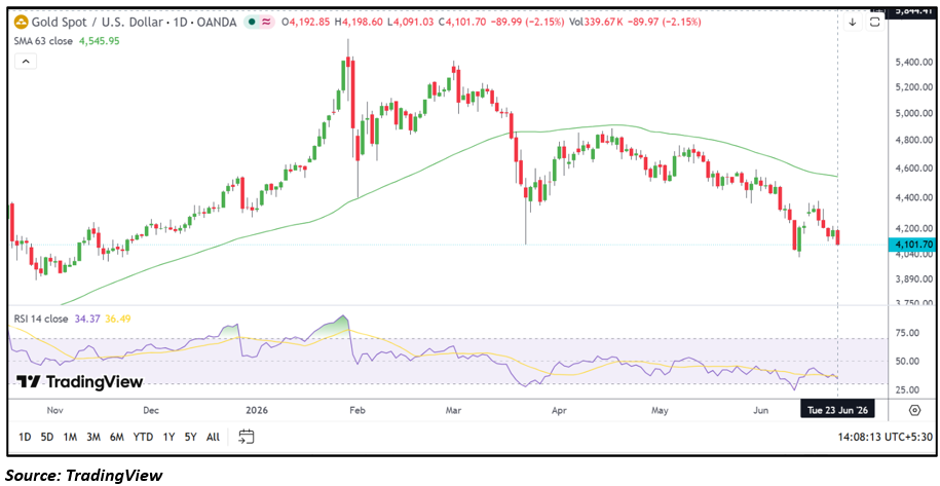
From a technical standpoint, gold continues to exhibit a weak price structure. The metal remains below its longer-term trend average, highlighting that the broader trend remains under pressure despite intermittent recovery attempts.
Recent rebounds have failed to establish sustained upside momentum, indicating that sellers continue to dominate market activity. Momentum indicators remain subdued, reflecting cautious sentiment among traders. Unless gold can reclaim key overhead zones and attract stronger buying participation, the prevailing trend remains vulnerable to further downside movement.
Key Technical Levels to Monitor
Gold is trading near $4,101.70 after extending its recent decline and remaining below its longer-term trend structure. Immediate support is seen around $4,050.00, a zone that has attracted buying interest during recent sessions. A break below this area could expose the metal to further weakness toward $3,950.00, which represents the next significant demand region visible on the chart.
On the upside, initial resistance is positioned near $4,250.00, where previous recovery attempts have faced selling pressure. A sustained move above this level could open the door for a test of $4,450.00, a broader resistance zone that aligns with earlier consolidation activity. The price reaction around these levels may provide important clues regarding the next directional move in gold.
Market Outlook
The near-term outlook for gold remains closely tied to developments in monetary policy, inflation expectations, Treasury yields, and currency markets. While geopolitical developments may occasionally provide support, investors currently appear more focused on interest-rate expectations and dollar strength.
Unless markets begin pricing in a more accommodative policy environment, gold may continue facing challenges in regaining upward momentum.
Risks to Watch
- Federal Reserve policy signals and interest-rate expectations.
- U.S. inflation and economic growth data.
- Movements in the U.S. Dollar Index.
- Treasury yield fluctuations.
- Developments in Middle East diplomatic negotiations.
- Changes in global risk appetite and safe-haven demand.
FAQ
Why are gold prices falling today?
Gold prices are under pressure due to a stronger U.S. dollar, rising expectations of higher interest rates, and reduced safe-haven demand amid improving geopolitical sentiment.
How do higher interest rates affect gold?
Higher interest rates increase the opportunity cost of holding non-yielding assets such as gold, making interest-bearing investments relatively more attractive.
Why does dollar strength hurt gold prices?
A stronger dollar makes gold more expensive for international buyers, which can reduce demand and weigh on prices.
Are geopolitical tensions still supporting gold?
While geopolitical developments continue to influence sentiment, recent diplomatic progress has reduced some of the safe-haven demand that previously supported bullion prices.
What are traders watching next?
Investors are closely monitoring inflation data, Federal Reserve commentary, Treasury yields, and U.S. dollar movements for clues about the future direction of gold prices.