

Highlights
- WTI crude oil remained under pressure as Middle East supply continued to recover.
- Normalization of shipping through the Strait of Hormuz improved supply expectations.
- Expectations of higher Iranian crude exports added to market supply.
- Lower U.S. crude inventories failed to offset bearish market sentiment.
- Traders continued to monitor geopolitical developments and global supply trends.
Overview
WTI crude oil extended its recent decline on Thursday as improving supply conditions across the Middle East outweighed supportive demand indicators. Prices slipped toward levels last seen before the recent geopolitical tensions, reflecting easing concerns over supply disruptions. As supply expectations improved, market participants shifted their focus from geopolitical risks to the prospect of increased crude availability in the global market.
Recovery in Middle East Supply Reduces Risk Premium
The biggest factor weighing on crude oil prices has been the steady normalization of supply from the Middle East. Shipping activity through the Strait of Hormuz has continued to improve, allowing crude exports to reach international markets more efficiently. As concerns over prolonged supply disruptions fade, the geopolitical premium that had supported oil prices in recent weeks has gradually disappeared.
Higher Export Expectations Improve Global Supply Outlook
Expectations of rising crude exports from the region have further strengthened the market's supply outlook. Additional barrels entering international markets have eased concerns about near-term shortages and encouraged traders to reassess previous supply risk assumptions. The improving availability of crude has become the dominant driver behind the recent weakness in oil prices.
Inventory Tightness Takes a Back Seat
Although U.S. crude inventories declined to one of their lowest levels in decades, the market paid limited attention to the supportive inventory data. Investors instead focused on the broader global supply picture, believing that improving export flows from the Middle East would more than offset tighter domestic stock levels. This shift in market focus has kept downward pressure on oil prices despite favourable inventory trends.
Technical Perspective: Downtrend Remains Intact Despite Intraday Stability
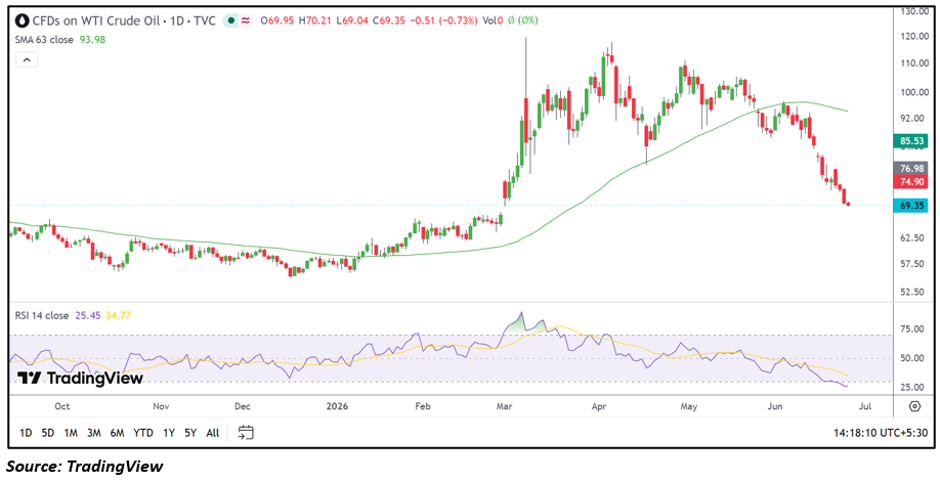
From a technical perspective, WTI crude oil continues to trade within a weak short-term trend after breaking below several important support zones during recent sessions. The commodity is currently trading near $69.58 per barrel while remaining below its 63-day Simple Moving Average, indicating that the broader trend continues to favour sellers. Momentum indicators remain subdued, suggesting buying interest has yet to return in a meaningful way. Although prices have attempted to stabilize after the recent decline, stronger bullish confirmation will be required before the market can establish a sustained recovery.
Key Technical Levels
WTI crude oil is currently trading around $69.58 per barrel. Immediate support is positioned near $67.85, with the next important support located around $66.10. On the upside, the first resistance is seen near $71.32, while a stronger resistance zone is located around $73.06. Holding above immediate support could help stabilize price action, whereas a move below support may extend the current corrective trend.
Market Outlook
The near-term outlook for WTI crude oil will continue to depend on supply developments across the Middle East, export activity, and broader global demand expectations. Traders will also monitor economic data, inventory reports, and geopolitical developments for fresh market direction. Until supply concerns re-emerge or demand expectations improve, crude oil prices may continue to experience elevated volatility.
Risks to Watch
- Recovery in Middle East crude supply.
- Changes in regional export flows.
- Weekly U.S. inventory data.
- Global economic growth expectations.
- Fresh geopolitical developments affecting energy markets.
FAQ
Q: Why are WTI crude oil prices falling today?
A: Improving supply conditions across the Middle East and expectations of higher crude exports have reduced supply concerns, weighing on oil prices.
Q: Why is the Strait of Hormuz important for crude oil?
A: The Strait of Hormuz is one of the world's most important oil shipping routes, and smoother traffic through the passage improves global crude supply.
Q: Why didn't lower U.S. crude inventories support prices?
A: Investors focused more on improving global supply conditions than domestic inventory data, limiting the positive impact of lower stockpiles.
Q: What could influence crude oil prices next?
A: Supply developments, export activity, inventory reports, global demand expectations, and geopolitical events will remain the key drivers.
Q: What technical levels should traders watch?
A: Immediate support is located near $67.85 and $66.10, while resistance is positioned around $71.32 and $73.06.