

Highlights
- Gold remained under pressure as the U.S. dollar stayed firm and Treasury yields remained elevated.
- Expectations of higher U.S. interest rates continued to weigh on the precious metal.
- Reports of upcoming U.S.-Iran talks in Oman reduced immediate safe-haven demand.
- Investors remained focused on Federal Reserve policy and geopolitical developments.
- Gold traded near $4,072.46 per ounce after extending its recent weakness.
Overview
Gold prices remained under pressure as investors assessed the combined impact of a stronger U.S. dollar, elevated Treasury yields, and renewed diplomatic efforts between the United States and Iran. While geopolitical tensions usually support safe-haven assets, expectations that both countries could return to negotiations reduced immediate demand for bullion. At the same time, markets continued to factor in a higher-for-longer interest rate environment, limiting gold's recovery attempts.
Why Is a Stronger Dollar Limiting Gold's Recovery?
The primary driver behind gold's recent weakness remains the strength of the U.S. dollar following resilient economic data and expectations that the Federal Reserve could maintain restrictive monetary policy for longer. Higher interest rates increase the attractiveness of interest-bearing assets while raising the opportunity cost of holding non-yielding assets such as gold. As a result, investors have continued to favour the dollar, keeping pressure on precious metals despite ongoing geopolitical uncertainty.
How Are U.S.-Iran Talks Influencing Market Sentiment?
Market participants are also closely monitoring developments surrounding the United States and Iran after reports suggested both countries are preparing for another round of discussions in Oman. The possibility of renewed diplomatic engagement has eased concerns over a prolonged disruption in the Middle East and reduced immediate demand for safe-haven assets. However, investors remain cautious, as any setback in negotiations or renewed military escalation could quickly shift market sentiment and increase volatility across commodity markets.
Technical Analysis
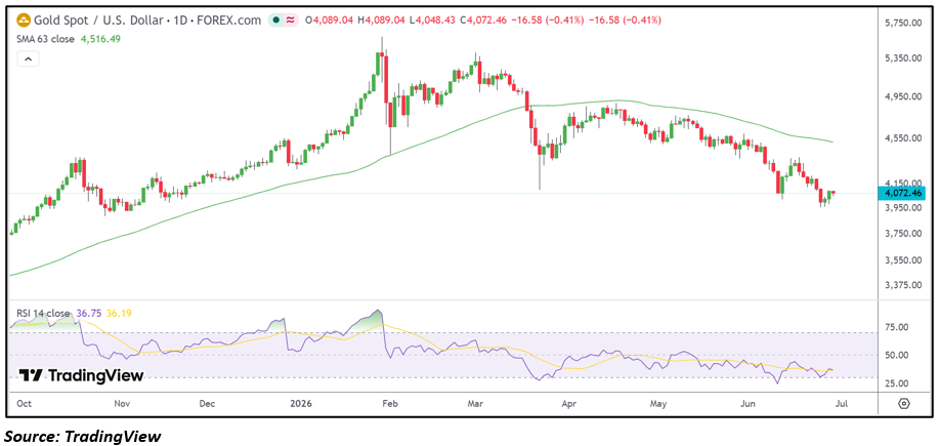
Gold continues to trade within a weak technical structure after extending its recent decline. The metal remains below its 63-day Simple Moving Average near $4,516.49, indicating that the broader trend continues to favour the downside. Price action has consistently formed lower highs and lower lows over recent sessions, reflecting persistent selling pressure. Meanwhile, the 14-day Relative Strength Index (RSI) is positioned near 36.75, remaining below its average and indicating that bearish momentum continues to dominate, although the indicator is gradually approaching oversold territory. Unless gold reclaims levels above its long-term moving average, any short-term recovery could continue to face resistance.
Key Technical Levels
Gold is currently trading around $4,072.46. Immediate support is placed near $3,970.65, while the next important downside level is seen around $3,868.84. On the upside, the first resistance is positioned near $4,174.27, followed by the next resistance around $4,276.08. Holding above the immediate support zone could help stabilize short-term price action, while a decisive move above resistance may improve market sentiment. Conversely, a break below support could expose gold to additional downside pressure.
Conclusion
Gold remains caught between macroeconomic headwinds and geopolitical developments. While renewed diplomatic efforts between the United States and Iran have reduced immediate safe-haven demand, expectations of elevated U.S. interest rates and continued dollar strength remain the dominant factors influencing price action. Investors are expected to closely monitor upcoming economic data, Federal Reserve commentary, and geopolitical developments for the next major directional move.
FAQ
Q: Why are gold prices falling today?
A: Gold prices are under pressure due to a stronger U.S. dollar, elevated Treasury yields, expectations of prolonged higher interest rates, and easing safe-haven demand following reports of renewed U.S.-Iran negotiations.
Q: How do higher U.S. interest rates affect gold?
A: Higher interest rates increase the opportunity cost of holding gold because it does not generate income, making yield-bearing assets more attractive to investors.
Q: Why are U.S.-Iran talks important for gold prices?
A: Progress in diplomatic negotiations could reduce geopolitical uncertainty and weaken safe-haven demand for gold, while renewed tensions could support bullion prices.