

Highlights
- Crude oil prices surged more than 4% following fresh military strikes in the Middle East.
- OPEC+ approved another production increase for July, but supply concerns continue to dominate market sentiment.
- Uncertainty surrounding shipping routes through the Strait of Hormuz remains a major driver of price volatility.
Fresh Escalation Sparks New Oil Rally
Crude oil prices moved sharply higher after renewed military action in the Middle East raised fears of prolonged supply disruptions. The latest escalation involving strikes on energy and military infrastructure reignited concerns about the security of regional oil exports, pushing both Brent and WTI benchmarks significantly higher.
The rally came despite recent hopes that geopolitical tensions could ease. Instead, fresh developments have increased uncertainty around global energy supplies, prompting traders to price in a higher risk premium.
OPEC+ Adds Supply but Market Focus Remains Elsewhere
OPEC+ approved another production increase for July, extending its recent strategy of gradually restoring output. The latest increase adds 188,000 barrels per day to collective production targets and follows several earlier supply adjustments announced this year.
Ordinarily, additional production would help ease concerns about tight supplies and place downward pressure on prices. However, market participants remain focused on whether those barrels can reach global consumers given ongoing disruptions affecting key export routes.
As a result, the latest OPEC+ decision has had limited impact on easing bullish sentiment across the oil market.
Strait of Hormuz Remains the Biggest Concern
The Strait of Hormuz continues to be the most critical factor influencing crude prices. The waterway is one of the world's most important energy shipping corridors, handling a significant share of global crude oil and liquefied natural gas exports.
Restrictions on tanker movements and uncertainty surrounding future transit conditions have created concerns that global supplies could remain constrained even if producers increase output. Traders are closely monitoring developments in the region, as any prolonged disruption could significantly alter supply-demand balances.
The market's focus has shifted from production capacity to actual delivery capability, making shipping risks a central theme for oil prices.
Supply Risks Outweigh Demand Concerns
While higher oil prices often raise concerns about weaker demand, current market dynamics are being driven primarily by supply-side risks. Geopolitical tensions, shipping bottlenecks, and uncertainty regarding future export flows have overshadowed broader economic concerns.
Several producing nations have indicated their willingness to increase output, but logistical challenges continue to limit the market's confidence that additional supplies will reach consumers quickly enough to offset potential shortages.
This supply uncertainty has helped support crude prices despite expectations of increased production.
Inflation Fears Return to the Spotlight
The latest rise in crude prices has also renewed concerns about inflation. Energy costs remain a key component of global inflation trends, and sustained increases in oil prices could complicate efforts by central banks to manage price stability.
Higher energy prices may increase transportation and manufacturing costs, potentially feeding into broader consumer inflation. This has implications not only for commodity markets but also for interest-rate expectations and overall financial market sentiment.
Technical Picture Remains Mixed
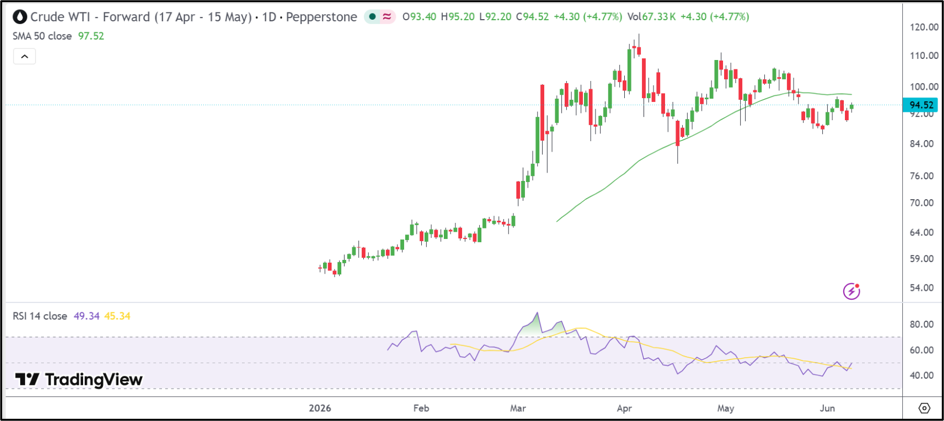
WTI crude oil is trading near 94.52, slightly below its 50-day simple moving average of 97.52, indicating that the market remains in a consolidation phase despite the recent rebound.
The 14-day RSI stands near 49.34, suggesting neutral momentum. While the latest rally highlights renewed buying activity, a decisive move above key resistance levels would be needed to confirm a stronger bullish trend.
Key Technical Levels
WTI crude oil is currently trading around 94.52. Immediate support is seen near 89.79 and 84.97, while upside hurdles are positioned around 99.25 and 104.07. A sustained move above resistance could strengthen bullish momentum, while a break below support may expose the market to renewed selling pressure.
Source: TradingView
Key Risks
- Further escalation of Middle East conflicts.
- Extended disruptions in the Strait of Hormuz.
- Slower-than-expected global demand growth.
- Unexpected increases in crude production from major exporters.
Summary
Oil prices have moved higher despite another OPEC+ production increase as traders remain focused on geopolitical risks and supply disruptions. Concerns surrounding the Strait of Hormuz, renewed military tensions, and uncertainty over global energy flows continue to outweigh the impact of additional planned output. With supply security remaining the dominant theme, crude oil is likely to remain highly sensitive to developments across the Middle East.
FAQs
Why are oil prices rising despite OPEC+ increasing production?
Markets remain concerned about supply disruptions and shipping restrictions in the Middle East, which could limit the impact of higher production.
Why is the Strait of Hormuz important for oil prices?
The Strait of Hormuz is a critical global energy shipping route through which a large portion of the world's oil exports pass.
What is the outlook for crude oil prices?
Future price direction will depend largely on geopolitical developments, shipping conditions, and whether additional OPEC+ supply reaches global markets.