

Key Highlights
- S.-Iran peace talks collapsed over the weekend, increasing fears of fresh supply disruptions.
- Concerns are rising that any disruption in the Strait of Hormuz could affect nearly 20.00% of global oil supply.
- Brent crude moved above USD 100.00 per barrel following the renewed Middle East tensions.
- WTI crude also crossed USD 100.00 amid concerns around tighter global supplies.
- Oil prices gained more than 00% in early trade after the announcement of a blockade of Iranian ports.
- A geopolitical premium has started to return to crude after last week’s steep decline.
- Analysts have begun revising higher their 2026 oil price forecasts due to the ongoing conflict.
- Higher crude prices are increasing worries around inflation, transport costs and global economic growth.
Oil Prices Surge Above USD 100.00 as U.S.-Iran Tensions Escalate
Global oil prices surged at the start of the week after U.S.-Iran peace talks failed and the U.S. announced a naval blockade around Iranian ports and the Strait of Hormuz. The renewed tensions sharply increased fears of supply disruptions across the Middle East, leading to a strong rebound in crude prices. Brent crude climbed above USD 102.00 per barrel, while WTI crude rose beyond USD 104.00, marking a significant recovery from the previous week’s decline. Markets are particularly concerned because nearly 20.00% of the world’s oil supply moves through the Strait of Hormuz, making it one of the most important shipping routes for global energy markets.
The latest escalation has restored a geopolitical premium in oil prices, with investors increasingly worried that the conflict could spread further or affect shipping and production facilities across the Gulf region. Concerns are also rising that Iran could respond by disrupting oil flows or targeting infrastructure, which may place additional pressure on global supplies. Higher oil prices are now adding to worries around inflation, transport costs and slower economic growth, particularly for oil-importing countries. Analysts believe crude may remain volatile in the coming sessions as markets continue to monitor further developments in the Middle East.
Technical View: Brent Crude Holds Above 50-Day SMA While Testing Near-Term Support; Is Momentum Still Intact?
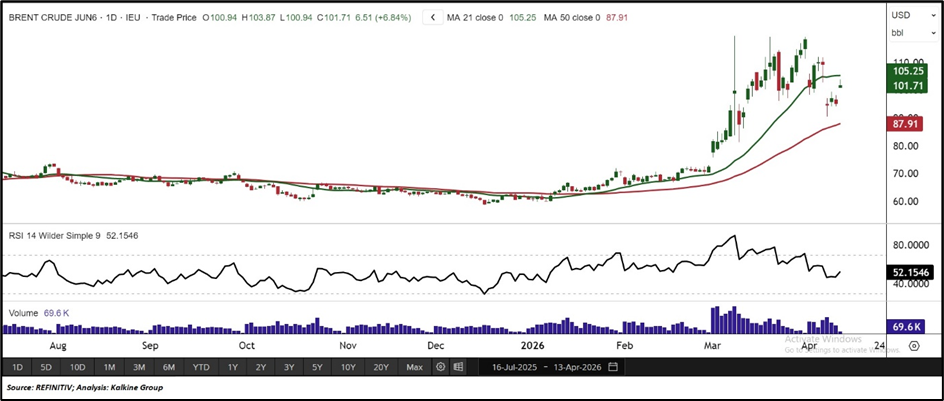
From a technical perspective, Brent Crude June 2026 futures are trading near USD 101.71 per barrel, up around 6.84%, and continue to remain above the 50-day SMA near USD 87.91, indicating that the broader upward structure remains intact. However, prices have slipped below the 21-day SMA near USD 105.25, suggesting that near-term momentum has moderated following the recent rally. The chart continues to show a pattern of higher lows, while the 14-day RSI near 52.15 points to balanced momentum with room for further upside. Immediate support is placed in the USD 100.00–92.00 zone, while resistance is seen near the USD 115.00–125.00 range.
Summary
Brent crude has rebounded sharply after the collapse of U.S.-Iran peace talks and the announcement of a U.S. naval blockade around Iranian ports and the Strait of Hormuz. The move pushed Brent above USD 100.00 per barrel and revived concerns around global oil supplies, inflation and economic growth. From a technical perspective, Brent continues to hold above its 50-day SMA, keeping the broader structure constructive despite some moderation in near-term momentum below the 21-day SMA. As long as geopolitical tensions remain elevated, crude prices are likely to stay volatile.
FAQs
- Why did Brent crude rise more than 7.00%?
Brent crude moved sharply higher after U.S.-Iran peace talks failed and the U.S. announced a blockade around Iranian ports and the Strait of Hormuz, increasing fears of tighter global oil supplies. - Why is the Strait of Hormuz important for oil prices?
The Strait of Hormuz is one of the world’s most important oil shipping routes, with nearly 20.00% of global crude supply passing through it. Any disruption can significantly affect global energy prices. - What are the key levels to watch in Brent crude?
Brent crude continues to hold above the 50-day SMA near USD 87.91. The immediate support zone is seen between USD 100.00 and USD 92.00, while the next hurdle remains in the USD 115.00–125.00 range.