

Key Highlights
- S. farmers plan to plant 84.7 million acres of soybeans in 2026, up from 81.2 million acres last year.
- Corn acreage is expected to fall to 95.3 million acres, down sharply from nearly 98.8 million acres in 2025.
- Higher fertilizer and fuel prices are pushing growers toward soybeans, which require less nitrogen than corn and wheat.
- The Iran conflict has disrupted Gulf fertilizer supplies, raising production costs across the farm sector.
- Soybean futures moved higher after acreage estimates came in below market expectations, suggesting tighter supplies.
- Wheat acreage dropped to its lowest level in more than a century, as expensive fertilizer also hurt wheat planting.
- Farm profitability remains under pressure, with weak crop prices and lower expected farm income in 2026.
Soybeans Gain Momentum as Farmers Cut Corn Planting Plans
Soybeans emerged as one of the strongest-performing agricultural commodities, with prices rising nearly 11% over the past three months as U.S. farmers planned to expand soybean acreage while reducing corn planting. Farmers now intend to plant 84.7 million acres of soybeans in 2026, up from 81.2 million acres last year. The shift comes as the Iran conflict has driven up fertilizer and diesel costs, making soybeans more attractive because they require less nitrogen than corn and wheat. The market also gained support from expectations that more corn acreage could switch to soybeans if input costs remain elevated through the spring.
The soybean market also received support because acreage expectations still came in below what traders had anticipated. Analysts had expected even larger soybean plantings, and the lower estimate helped lift soybean prices. Market participants now believe that additional corn acreage could shift into soybeans later this spring if fertilizer and fuel costs remain elevated. However, the sector continues to face challenges from weak Chinese demand, soft grain prices and pressure on farm incomes. Even so, the combination of smaller projected corn acreage and rising soybean plantings is beginning to reshape expectations for the 2026 U.S. crop season.
Technical View: Soybean Momentum Picking Up as Price Keeps Above 50-Day SMA
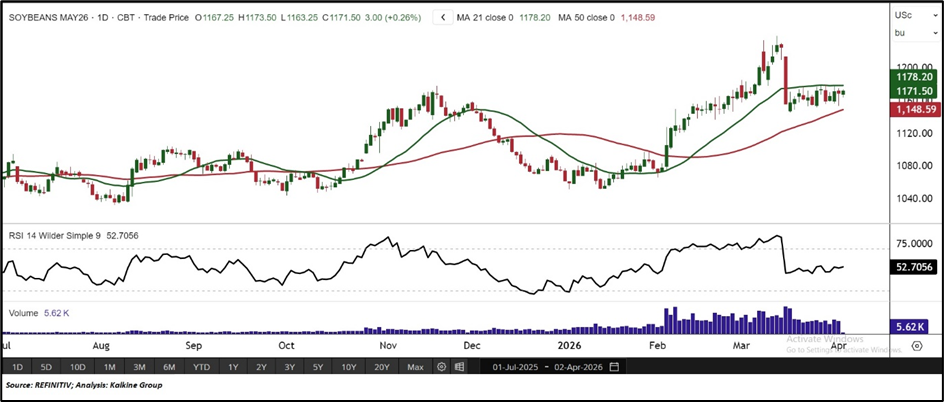
From a technical perspective, Soybeans May 2026 futures are trading near 1,171.50 US cents per bushel, up around 0.26%, and continue to hold above the 50-day SMA near 1,148.59, indicating the broader uptrend remains intact. However, prices are still slightly below the 21-day SMA near Usc 1,178.20, suggesting near-term momentum has moderated after the sharp rally in March. The chart continues to show a pattern of higher lows, while the 14-day RSI near 52.71 points to balanced momentum with room for further gains. Immediate support is placed in the Usc 1,100.00– Usc 1,040.00 zone, while resistance is seen near Usc 1,250.00– Usc 1,400.00.
Bottom Line: Soybeans Stay Supported as Higher Costs Shift Planting Away from Corn
Soybean prices remain supported as rising fertilizer and fuel costs continue to push U.S. farmers away from corn and toward soybeans. If futures hold above the 50-day SMA near Usc 1,148.00, the market could gradually move toward the Usc 1,250.00-resistance zone.