

Highlights
- Gold prices are on track for a third straight weekly decline.
- Higher interest-rate expectations have reduced the appeal of non-yielding assets.
- A stronger U.S. dollar continues to pressure bullion demand.
- Traders remain cautious amid uncertainty surrounding future monetary policy.
- Safe-haven buying has weakened despite lingering geopolitical developments.
Overview
Gold prices remained under pressure on Friday, extending recent losses and heading toward a third consecutive weekly decline. The precious metal struggled to maintain momentum as investors focused on a stronger U.S. dollar and expectations that interest rates could remain elevated for a longer period.
While geopolitical developments initially provided support earlier in the week, the broader market focus has shifted toward monetary policy and interest-rate expectations, creating a challenging environment for bullion prices.
Hawkish Monetary Policy Weighs on Sentiment
A key factor behind gold's weakness has been the growing expectation that interest rates may stay higher for longer. Investors have adjusted their outlook following recent policy signals that suggest inflation risks remain a concern.
Higher borrowing costs typically reduce the attractiveness of gold because the metal does not generate interest income. As a result, capital often shifts toward yield-bearing assets during periods of elevated rates.
Strong Dollar Creates Additional Pressure
The continued strength in the U.S. dollar has emerged as another major headwind for gold. Since bullion is priced globally in dollars, a stronger currency makes gold more expensive for international buyers and can limit physical demand.
The recent advance in the dollar has therefore amplified selling pressure across precious metals, contributing to the ongoing decline in prices.
Safe-Haven Demand Loses Momentum
Gold's traditional role as a safe-haven asset has provided limited support in recent sessions. Improving risk sentiment in some areas of the financial markets has reduced the urgency for defensive positioning, allowing investors to shift attention toward other asset classes.
As safe-haven demand moderates and monetary policy concerns dominate market thinking, gold has struggled to attract fresh buying interest.
Gold's Technical Structure Remains Fragile
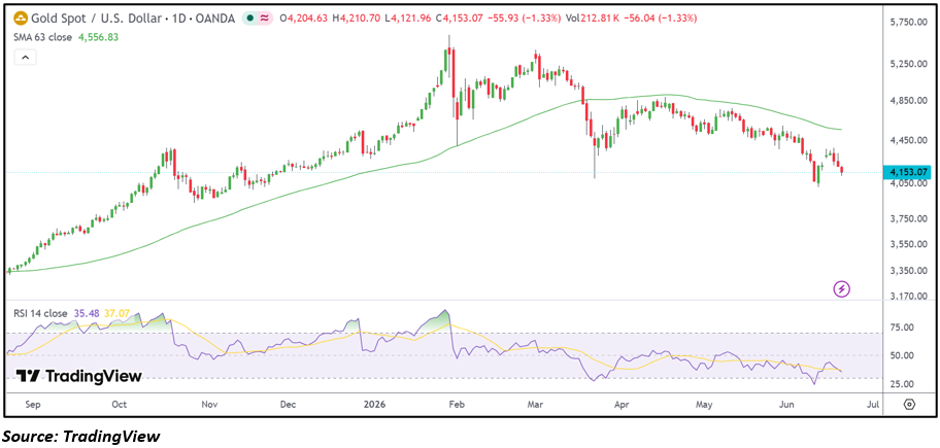
From a chart perspective, gold remains in a corrective phase after failing to sustain its previous upward momentum. The metal has been forming lower highs over recent sessions, indicating that sellers continue to dominate near resistance zones. Price action has also remained below recent swing highs, reflecting weakening bullish momentum and a cautious trading environment. While gold continues to hold above key longer-term trend areas, the inability to generate a strong recovery suggests that traders remain focused on downside risks until a clear breakout signal emerges.
Key Technical Levels
Based on the current price near 4,153.07, immediate support is positioned around 4,049.24, while the next major downside zone is located near 3,945.42. On the upside, resistance is seen around 4,256.90, followed by a stronger barrier near 4,360.72. A sustained move above these resistance levels could improve sentiment and encourage renewed buying activity, whereas a break below support zones may lead to further weakness in the near term.
Market Outlook
The near-term outlook for gold remains closely tied to interest-rate expectations, inflation trends, and currency movements. If markets continue to anticipate elevated borrowing costs and a firm dollar, bullion may face challenges in building sustained upward momentum. However, any shift in policy expectations or renewed safe-haven demand could provide support and help stabilize prices.
Risks to Watch
- Further strengthening of the U.S. dollar.
- Higher-than-expected inflation readings.
- Additional increases in bond yields.
- Changes in monetary policy expectations.
- Shifts in global safe-haven demand trends.
FAQ
Why are gold prices falling today?
Gold prices are under pressure due to higher interest-rate expectations and a stronger U.S. dollar, both of which reduce the attractiveness of bullion.
How do interest rates affect gold?
Higher interest rates increase the opportunity cost of holding non-yielding assets such as gold, often leading investors to Favor income-generating investments.
Why does a stronger dollar impact gold prices?
A stronger dollar makes gold more expensive for international buyers, which can reduce demand and pressure prices.
Is gold still considered a safe-haven asset?
Yes, gold remains a widely recognized safe-haven asset, although short-term price movements are often influenced by monetary policy and currency trends.
What are the important levels traders are watching?
Immediate support is near 4,049.24 and 3,945.42, while resistance is around 4,256.90 and 4,360.72.