

Highlights
- Gold slipped to its lowest level in more than six months despite escalating tensions between the United States and Iran.
- Rising oil prices have increased inflation concerns, leading markets to reassess the outlook for US interest rates.
- Traders are closely monitoring upcoming economic data for clues on the Federal Reserve's next move.
Why Has Gold Fallen to a Six-Month Low?
Gold prices have come under heavy pressure and recently touched their lowest levels in more than six months, surprising many investors given the heightened geopolitical tensions in the Middle East. Traditionally, gold benefits during periods of uncertainty as investors seek safer assets. However, the current market environment has shifted attention away from safe-haven demand and toward inflation expectations and monetary policy concerns.
Recent military developments involving the United States and Iran have intensified uncertainty across global markets. Yet instead of supporting gold prices, the conflict has driven oil prices sharply higher, creating concerns that inflation could remain elevated for longer. As a result, investors are increasingly focusing on the possibility of tighter monetary policy rather than geopolitical risk alone.
How Are Iran Tensions Influencing Commodity Markets?
The conflict between the United States and Iran has become a major driver of commodity market volatility. Fresh military strikes, ongoing threats of further escalation, and disruptions surrounding the Strait of Hormuz have significantly affected energy markets.
The Strait of Hormuz remains one of the world's most critical energy transit routes. Any disruption to shipping activity raises concerns about global oil supply shortages. Crude oil prices have therefore surged, creating a ripple effect across financial markets.
While geopolitical tensions would normally increase demand for gold, the accompanying surge in energy prices has shifted investor focus toward inflation risks. This unusual dynamic explains why gold has struggled even as uncertainty remains elevated.
Why Are Inflation Concerns Becoming More Important Than Safe-Haven Demand?
One of the biggest reasons behind gold's weakness is the growing concern that higher oil prices could fuel broader inflationary pressures.
Recent US inflation data showed consumer prices rising at the fastest annual pace in roughly three years. Energy costs accounted for a significant portion of the increase, reinforcing fears that inflation could remain stubbornly high.
When inflation remains elevated, central banks often maintain restrictive monetary policies to prevent prices from accelerating further. Investors are therefore becoming increasingly concerned that the Federal Reserve may keep interest rates higher for longer than previously expected.
This shift in expectations has become a major obstacle for gold.
What Role Is the Federal Reserve Playing in Gold's Decline?
Interest rates remain one of the most important drivers of gold prices. Because gold does not generate interest income, it tends to become less attractive when interest rates rise.
Following the latest inflation data, markets have reduced expectations for aggressive rate cuts while increasing the probability that policymakers could maintain a restrictive stance for an extended period.
Higher rates generally strengthen bond yields and improve returns on interest-bearing assets. This often encourages investors to shift capital away from precious metals and toward fixed-income investments.
As a result, even though geopolitical uncertainty remains elevated, concerns surrounding future monetary policy have weighed heavily on gold prices.
How Is the US Dollar Adding Pressure on Bullion?
The US dollar has remained relatively firm as investors seek stability amid economic and geopolitical uncertainty. A stronger dollar often creates additional pressure on gold because bullion becomes more expensive for international buyers.
Dollar strength, combined with elevated Treasury yields, has created a challenging environment for precious metals. This relationship has been particularly evident during the recent sell-off, where safe-haven demand has largely flowed into dollar-denominated assets instead of gold.
Until the dollar weakens or interest-rate expectations soften, bullion may continue to face headwinds.
What Does the Technical Setup Suggest for Gold?
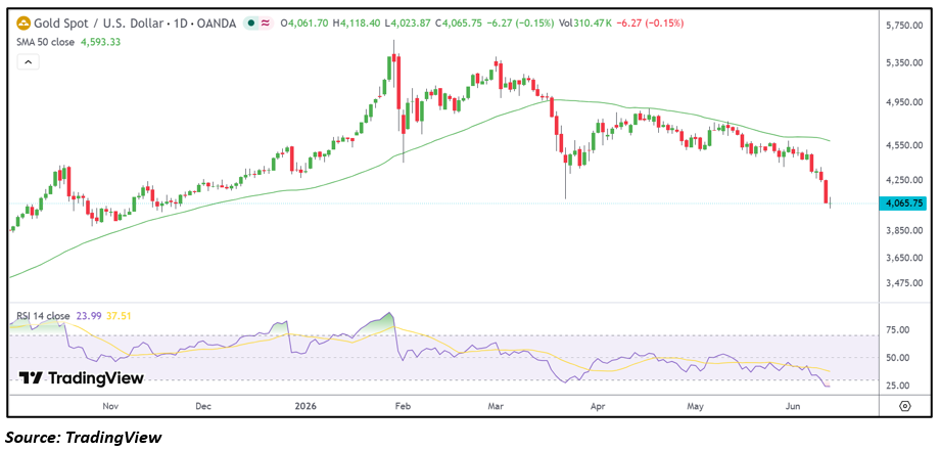
Gold is currently trading near 4,065.75 and remains significantly below its 50-day SMA of 4,593.33. The broader technical structure reflects persistent weakness following a breakdown from previous consolidation zones.
The recent decline has pushed prices to levels not seen in over six months, highlighting the strength of the prevailing downward trend. Market participants are closely watching whether support zones can stabilize the current sell-off or if additional downside pressure emerges.
Is Momentum Signaling an Oversold Condition?
Momentum indicators suggest that gold may be entering an oversold phase. The RSI currently stands near 23.99, reflecting intense selling pressure over recent sessions.
Historically, such readings can indicate that bearish momentum has become stretched in the short term. While oversold conditions do not guarantee an immediate recovery, they can increase the likelihood of temporary rebounds or periods of consolidation.
Investors will likely monitor whether buyers begin returning near current levels or if broader macroeconomic concerns continue driving prices lower.
Which Price Levels Could Influence Gold's Next Move?
From a technical perspective, immediate support is positioned near 3,964.11, while a deeper support zone is located around 3,862.46. On the upside, resistance is seen near 4,167.39. If gold manages to reclaim this level, the next resistance area could emerge around 4,269.04. These levels are likely to remain important reference points as traders assess future developments in inflation, interest rates, and geopolitical tensions.
Key Risks
- Further escalation between the United States and Iran could trigger additional volatility across commodity markets.
- Sustained increases in oil prices may reinforce inflation pressures and strengthen expectations for restrictive monetary policy.
- Stronger-than-expected US inflation data could increase the likelihood of higher interest rates.
- Continued strength in the US dollar may limit recovery attempts in gold prices.
- Unexpected changes in Federal Reserve communication could trigger sharp moves in bullion markets.
Conclusion
Gold's slide to a six-month low demonstrates how inflation concerns and interest-rate expectations are currently outweighing traditional safe-haven demand. While tensions between the United States and Iran continue to create uncertainty, investors are focusing more on the inflationary impact of rising energy prices and the possibility of a prolonged restrictive monetary policy environment. Going forward, developments in the Middle East, upcoming US economic data, and Federal Reserve signals will likely remain the key drivers for gold. A moderation in inflation expectations could support a recovery, while persistent price pressures may keep bullion under pressure.
FAQs
Why is gold falling despite rising Iran tensions?
Gold is facing pressure because investors are focusing on inflation and interest-rate expectations rather than geopolitical risk alone. Rising oil prices have increased concerns about higher inflation and tighter monetary policy.
Why do higher interest rates hurt gold prices?
Gold does not generate income. When interest rates rise, investors often prefer interest-bearing assets such as bonds, reducing the attractiveness of holding gold.
What are the key support and resistance levels for gold?
Immediate support is located near 3,964.11, followed by a stronger support zone around 3,862.46. Resistance is positioned near 4,167.39, with the next hurdle around 4,269.04.
What should gold investors monitor next?
Investors should closely watch developments involving Iran, movements in oil prices, upcoming US inflation data, and signals from the Federal Reserve regarding future interest-rate policy.