

Highlights
- Nifty IT declined sharply as investors reassessed the long-term impact of artificial intelligence on traditional IT services.
- Heavyweights including Infosys, TCS, and HCLTech were among the biggest contributors to the sector's weakness.
- Concerns around automation, pricing pressure, and future revenue visibility continue to weigh on sentiment.
Why Is Nifty IT Under Pressure?
The Nifty IT index came under significant selling pressure as concerns surrounding artificial intelligence resurfaced across the technology sector. Investors are increasingly evaluating how generative AI and automation could reshape traditional outsourcing, software development, testing, and maintenance services that have historically driven growth for Indian IT companies.
The latest decline reflects growing uncertainty about whether AI will create enough new opportunities to offset potential disruption in legacy service lines. As a result, technology stocks emerged among the weakest performers in the broader market.
Why Are Large IT Companies Leading the Decline?
Large-cap IT stocks including Infosys, TCS, and HCLTech were among the biggest drags on the index. These companies generate substantial revenue from global enterprises that are actively exploring AI-driven productivity improvements.
While most IT firms are investing aggressively in artificial intelligence capabilities, investors remain focused on how quickly these investments can translate into meaningful revenue growth. The market is also evaluating whether AI tools could reduce demand for certain labour-intensive services that have historically supported profitability.
This uncertainty has contributed to cautious sentiment across the sector.
Is AI a Threat or an Opportunity for IT Companies?
Artificial intelligence presents both opportunities and challenges for the industry. On one hand, enterprises are expected to increase spending on AI consulting, implementation, cloud infrastructure, cybersecurity, and digital transformation projects.
On the other hand, AI-driven automation may reduce the need for some traditional service offerings. The market is currently attempting to determine which effect will dominate over the coming years.
Many leading IT companies have already announced partnerships, internal AI deployments, and industry-specific solutions. However, investors are seeking clearer evidence of large-scale monetization before assigning higher valuations to the sector.
How Are Global Technology Spending Trends Affecting Sentiment?
Apart from AI concerns, investors continue to monitor global technology spending. Enterprises remain selective in discretionary spending decisions as they balance economic uncertainty with the need for digital transformation.
Many companies are prioritizing efficiency-focused projects over large-scale technology upgrades. This environment has created a more competitive landscape for IT service providers and increased pressure on margins.
The combination of AI-related uncertainty and cautious client spending has contributed to recent weakness in technology stocks.
What Does the Technical Structure Indicate?
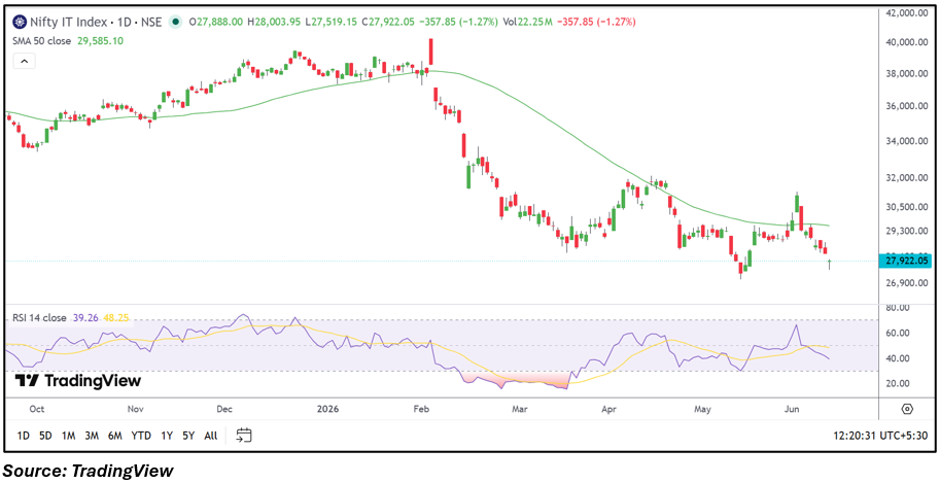
The Nifty IT index is currently trading near 27,950.80, significantly below its 50-day SMA of 29,585.68. The broader trend remains weak as the index continues to trade below a declining moving average structure.
Recent rallies have struggled to sustain momentum, indicating that investors remain cautious despite periodic recovery attempts. The inability to reclaim key higher levels has kept the overall technical picture under pressure.
How Is Momentum Looking?
The RSI is currently near 39.45, suggesting weak momentum but not yet entering deeply oversold territory. The indicator reflects persistent selling pressure, although it also indicates that the pace of the decline has moderated compared with earlier phases of the correction.
Investors will watch for signs of stabilization in both price action and momentum indicators before turning more constructive on the sector.
Key Technical Levels
From a technical perspective, immediate support is positioned near 27,251.03, while a stronger downside support zone is located around 26,553.26. On the upside, resistance is seen near 28,649.57, followed by a higher hurdle around 29,348.34. These levels may remain important as investors assess sector sentiment and the evolving impact of artificial intelligence on technology businesses.
Key Risks
- Slower monetization of AI investments.
- Reduced demand for traditional outsourcing services.
- Weak global technology spending.
- Margin pressure from increased AI-related investments.
- Intensifying competition in enterprise AI solutions.
Final Take
The latest decline in Nifty IT highlights growing investor concern about how artificial intelligence could reshape the industry's long-term growth model. While AI creates substantial opportunities in consulting, automation, cloud services, and enterprise transformation, the market remains uncertain about the balance between new revenue streams and disruption to existing business lines. Until investors gain greater visibility into AI-driven earnings growth, sentiment toward the sector may remain cautious despite continued technological innovation.
FAQs
Why is Nifty IT falling today?
Nifty IT is falling due to concerns that artificial intelligence could disrupt traditional IT services and create uncertainty around future revenue growth.
Which stocks are leading the decline?
Infosys, TCS, and HCLTech were among the major contributors to the sector's weakness.
Is AI bad for the IT sector?
Not necessarily. AI creates new business opportunities, but investors are currently evaluating whether those opportunities can offset disruption to traditional service offerings.
What are the important levels for Nifty IT?
Support levels are near 27,251.03 and 26,553.26, while resistance levels are positioned around 28,649.57 and 29,348.34.