

Highlights
- USD/INR remains near the 95 level despite policy stability and central bank support measures.
• Rising crude oil prices and geopolitical tensions continue to pressure the Indian Rupee.
• Central bank intervention has helped contain excessive volatility but has not reversed the broader trend.
Rupee Faces Persistent External Pressures
The USD/INR pair continues to trade at elevated levels as the Indian Rupee faces a combination of global and domestic challenges. While a stable interest rate environment would typically support currency stability, external factors such as higher energy prices and geopolitical uncertainty have kept demand for the US Dollar relatively strong.
Crude Oil Prices Remain a Key Concern
One of the biggest challenges for the Rupee is the rise in global crude oil prices. As India remains a major importer of crude oil, higher energy costs increase the country's import bill and can widen trade deficits. This often creates additional demand for the US Dollar, placing pressure on the local currency.
Geopolitical Risks Boost Safe-Haven Demand
Ongoing tensions in the Middle East have increased uncertainty across financial markets. During periods of geopolitical stress, investors often shift toward traditionally safer assets, including the US Dollar. This trend has supported the greenback and limited the Rupee's ability to strengthen despite supportive domestic policy measures.
Central Bank Maintains a Balancing Act
The central bank has maintained a cautious policy stance while emphasizing its commitment to preventing disorderly currency movements. Recent measures aimed at improving liquidity and supporting the currency have helped reduce volatility. However, authorities have also indicated that market-driven exchange rate movements will continue to play a role in determining the Rupee's direction.
Capital Flows Continue to Influence Currency Trends
Investor allocation decisions remain another important factor. Global investors have increasingly directed capital toward US markets amid expectations of stronger returns and ongoing economic resilience. This shift has reduced support for emerging-market currencies and contributed to the USD/INR pair remaining near recent highs.
Technical Structure Remains Firm
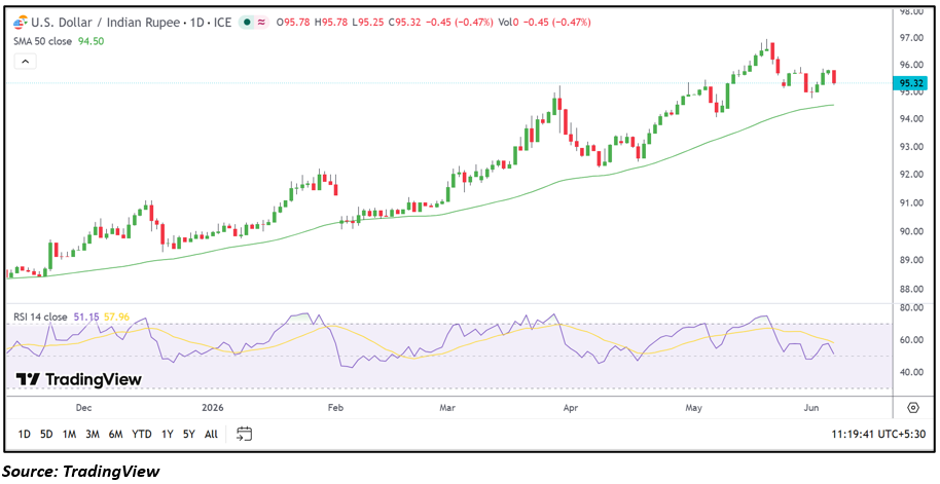
USD/INR is trading near 95.32 and remains above its 50-day Simple Moving Average (SMA) near 94.50, indicating that the broader trend remains constructive. The 14-day RSI is around 51.15, suggesting neutral momentum after recent consolidation.
Key Technical Levels
Immediate support is located near 92.94, followed by a stronger support zone around 90.55.
On the upside, resistance is positioned near 97.70, while a break above this level could open the path toward 100.09.
Key Risks
- Further increases in global crude oil prices.
• Escalation of geopolitical tensions.
• Persistent demand for the US Dollar globally.
• Changes in foreign capital flow trends.
Summary
USD/INR remains elevated despite a stable interest rate environment as external pressures continue to outweigh domestic support factors. Higher crude oil prices, geopolitical uncertainty, and global capital flow dynamics are keeping the Rupee under pressure, while central bank actions are primarily helping to limit volatility rather than reverse the broader trend.
FAQs
Why is USD/INR trading near multi-month highs?
The pair is being supported by higher crude oil prices, geopolitical uncertainty, and stronger demand for the US Dollar.
How is the central bank supporting the Rupee?
Authorities have taken steps to curb excessive volatility and ensure orderly market functioning while allowing market-driven adjustments.
What levels should traders watch?
Support is seen near 92.94 and 90.55, while resistance is located around 97.70 and 100.09.