

Highlights
- Bank Nifty advanced after the central bank kept the repo rate unchanged at 5.25% and maintained a neutral policy stance.
• Stable interest rates are supporting credit growth expectations and banking sector sentiment.
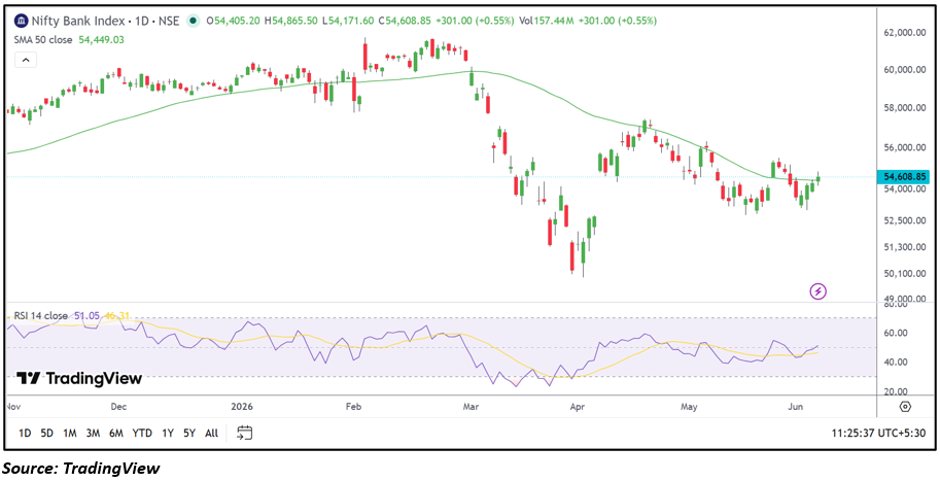
• The index continues to trade above its 50-day SMA, while momentum indicators suggest a gradual improvement in trend strength.
RBI Decision Brings Stability to Banking Stocks
Banking stocks witnessed renewed interest after the central bank left the repo rate unchanged at 5.25% and retained its neutral stance. The decision was largely in line with market expectations and reduced concerns about policy uncertainty. With inflation risks being monitored closely and economic growth remaining resilient, the stable policy environment has provided support to financial sector stocks.
The banking sector generally benefits from policy stability, as it allows lenders to plan credit expansion, deposit mobilization, and capital allocation with greater confidence. Investors appear to be focusing on the improving operating environment rather than anticipating aggressive policy changes in the near term.
Credit Growth Outlook Remains Supportive
A steady rate environment could help sustain lending activity across retail, corporate, and infrastructure segments. Banks have already shown resilience despite global uncertainties, and stable borrowing costs may continue to support loan demand.
Strong balance sheets, improving asset quality, and healthy capitalization levels remain key positives for the sector. These factors have helped banking stocks absorb external volatility more effectively than many other market segments over recent months.
Global Risks Continue to Influence Market Sentiment
While domestic fundamentals remain relatively stable, investors are still monitoring geopolitical developments, crude oil prices, and global capital flows. Any sharp rise in energy costs or deterioration in global risk sentiment could affect financial markets and influence banking sector performance.
Foreign investor activity also remains an important variable. Continued stability in domestic liquidity and institutional participation could help offset periods of overseas selling pressure.
Why the 56,000 Level Matters
The 56,000 regions has emerged as an important psychological and technical hurdle for Bank Nifty. A decisive move above this zone could strengthen bullish sentiment and potentially attract additional momentum-based participation.
At the same time, failure to sustain gains above nearby resistance levels may keep the index confined within a broader consolidation range. Traders are likely to watch upcoming macroeconomic data and sector-specific developments for further direction.
Technical Structure Shows Gradual Improvement
Bank Nifty closed near 54,608.85 and continues to trade above its 50-day Simple Moving Average near 54,449.03, indicating that the broader trend remains constructive. Price action has recovered meaningfully from the March-April lows and is attempting to build a higher-base formation.
The 14-day RSI is near 51.05, suggesting neutral momentum with room for further upside if buying momentum strengthens. The RSI's recovery from lower levels indicates improving market participation without entering overbought territory.
Key Technical Levels
Bank Nifty has immediate support around 53,243.00, followed by a stronger support zone near 51,878.00. Holding above these levels could help maintain the current recovery structure.
On the upside, resistance is placed near 55,974.00, while a stronger breakout zone is visible around 57,339.00. A sustained move above these levels may strengthen the bullish outlook and open the possibility of an extended advance.
Key Risks Investors Should Watch
- Unexpected rise in inflation pressures.
• Sharp increase in crude oil prices.
• Global geopolitical tensions affecting risk sentiment.
• Foreign institutional investor outflows.
• Slower-than-expected credit growth across key segments.
Can Banking Stocks Lead the Next Market Move?
The banking sector remains one of the most influential segments of the Indian equity market. Stable interest rates, improving asset quality, and resilient domestic demand continue to support the sector's medium-term outlook.
If economic activity remains firm and liquidity conditions stay supportive, banking stocks could continue to attract investor attention. However, global uncertainties and commodity price movements remain important variables that could influence sentiment in the coming months.
Bottom Line
Bank Nifty appears to be stabilizing after recent volatility, supported by a steady monetary policy environment and improving technical conditions. While the index faces an important resistance zone near 56,000, supportive domestic fundamentals are helping maintain a constructive outlook. The ability to sustain above key support levels and overcome resistance barriers will likely determine the next major directional move.
FAQs
Why did Bank Nifty react positively to the policy decision?
The market welcomed policy stability, which reduces uncertainty and supports lending growth expectations for banks.
What is the most important resistance level for Bank Nifty?
The immediate resistance is around 55,974, while a stronger hurdle is located near 57,339.
What factors could support further upside?
Stable interest rates, healthy credit demand, improving asset quality, and supportive domestic liquidity conditions could aid the index.