

Highlights
- Debt consolidation can combine multiple repayments into a single monthly obligation.
- A personal loan may reduce repayment complexity for borrowers managing several debts.
- Lower interest costs are not guaranteed and depend on individual borrowing terms.
Debt consolidation refers to combining multiple outstanding debts into a single loan. Instead of managing several repayment schedules, borrowers use one loan to repay existing liabilities and then make a single monthly payment to the new lender.
Personal loans are among the most commonly used tools for debt consolidation because they can be used for a variety of financial purposes, including refinancing existing debt. The approach is often considered by individuals dealing with multiple credit card balances, consumer loans, or other unsecured borrowings.
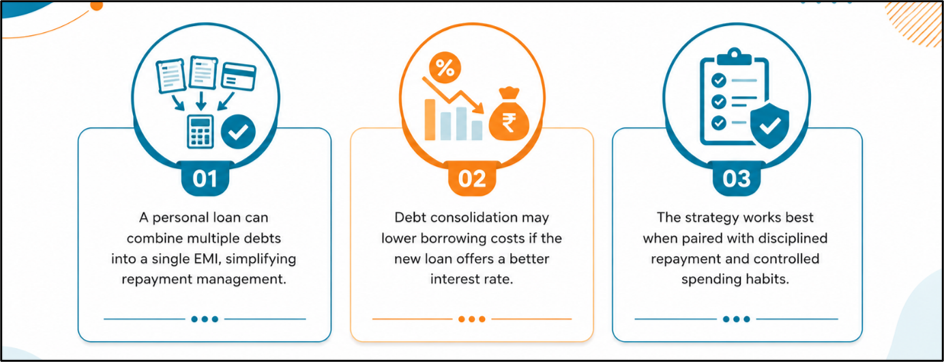 Source: Analysis by Kalkine
How Debt Consolidation Through A Personal Loan Works
Under a debt consolidation strategy, a borrower takes a personal loan and uses the proceeds to repay existing debts. Once those liabilities are cleared, only the personal loan remains outstanding.
For example, an individual carrying balances across multiple credit cards and small loans may replace them with a single personal loan that has one repayment schedule and one interest rate. This can simplify financial management and make monthly obligations easier to track.
Potential Benefits Of Debt Consolidation
Simplified Repayment Structure
Managing several debts often means tracking multiple due dates, lenders, and interest rates. Consolidating these obligations into a single loan can reduce administrative complexity and lower the likelihood of missed payments.
Better Financial Visibility
A single loan account may provide a clearer picture of total outstanding debt. Borrowers can monitor one repayment schedule instead of several separate obligations.
Possibility Of Lower Interest Costs
In some cases, borrowers may obtain a personal loan at an interest rate lower than the rates charged on certain existing debts, particularly high-interest credit card balances. If this occurs, overall borrowing costs may decline over time.
Structured Repayment Timeline
Personal loans generally come with a fixed tenure and predefined repayment schedule. This can help borrowers create a more predictable debt repayment plan.
Factors To Evaluate Before Taking A Consolidation Loan
Compare Total Borrowing Costs
A lower monthly installment does not necessarily mean lower overall costs. Borrowers should evaluate the total interest payable over the loan tenure, processing fees, foreclosure charges, and any other associated expenses.
Assess Loan Eligibility
Interest rates offered by lenders depend on factors such as credit score, repayment history, income level, and existing debt obligations. Not every borrower may qualify for favourable loan terms.
Review Existing Debt Conditions
Some loans and credit facilities may involve prepayment charges or closure fees. These costs should be included when evaluating whether consolidation is financially beneficial.
Situations Where Debt Consolidation May Be Useful
Debt consolidation may be considered when a borrower is managing multiple high-interest debts, struggling to track various repayment schedules, or seeking a structured repayment approach.
It may also be relevant when the borrower has a stable income and the ability to meet repayment obligations under the new loan arrangement.
When Debt Consolidation May Not Help
Debt consolidation does not eliminate debt; it simply restructures it.
If the new loan carries a similar or higher interest rate than existing borrowings, the financial benefits may be limited. Likewise, if a borrower continues accumulating additional debt after consolidation, overall liabilities can increase rather than decline.
Borrowers should therefore view debt consolidation as a repayment strategy rather than a solution to underlying spending or borrowing habits.
The Importance Of Repayment Discipline
The effectiveness of debt consolidation depends largely on repayment behaviour. Timely EMI payments can support credit health, while missed payments may negatively affect credit scores and increase financial stress.
Before taking a personal loan for consolidation, borrowers may benefit from reviewing their budget, income stability, and future repayment capacity.
Key Risks To Consider
- Total borrowing costs may increase with a longer loan tenure.
- Processing fees and prepayment charges can reduce savings.
- New debt accumulation may worsen overall financial obligations.
- Missed EMIs can negatively affect credit scores.
Summary
Using a personal loan for debt consolidation can simplify repayments by combining multiple debts into a single monthly obligation. The strategy may improve financial visibility and, in some cases, reduce borrowing costs. However, benefits depend on interest rates, fees, repayment discipline, and overall financial behaviour. Borrowers should compare total costs carefully before replacing existing debts with a new personal loan.
FAQs
Q: What is debt consolidation through a personal loan?
A: It involves taking a personal loan to repay multiple existing debts and replacing them with one loan.
Q: Can debt consolidation reduce overall interest costs?
A: It can, but only if the new loan offers lower effective borrowing costs than existing debts.
Q: Does debt consolidation improve credit scores automatically?
A: No. Credit impact depends on repayment behaviour, credit utilization, and overall debt management practices.