

How Early Debt Management Can Strengthen Financial Health and Accelerate Wealth Creation
For many young professionals, the early years of a career are marked by exciting opportunities, growing income potential, and increasing financial independence. However, this stage of life often comes with financial obligations such as education loans, credit card balances, personal loans, vehicle financing, and other forms of debt. While borrowing can help individuals achieve important goals, unmanaged debt can become a significant obstacle to long-term financial success.
Effective debt management is not simply about repaying loans; it is about creating a balanced financial strategy that supports both current needs and future aspirations. By developing disciplined financial habits and implementing a structured repayment plan, young professionals can reduce financial stress, improve financial security, and build a stronger foundation for wealth creation.
This article explores practical debt management strategies that can help young professionals take control of their finances and achieve long-term financial stability.
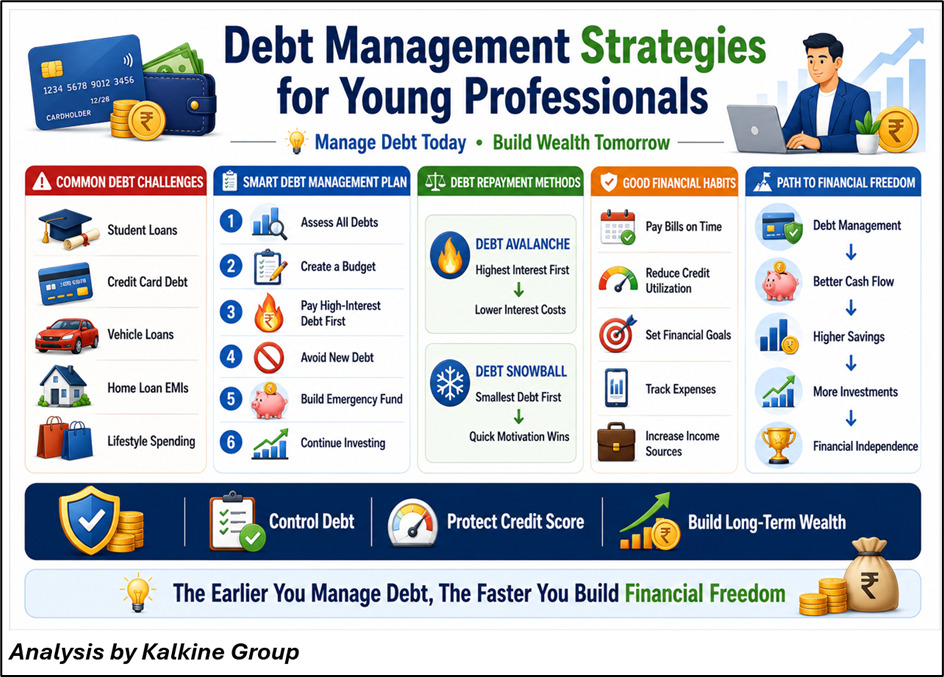
Understanding the Impact of Debt
Debt can be a useful financial tool when used responsibly. Education loans can support career development, home loans can facilitate asset ownership, and business loans can help create growth opportunities. However, excessive or poorly managed debt can reduce financial flexibility and limit the ability to save and invest.
High debt levels often result in:
- Increased financial stress
- Reduced savings capacity
- Lower investment contributions
- Difficulty achieving financial goals
- Greater vulnerability during economic uncertainty
Understanding the nature and cost of debt is the first step toward managing it effectively.
Evaluate Your Complete Debt Situation
Before creating a repayment strategy, it is important to gain a comprehensive understanding of all outstanding liabilities.
Prepare a list of:
- Loan type
- Outstanding balance
- Interest rate
- Monthly EMI or payment obligation
- Remaining repayment tenure
This assessment helps identify which debts require immediate attention and provides a clear picture of overall financial obligations.
A detailed review also enables individuals to prioritize repayments more effectively.
Create a Realistic Monthly Budget
Successful debt management begins with disciplined budgeting. A monthly budget allows individuals to monitor income, control expenses, and allocate sufficient funds toward debt repayment.
A practical budget should include:
- Essential living expenses
- Loan repayments
- Savings contributions
- Investment allocations
- Discretionary spending
Tracking expenses regularly can reveal areas where spending can be reduced, allowing additional funds to be directed toward debt reduction.
Prioritize High-Interest Debt
Not all debt carries the same financial burden. High-interest obligations such as credit card balances and certain personal loans can significantly increase repayment costs over time.
One effective approach is the Debt Avalanche Method, which focuses on paying off debts with the highest interest rates first while maintaining minimum payments on other obligations.
Benefits of this strategy include:
- Lower overall interest costs
- Faster debt reduction
- Improved financial efficiency
Reducing high-interest debt should generally be a top priority for young professionals seeking financial stability.
Consider the Debt Snowball Approach
Another widely used repayment strategy is the Debt Snowball Method. Under this approach, individuals focus on paying off the smallest debt first while making minimum payments on larger obligations.
As each debt is eliminated, the freed-up payment amount is directed toward the next debt.
This method can provide psychological motivation by generating quick wins and reinforcing positive financial behaviour.
The choice between the avalanche and snowball methods depends on individual preferences and financial circumstances.
Avoid Accumulating New Debt
One of the most common obstacles to successful debt management is continuing to accumulate additional debt while attempting to repay existing obligations.
Young professionals should exercise caution when:
- Using credit cards for discretionary spending
- Taking unnecessary personal loans
- Financing lifestyle purchases
- Making impulse purchases through easy credit options
Limiting new borrowing can accelerate debt reduction and improve overall financial health.
Build an Emergency Fund
Unexpected financial events can derail even the most carefully designed debt repayment plan.
Medical emergencies, temporary job loss, family obligations, or urgent repairs may force individuals to rely on additional borrowing if adequate savings are unavailable.
Building an emergency fund equivalent to at least three to six months of essential expenses can provide a financial safety net and reduce dependence on debt during difficult periods.
Even small, regular contributions can gradually strengthen financial resilience.
Explore Loan Refinancing Opportunities
Interest rates and lending conditions may change over time. In certain situations, refinancing or consolidating existing loans can help reduce borrowing costs.
Potential benefits include:
- Lower interest rates
- Reduced monthly payments
- Simplified debt management
- Improved cash flow
Before refinancing, individuals should carefully evaluate processing fees, repayment terms, and overall cost savings.
A thorough analysis can help determine whether refinancing is financially beneficial.
Maintain a Healthy Credit Score
Debt management is closely linked to creditworthiness. A strong credit score can improve access to future borrowing opportunities and potentially lower borrowing costs.
Key practices for maintaining a healthy credit profile include:
- Making payments on time
- Avoiding excessive credit utilization
- Monitoring credit reports regularly
- Maintaining a balanced credit mix
- Avoiding frequent loan applications
Responsible credit management supports long-term financial flexibility and stability.
Balance Debt Repayment with Investing
Many young professionals face the challenge of deciding whether to prioritize debt repayment or investing.
The answer often depends on the interest rate of the debt and individual financial goals.
Generally:
- High-interest debt should be prioritized for repayment.
- Long-term investing should not be ignored entirely.
- Retirement contributions should continue whenever possible.
A balanced strategy can help individuals reduce debt while simultaneously building wealth for the future.
Increase Income to Accelerate Debt Repayment
While reducing expenses is important, increasing income can significantly improve debt repayment capacity.
Potential approaches include:
- Pursuing skill development
- Seeking career advancement opportunities
- Taking on freelance assignments
- Starting side income ventures
- Monetizing specialized expertise
Additional income can be directed toward debt reduction, helping shorten repayment timelines and reduce interest costs.
Develop Long-Term Financial Discipline
Debt management is not a one-time activity but an ongoing financial practice. Developing healthy financial habits can help prevent future debt-related challenges.
Important habits include:
- Living within one's means
- Saving consistently
- Investing regularly
- Tracking expenses
- Reviewing financial goals periodically
Long-term financial discipline creates a strong foundation for sustained financial success.
Conclusion
Debt is a common part of modern financial life, particularly for young professionals pursuing education, career development, and personal goals. However, unmanaged debt can become a significant barrier to financial progress.
By understanding their debt obligations, prioritizing high-interest liabilities, maintaining a realistic budget, building emergency savings, and avoiding unnecessary borrowing, young professionals can regain control of their finances and improve long-term financial outcomes.
Effective debt management is not merely about becoming debt-free. It is about creating financial flexibility, reducing stress, and establishing a solid foundation for future wealth creation and financial independence.
Frequently Asked Questions (FAQs)
- Which debt should be repaid first?
High-interest debt, such as credit card balances and personal loans, should generally be prioritized because these obligations increase borrowing costs more rapidly than lower-interest loans.
- Is it better to save money or pay off debt?
The decision depends on the type of debt and individual financial circumstances. High-interest debt should typically be prioritized, while maintaining an emergency fund and continuing essential long-term investments.
- How much of my income should go toward debt repayment?
While the ideal percentage varies based on income and expenses, financial planners often recommend keeping total debt obligations at manageable levels while ensuring adequate savings and essential living expenses are maintained.