


Dividend investing has remained one of the most widely followed investment approaches among Indian investors seeking regular income and relative portfolio stability. While growth stocks often dominate headlines during bullish market phases, dividend-paying companies continue to attract attention from investors looking for steady cash flows and potentially lower volatility.
In India’s evolving equity market landscape, dividend stocks are often associated with mature businesses, strong balance sheets, and disciplined capital allocation strategies. Many investors consider dividend-focused investing as part of a diversified wealth-building strategy, particularly during periods of market uncertainty, inflation concerns, or volatile economic cycles.
This article explores dividend stocks in India, their potential benefits, factors investors may evaluate, associated risks, and key sectors that historically have shown dividend-paying characteristics.
Key Takeaways
- Dividend stocks are companies that distribute a portion of profits to shareholders.
- Indian dividend-paying companies are often found in sectors like PSU, FMCG, banking, utilities, and energy.
- Investors may evaluate dividend consistency, payout ratio, cash flow strength, and debt levels before investing.
- High dividend yield alone should not be the sole basis for investment decisions.
- Dividend investing may offer passive income opportunities and long-term compounding benefits.
- Market risks, dividend cuts, and sector concentration remain important considerations.
What Are Dividend Stocks?
Dividend stocks are shares of companies that periodically distribute part of their earnings to shareholders in the form of dividends. These payments may be made quarterly, semi-annually, or annually depending on the company’s dividend policy.
In India, dividends are usually announced by the board of directors and approved by shareholders where applicable. Companies with stable operations and consistent profitability are generally more likely to distribute dividends over time.
Dividend-paying companies are often characterised by:
- Established business operations
- Stable revenue generation
- Strong cash flow management
- Mature business models
- Consistent earnings history
Such companies may appeal to investors who seek a balance between capital appreciation and income generation.
Why Dividend Investing Attracts Attention in India
Dividend-oriented investing has remained popular among various categories of investors in India, including retirees, conservative investors, and long-term wealth creators.
Several factors contribute to the popularity of dividend investing.
- Passive Income Potential
Dividends may provide investors with a regular source of income without selling shares. This can be particularly attractive for individuals seeking supplementary cash flow.
- Relative Portfolio Stability
Companies with long dividend histories are often perceived as financially disciplined businesses. During uncertain market conditions, some dividend-paying stocks may experience relatively lower volatility compared to speculative growth stocks.
- Long-Term Compounding Benefits
Reinvesting dividends over time can contribute to compounding returns. Long-term investors often consider dividend reinvestment as a strategy to potentially enhance wealth creation.
- Defensive Characteristics
Certain dividend-paying sectors such as FMCG, utilities, and energy are considered relatively defensive because demand for their products and services may remain comparatively stable during economic slowdowns.
How Dividend Stocks Work in India
When a listed Indian company declares a dividend, shareholders holding the stock before the ex-dividend date may become eligible to receive the announced payout.
Some important terms investors should understand include:
Dividend Yield
Dividend yield measures the annual dividend relative to the stock price.
Formula:
Dividend Yield = Annual Dividend per Share / Current Share Price × 100
For example, if a company pays ₹20 annually as dividend and the share price is ₹400:
Dividend Yield = 20 / 400 × 100 = 5%
A higher dividend yield may appear attractive, but investors should evaluate whether the payout is sustainable.
Ex-Dividend Date
This is the cut-off date determining shareholder eligibility for dividends. Investors purchasing shares after the ex-dividend date may not receive the upcoming dividend.
Record Date
The company identifies eligible shareholders based on records maintained on this date.
Dividend Payout Ratio
This ratio reflects the percentage of profits distributed as dividends.
Formula:
Dividend Payout Ratio = Dividends Paid / Net Profit
A very high payout ratio may indicate limited reinvestment capacity or unsustainable dividend practices.
Important Factors Investors Should Consider Before Investing in Dividend Stocks
- Dividend Consistency
A company’s dividend history may provide insights into its financial strength and management discipline.
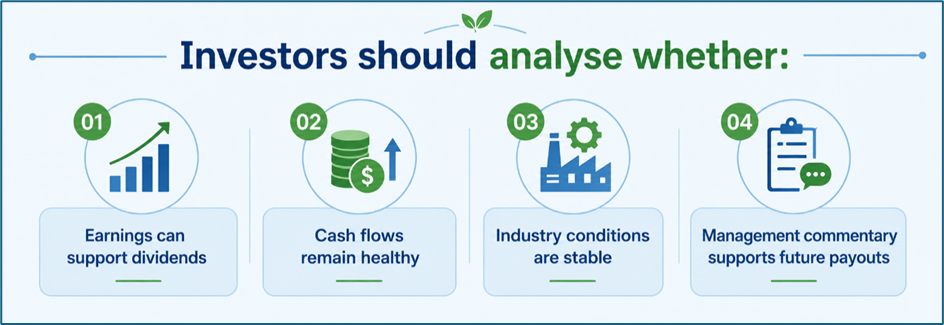
Companies that have maintained dividends across economic cycles may indicate stronger operational resilience.
- Business Fundamentals
Dividend investing should not rely solely on dividend yield.
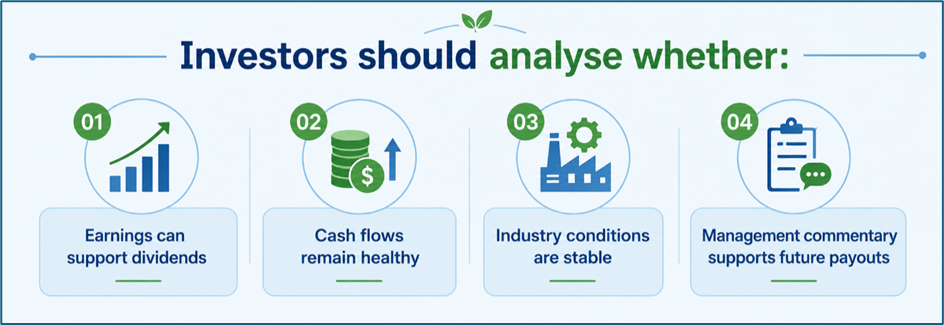
Investors may analyse:
Revenue Growth
Stable or growing revenues may indicate business sustainability.
Profitability Trends
Consistent earnings can support future dividend payments.
Debt Levels
High debt may pressure future cash flows and impact dividend distribution capacity.
Cash Flow Generation
Strong operating cash flows are often essential for sustaining dividends.
Return Ratios
Metrics such as Return on Equity (ROE) and Return on Capital Employed (ROCE) may help assess business efficiency.
- Dividend Yield Sustainability
Extremely high dividend yields may sometimes result from declining stock prices rather than improving fundamentals.
This phenomenon is often referred to as a “dividend yield trap.”
- Sector Outlook
Industry conditions can significantly impact dividend sustainability.
For example:
- Commodity cycles may impact metal and energy companies.
- Regulatory changes can affect PSU profitability.
- Interest rate movements may influence banking sector earnings.
Understanding broader sector trends remains important when evaluating dividend opportunities.
- Management Quality and Capital Allocation
Management decisions play a critical role in balancing:
- Business expansion
- Debt reduction
- Shareholder payouts
- Cash reserves
Companies with disciplined capital allocation strategies are often viewed more favourably by long-term investors.
Sectors in India Often Associated With Dividend Stocks
Several sectors in India have historically been associated with dividend-paying companies.
- PSU Companies
Public Sector Undertakings (PSUs) have traditionally distributed dividends due to government ownership structures and relatively mature business operations.

However, PSU performance can also be influenced by government policies and global commodity cycles.
- FMCG Sector
Fast-Moving Consumer Goods (FMCG) companies often generate stable cash flows because consumer demand remains relatively consistent.
This sector may attract dividend-focused investors seeking defensive exposure.
- Energy Sector
Large integrated energy businesses may distribute dividends due to strong cash generation during favourable commodity cycles.
However, global crude oil fluctuations can impact earnings.
- Utilities
Utility companies such as power transmission and electricity distribution businesses are often considered stable due to recurring demand patterns.
- Banking and Financial Services
Established banks and financial institutions sometimes distribute dividends while maintaining growth and expansion plans.
However, credit cycles and economic conditions can influence future payouts.
Benefits of Dividend Investing
Dividend-oriented investing may offer multiple potential advantages for long-term investors.
Regular Income Stream
Dividends may help generate periodic cash flows, especially for retirees or income-focused investors.
Potential Lower Volatility
Mature dividend-paying businesses may exhibit relatively stable price movements during uncertain market phases.
Long-Term Wealth Creation
Reinvesting dividends can contribute to compounding returns over long investment horizons.
Indicator of Financial Strength
Consistent dividend payments may signal management confidence and business stability.
Risks Associated with Dividend Investing
Despite potential advantages, dividend investing also involves several risks investors should understand.
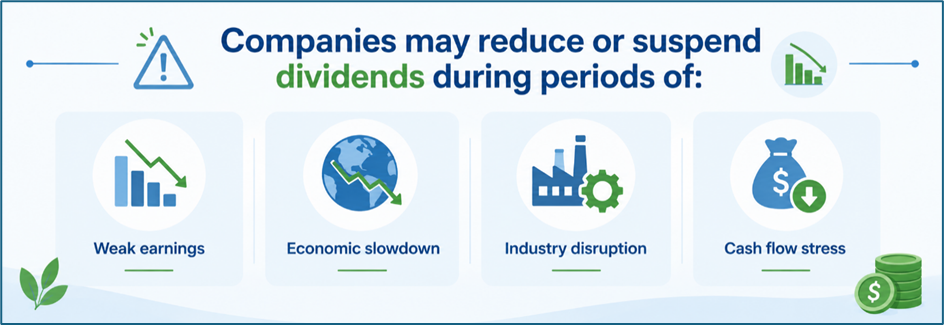
- Dividend Cuts During Economic Downturns
2.Slower Growth Potential
Mature dividend-paying companies may offer lower growth rates compared to emerging high-growth businesses.
- Sector Concentration Risk
Dividend-focused portfolios sometimes become heavily concentrated in sectors like PSU, utilities, or energy.
Overexposure to a single sector can increase portfolio risk.
- Dividend Yield Traps
Very high dividend yields may result from falling stock prices caused by deteriorating fundamentals.
This is why yield alone should not drive investment decisions.
Taxation of Dividends in India
Dividend taxation rules in India have evolved in recent years.
Currently:
- Dividends are generally taxable in the hands of investors according to their applicable income tax slab.
- Companies deduct TDS (Tax Deducted at Source) beyond prescribed thresholds.
Investors should consult tax professionals for personalised tax guidance.
Dividend Reinvestment Strategy
Some long-term investors prefer reinvesting dividend income instead of withdrawing it.
Potential benefits of reinvestment may include:
- Enhanced compounding
- Increased share accumulation
- Long-term portfolio growth
Dividend reinvestment can be particularly impactful over extended investment horizons.
Difference Between Dividend Stocks and Growth Stocks
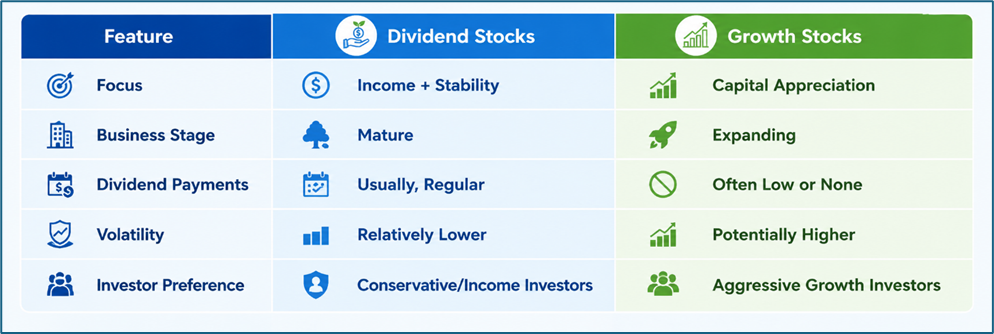
Both approaches may serve different investment objectives depending on risk appetite and financial goals.
How Investors Can Research Dividend Stocks
Before investing, investors may consider conducting independent research using:
- Company annual reports
- Quarterly earnings updates
- Dividend history
- Industry analysis
- Financial ratios
- Cash flow statements
- Credit ratings
Professional financial advice may also help align investment choices with individual financial goals.
Final Thoughts
Dividend investing continues to remain an important strategy within the Indian stock market ecosystem. Companies with stable operations, disciplined capital allocation, and strong cash flow generation often attract investors seeking a combination of income generation and long-term stability.
However, dividend investing should not rely solely on headline dividend yields. Investors may benefit from analysing broader business fundamentals, industry outlook, financial strength, and long-term sustainability before making investment decisions.
A diversified approach, aligned with financial goals and risk tolerance, remains important for long-term investing success.
Frequently Asked Questions (FAQs)
- What are dividend stocks?
Dividend stocks are shares of companies that distribute a portion of profits to shareholders as dividends.
- Are dividend stocks suitable for long-term investing?
Some investors consider dividend stocks for long-term investing because of potential income generation and compounding benefits. However, suitability depends on individual financial goals and risk appetite.
- What is a good dividend yield in India?
There is no fixed ideal dividend yield. Investors often evaluate dividend sustainability, business quality, and cash flow strength alongside yield.
- Can companies stop paying dividends?
Yes. Companies may reduce or suspend dividends during economic stress, weak profitability, or changing business conditions.
- Are PSU stocks known for dividends?
Historically, several PSU companies in India have distributed dividends due to stable operations and government ownership structures.
- Is dividend investing risk-free?
No. Dividend investing involves risks including dividend cuts, sector concentration, market volatility, and business downturns.
- How are dividends taxed in India?
Dividends are generally taxable according to the investor’s applicable income tax slab. Tax rules may change over time.
- Should investors focus only on high dividend yield stocks?
A high dividend yield alone may not indicate a good investment opportunity. Investors often evaluate broader financial and business fundamentals.