

One of the most debated topics in the investment world is whether investors should focus on growth stocks or value stocks. Both strategies have created significant wealth for investors over the years, yet they follow fundamentally different approaches to stock selection.
Growth investors seek companies capable of delivering rapid earnings expansion and market leadership, while value investors look for fundamentally strong businesses trading below their perceived intrinsic value. Understanding the differences between these two investment styles can help investors choose an approach that aligns with their financial goals, risk tolerance, and investment horizon.
Rather than determining which strategy is universally superior, investors should focus on understanding how each approach works and where it may fit within a long-term portfolio.
What Is Growth Investing?
Growth investing focuses on companies that are expected to grow revenues, earnings, and cash flows at a faster pace than the broader market.
These businesses often operate in industries experiencing strong structural growth, such as technology, healthcare innovation, digital services, renewable energy, and emerging consumer trends.
Growth investors are typically willing to pay a premium valuation because they expect future earnings growth to justify higher stock prices.
Characteristics of Growth Stocks
Growth companies often exhibit:
- Strong revenue growth
- Expanding profit margins
- Large addressable markets
- Innovation-driven business models
- Reinvestment of profits into expansion
Instead of distributing significant dividends, many growth companies reinvest earnings to accelerate future growth.
What Is Value Investing?
Value investing involves identifying stocks that appear undervalued relative to their intrinsic worth.
Value investors believe that markets occasionally misprice companies due to temporary challenges, economic uncertainty, or negative sentiment. By purchasing quality businesses at attractive valuations, investors aim to benefit when the market eventually recognizes their true value.
This investment philosophy is often associated with patience, discipline, and a focus on business fundamentals.
Characteristics of Value Stocks
Value stocks often feature:
- Lower valuation multiples
- Stable business models
- Strong asset bases
- Consistent cash flows
- Established market positions
These companies may not always deliver rapid growth, but they can provide attractive long-term returns when purchased at reasonable valuations.
Key Differences Between Growth and Value Investing
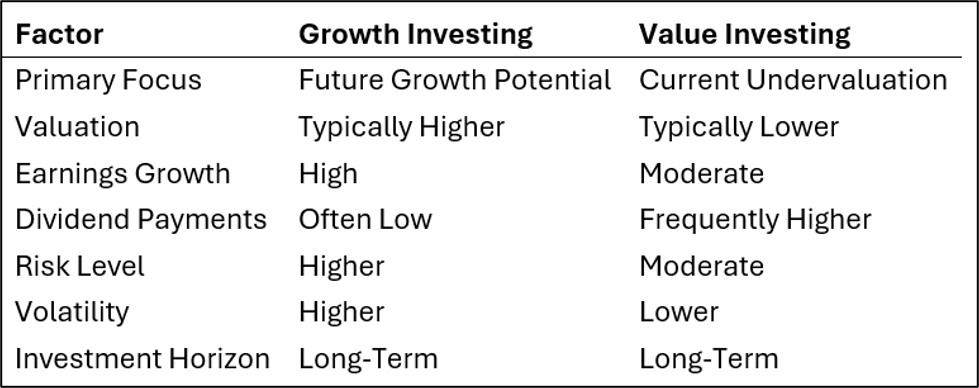
While both strategies aim to generate wealth, the path to achieving returns can differ significantly.
Advantages of Growth Investing
Potential for Superior Returns- Companies that successfully execute growth strategies can generate substantial shareholder value over time.
Exposure to Emerging Trends- Growth investing allows investors to participate in industries benefiting from technological innovation and structural economic changes.
Earnings Expansion- Rapid profit growth can drive long-term stock appreciation if the business continues to perform well.
Challenges of Growth Investing
- Higher valuations may increase downside risk.
- Growth expectations can be difficult to sustain.
- Stock prices may be more sensitive to economic conditions and interest rate changes.
Advantages of Value Investing
Margin of Safety- Purchasing stocks below their estimated intrinsic value may help reduce downside risk.
Attractive Valuations- Value investors often focus on companies trading at reasonable earnings and book value multiples.
Potential Dividend Income- Many value-oriented businesses distribute a portion of profits through dividends.
Challenges of Value Investing
- Undervalued stocks may remain inexpensive for extended periods.
- Some companies may appear cheap due to fundamental business issues.
- Market recognition of value can take time.
Which Strategy Performs Better?
There is no definitive winner between growth and value investing.
Different market environments tend to favor different styles:
Growth Investing Often Performs Better When:
- Economic growth is strong
- Interest rates are relatively low
- Innovation-driven sectors lead the market
- Investors prioritize future earnings growth
Value Investing Often Performs Better When:
- Markets focus on fundamentals
- Economic uncertainty increases
- Interest rates rise
- Investors seek stable cash flows and reasonable valuations
Over different market cycles, leadership frequently shifts between growth and value stocks.
Can Investors Combine Both Approaches?
Many successful investors avoid choosing one strategy exclusively.
A diversified portfolio may include:
- Growth companies with strong earnings potential
- Value stocks trading at attractive valuations
- Dividend-paying businesses providing income stability
Combining both approaches can help investors participate in growth opportunities while maintaining valuation discipline.
Common Mistakes Investors Should Avoid
Following Market Trends Blindly- Investors often switch strategies based on recent performance, which may lead to poor timing decisions.
Ignoring Valuation- Even exceptional growth companies can become overvalued.
Buying Cheap Stocks Without Research- A low valuation alone does not guarantee investment success.
Lack of Diversification- Concentrating solely on one investment style may increase portfolio risk.
Final Thoughts
Growth investing and value investing represent two distinct paths to long-term wealth creation. Growth investors seek businesses capable of delivering exceptional earnings expansion, while value investors focus on purchasing quality companies at attractive prices.
Neither strategy consistently outperforms the other across all market conditions. The most suitable approach depends on an investor’s objectives, risk tolerance, and investment philosophy.
For many investors, combining growth and value principles may provide a balanced framework for navigating changing market environments while pursuing long-term financial goals.
Frequently Asked Questions (FAQs)
1. What is the difference between growth and value investing?
Growth investing focuses on companies with strong future earnings potential, while value investing seeks undervalued stocks trading below their estimated intrinsic value.
2. Is growth investing riskier than value investing?
Growth stocks often carry higher valuations and greater volatility, which can result in increased investment risk.
3. Do value stocks pay dividends?
Many value-oriented companies distribute dividends, although dividend policies vary across businesses.
4. Which strategy is better for long-term investing?
Both strategies can be effective for long-term wealth creation depending on market conditions and individual investment goals.
5. Can investors combine growth and value stocks?
Yes. Many diversified portfolios include a mix of growth and value investments to balance risk and return opportunities.
6. Why do growth stocks often trade at higher valuations?
Investors are willing to pay a premium because they expect future earnings and cash flows to grow rapidly.
7. How can beginners choose between growth and value investing?
Investors should consider their risk tolerance, investment horizon, financial goals, and preferred investment style before selecting an approach.