

Highlights
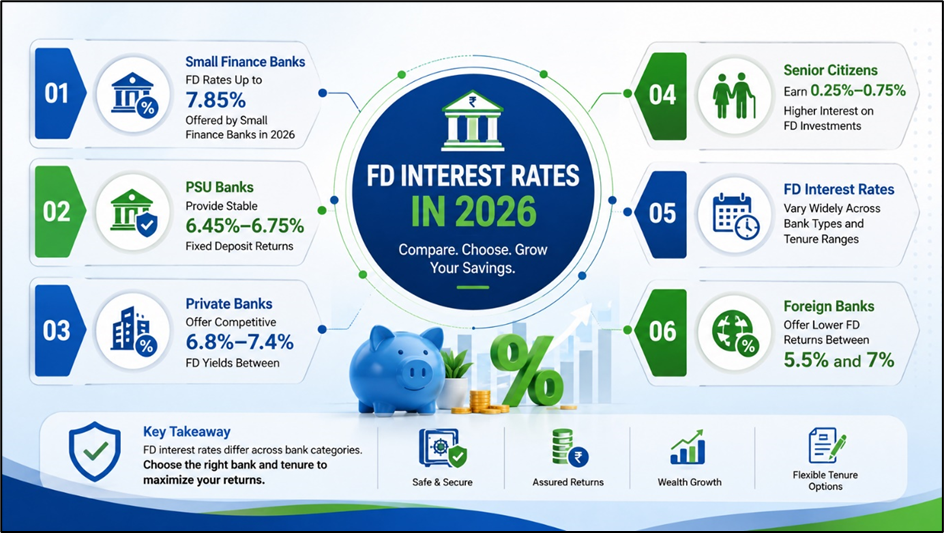
- Small finance banks are offering FD interest rates as high as 7.85% per annum.
- PSU banks generally provide FD returns in the range of 6.45% to 6.75%.
- FD rates vary by tenure, bank category and customer type including senior citizens.
Fixed deposit (FD) investors continue to see a wide range of interest rates across Indian banks in 2026, with returns influenced by bank category, deposit tenure and customer segment. Small finance banks remain at the higher end of the interest rate spectrum, while public sector banks offer comparatively moderate but stable returns.
The current rate environment reflects ongoing competition among banks to attract retail deposits while balancing liquidity and credit demand conditions in the economy.
 Source: Analysis by Kalkine
Small Finance Banks Lead in Higher FD Returns
Among all categories, small finance banks are offering the highest FD interest rates. In several cases, interest rates are reaching up to 7.85% per annum for select tenures between one and five years.
Banks such as SBM Bank India, CSB Bank, Bandhan Bank, IDFC First Bank and DCB Bank are among those offering relatively higher FD rates compared to mainstream banking institutions. These rates typically apply to specific tenure buckets and deposit conditions.
However, higher returns from small finance banks are generally associated with a comparatively higher risk profile than large scheduled banks.
Private Banks Offer Mid-Range FD Returns
Private sector banks are offering FD interest rates mostly in the range of around 6.8% to 7.4% depending on tenure and scheme type. Institutions such as RBL Bank, IndusInd Bank and IDFC First Bank fall within this category, providing competitive but moderate returns compared to small finance banks.
These banks often adjust their rates based on liquidity requirements and broader interest rate trends set by monetary policy conditions.
Public Sector Banks Maintain Stable FD Structure
Public sector banks continue to offer relatively lower but stable FD interest rates, typically ranging between 6.45% and 6.75% for one to five-year deposits.
Banks such as State Bank of India, Punjab National Bank, Bank of Baroda and Canara Bank are part of this category. While returns are lower compared to private and small finance banks, PSU bank deposits are generally preferred for perceived stability and lower risk exposure.
Foreign Banks and Select Institutions
Foreign banks operating in India also offer FD products, with interest rates generally ranging from 5.5% to 7% depending on tenure and deposit structure.
These institutions cater to niche customer segments and typically offer lower rates compared to domestic small finance banks but maintain a structured product offering aligned with global banking standards.
Senior Citizen Advantage in FD Rates
Senior citizens continue to receive additional interest benefits across most banks. In many cases, the rate advantage ranges from 0.25% to 0.75% above standard FD rates, depending on the institution and tenure selected.
This makes fixed deposits a commonly preferred investment tool among retirees seeking stable and predictable income streams.
Factors Influencing FD Interest Rates
FD rates are influenced by multiple macroeconomic and banking factors, including liquidity conditions, RBI policy rates, inflation trends and credit demand in the economy.
Banks periodically revise FD rates based on these conditions to manage deposit inflows and lending capacity.
Key Risks
- Higher FD rates in small finance banks may involve higher credit risk exposure.
- Early withdrawal of FD may reduce effective returns due to penalties.
- Fixed returns may not always beat inflation over long periods.
- Interest income is taxable depending on investor income slab.
Summary
Fixed deposit rates in 2026 show significant variation across bank categories, with small finance banks offering the highest returns, followed by private banks and public sector banks. While higher rates may be attractive, investors often balance returns with risk, liquidity and tax considerations. FD remains a widely used fixed-income instrument due to its predictability and capital protection features.
FAQs
Q: Which banks are offering the highest FD rates in 2026?
A: Small finance banks are offering FD rates up to around 7.85% depending on tenure and deposit conditions.
Q: Why do FD rates vary across banks?
A: Rates differ based on liquidity needs, RBI policy, bank category and customer segment.
Q: Are FD returns tax-free in India?
A: No, FD interest is taxable as per the investor’s income tax slab.