

Highlights
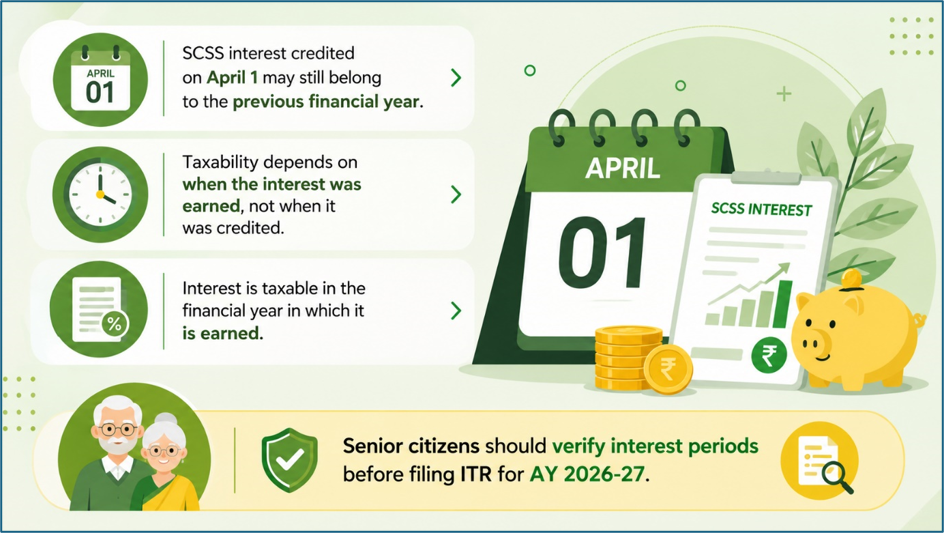
- SCSS interest taxation depends on the financial year in which it is earned.
- Interest credited in April may still relate to the previous financial year.
- Taxpayers should verify interest accrual details before filing ITR for AY 2026-27.
Many senior citizens investing in the Senior Citizen Savings Scheme (SCSS) face a common question during tax filing: if interest is credited on April 1, should it be reported in the current year's income tax return or in the following year?
The answer depends on the period during which the interest was earned rather than the date on which it was credited. Understanding this distinction can help taxpayers avoid errors while filing Income Tax Returns (ITR) for Assessment Year (AY) 2026-27.
Source: Analysis by Kalkine
How SCSS Interest Is Paid
The Senior Citizen Savings Scheme is a government-backed savings instrument that currently offers an annual interest rate of 8.2%, with interest payouts made quarterly. Interest is generally credited on the first day of April, July, October, and January.
The April credit typically represents interest earned during the January-March quarter of the immediately preceding financial year. As a result, taxpayers need to focus on when the income accrued rather than when the amount reached their account.
Accrual vs Receipt: Why It Matters
Income tax rules generally recognize interest income on an accrual basis. This means income is considered taxable in the year in which it is earned.
For example, interest relating to the January-March 2026 quarter may be credited on April 1, 2026. Although the credit appears in the next financial year, the income pertains to the previous financial year because it accrued during that period.
Therefore, taxpayers may need to include such interest while computing income for the financial year in which it was earned, subject to their method of accounting and tax reporting practices.
What Senior Citizens Should Check
Before filing ITR for AY 2026-27, senior citizens should review:
- SCSS account statements.
- Annual interest certificates, if available.
- Interest periods covered by each credit entry.
- Information reflected in tax reporting documents.
These records can help determine whether the interest relates to FY 2025-26 or FY 2026-27.
Importance of Accurate Reporting
Incorrect reporting can lead to either omission or double taxation of interest income. If interest belonging to a previous financial year is shifted to a later return, the taxable income reported for both years may become inaccurate.
Since SCSS interest is taxable according to the applicable income-tax slab, accurate classification remains important for senior citizens preparing their annual tax returns.
How Taxpayers Can Avoid Mistakes
Taxpayers should not rely solely on the date displayed in their bank account or passbook. Instead, they should identify the period for which the interest was generated.
Consulting account statements and maintaining a record of quarterly interest accruals can simplify tax reporting and reduce the chances of mismatches during return processing.
Where uncertainty exists, taxpayers may seek professional tax advice based on their individual circumstances and accounting method.
Key Risks to Watch
- Reporting interest based only on credit date may create tax errors.
- Missing accrued interest can result in under-reporting of income.
- Double-counting interest may increase taxable income unnecessarily.
- Incomplete records can lead to return reconciliation issues.
Summary
SCSS interest credited on April 1 may relate to the January-March quarter of the preceding financial year. For tax purposes, the relevant factor is generally the period during which the interest was earned rather than the date of credit. Senior citizens should review account statements carefully to determine the correct reporting year and avoid omissions or duplication while filing ITR for AY 2026-27.
FAQs
Q: Is SCSS interest taxable?
A: Yes. Interest earned under the Senior Citizen Savings Scheme is taxable according to the investor's applicable tax slab.
Q: When is SCSS interest normally credited?
A: SCSS interest is generally paid quarterly on April 1, July 1, October 1, and January 1.
Q: Should taxpayers consider accrual or credit date for SCSS interest?
A: Tax treatment generally depends on when the income was earned, not merely when it was credited.