

A Practical Framework for Achieving Financial Stability and Long-Term Wealth Creation
In today's dynamic economic environment, effective financial management has become more important than ever. Rising living costs, changing lifestyle aspirations, inflationary pressures, and increasing financial responsibilities make budgeting an essential component of personal financial planning. While many individuals understand the importance of budgeting, few successfully maintain a system that consistently supports their financial goals.
A well-structured monthly budget serves as a financial roadmap, helping individuals track income, manage expenses, increase savings, and make informed financial decisions. More importantly, it provides clarity and control over money, reducing financial stress and supporting long-term wealth creation.
This guide outlines practical steps to create a monthly budget that is realistic, sustainable, and capable of delivering meaningful financial results.
Why Budgeting Is Important
A budget is more than a record of income and expenses. It is a strategic tool that enables individuals to align their spending habits with their financial objectives. Without a budget, it becomes difficult to understand where money is being spent, often leading to overspending, inadequate savings, and unnecessary debt accumulation.
Effective budgeting can help individuals:
- Maintain control over their finances
- Increase savings and investments
- Prepare for unexpected expenses
- Reduce financial stress
- Avoid excessive debt
- Achieve short-term and long-term financial goals
By providing a clear picture of financial activity, budgeting allows individuals to make proactive rather than reactive financial decisions.
Step 1: Determine Your Monthly Income
The foundation of every budget begins with understanding your total monthly income. This includes all regular sources of earnings such as salary, business income, freelance earnings, rental income, dividends, and interest income.
For individuals with variable income streams, calculating an average income based on the previous six to twelve months can provide a more realistic budgeting baseline. Using conservative income estimates can also help prevent overspending and improve financial discipline.
A clear understanding of income is essential because it determines how much can be allocated toward expenses, savings, and investments.
Step 2: Track and Analyze Your Expenses
Before creating a budget, it is important to understand current spending patterns. Many people underestimate their monthly expenses because small, frequent purchases often go unnoticed.
Tracking expenses for at least one month can reveal valuable insights about spending behaviour. Expenses generally fall into three categories:
Fixed Expenses- These are recurring costs that remain relatively consistent each month and may include:
- Rent or home loan EMIs
- Insurance premiums
- Utility bills
- School fees
- Subscription services
Variable Expenses- These expenses fluctuate depending on lifestyle choices and consumption patterns, including:
- Groceries
- Transportation
- Dining out
- Shopping
- Entertainment
Irregular Expenses- Occasional expenses may include:
- Medical emergencies
- Vehicle maintenance
- Travel expenses
- Festival spending
- Home repairs
Understanding these categories helps create a more realistic and effective budget.
Step 3: Organize Spending into Categories
Categorizing expenses allows individuals to identify where their money is being allocated and determine whether spending aligns with financial priorities.
Common budget categories include:
- Housing and accommodation
- Utilities and communication
- Food and groceries
- Transportation
- Healthcare and insurance
- Investments and savings
- Debt repayments
- Entertainment and recreation
- Miscellaneous expenses
Once expenses are categorized, it becomes easier to identify areas where spending can be optimized.
Step 4: Adopt a Structured Budgeting Framework
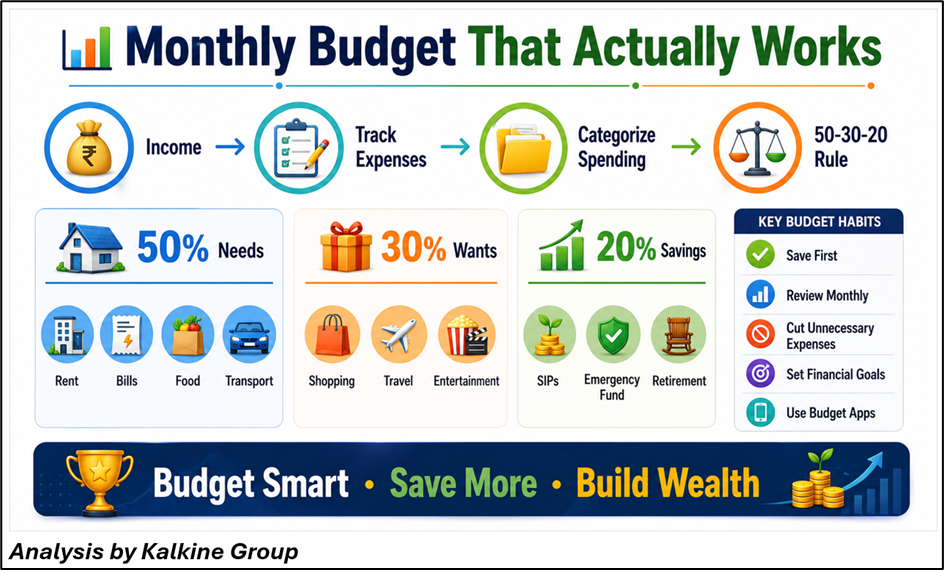
One of the most widely used budgeting methods is the 50-30-20 rule. This framework provides a balanced approach to managing income and expenses.
50% for Essential Needs- This portion covers necessities such as:
- Housing
- Utilities
- Food
- Transportation
- Insurance
- Education expenses
30% for Lifestyle and Personal Spending- This category includes discretionary expenses such as:
- Dining out
- Entertainment
- Travel
- Shopping
- Hobbies
20% for Savings and Investments- This portion should be allocated toward:
- Emergency fund contributions
- Mutual fund SIPs
- Retirement planning
- Debt reduction
- Long-term investments
Although these percentages may vary depending on individual circumstances, the framework offers an effective starting point for most households.
Step 5: Pay Yourself First
A common mistake in financial planning is treating savings as an afterthought. Many individuals save only what remains after spending, which often results in inconsistent savings habits.
A more effective approach is to prioritize savings and investments immediately after receiving income. This strategy, commonly known as "paying yourself first," ensures that financial goals receive priority treatment.
Automating transfers to savings accounts, SIPs, and retirement investments can significantly improve financial discipline and consistency.
Step 6: Build an Emergency Fund
Unexpected financial events can disrupt even the most carefully planned budgets. Medical emergencies, job loss, economic downturns, or major repairs can create significant financial pressure.
To mitigate these risks, financial experts generally recommend maintaining an emergency fund equivalent to six to twelve months of essential living expenses.
This fund should remain easily accessible and be kept in low-risk, liquid financial instruments. An emergency fund provides financial security and reduces dependence on high-interest debt during challenging situations.
Step 7: Eliminate Unnecessary Expenses
One of the most valuable outcomes of budgeting is identifying areas where money is being spent inefficiently.
Common examples include:
- Unused subscriptions
- Impulse purchases
- Frequent online food orders
- Excessive entertainment spending
- High-interest debt obligations
Reducing unnecessary expenses does not mean sacrificing enjoyment. Rather, it involves spending intentionally and directing resources toward activities and goals that provide greater long-term value.
Step 8: Align Your Budget with Financial Goals
Budgets are most effective when connected to specific financial objectives. Clear goals provide motivation and help maintain long-term financial discipline.
Short-Term Goals
- Building an emergency fund
- Purchasing a smartphone or appliance
- Planning a vacation
Medium-Term Goals
- Saving for a home down payment
- Funding higher education
- Purchasing a vehicle
Long-Term Goals
- Retirement planning
- Wealth creation
- Achieving financial independence
Establishing measurable goals helps ensure that budgeting efforts contribute directly to desired outcomes.
Step 9: Review and Adjust Your Budget Regularly
Financial circumstances change over time. Income levels, expenses, inflation, and personal priorities evolve, making periodic budget reviews essential.
A monthly review can help answer important questions:
- Were spending targets achieved?
- Which categories exceeded planned limits?
- Can savings be increased?
- Are financial goals progressing as expected?
Regular adjustments ensure that the budget remains practical, relevant, and aligned with changing circumstances.
Step 10: Leverage Technology to Simplify Budgeting
Modern financial technology has made budgeting easier and more efficient than ever before. Numerous tools can automate expense tracking, categorize spending, and provide detailed financial insights.
Useful tools include:
- Banking applications
- Expense tracking platforms
- Personal finance software
- Spreadsheet templates
- Investment monitoring tools
Technology can improve financial awareness and reduce the time required to manage personal finances effectively.
Conclusion
Creating a monthly budget that actually works requires a combination of planning, discipline, and consistency. A successful budget is not designed to restrict spending but to ensure that financial resources are allocated efficiently toward both present needs and future goals.
By understanding income, tracking expenses, prioritizing savings, building an emergency fund, and regularly reviewing financial progress, individuals can establish a budgeting system that supports long-term financial stability and wealth creation.
Ultimately, financial success is rarely the result of a single decision. Rather, it is built through consistent financial habits and disciplined money management over time.
Frequently Asked Questions (FAQs)
- What is the easiest budgeting method for beginners?
The 50-30-20 budgeting rule is widely considered one of the simplest methods for beginners. It divides income into essential expenses, lifestyle spending, and savings, making financial management straightforward and effective.
- How much of my monthly income should be saved?
Financial experts generally recommend saving at least 20% of monthly income. However, individuals pursuing aggressive financial goals may choose to save a higher percentage.
- How often should I review my budget?
A monthly review is recommended to monitor spending patterns, assess progress toward financial goals, and make necessary adjustments based on changing financial circumstances.