

Highlights
- A bounced cheque can trigger legal proceedings under specific circumstances.
- Responding within prescribed timelines may help prevent case escalation.
- Courts can impose fines, imprisonment, or both in eligible cases.
Cheque transactions continue to be widely used for business and personal payments across India. However, when a cheque is returned unpaid, the issue can extend beyond a banking inconvenience and enter the legal domain.
Many individuals assume that a bounced cheque only results in a financial dispute. In reality, certain cheque dishonour cases can lead to criminal proceedings under the Negotiable Instruments Act, provided the legal conditions are satisfied.
Source: Analysis by Kalkine
When Does a Cheque Bounce Become a Legal Matter?
A cheque is considered dishonoured when the bank refuses payment upon presentation. This can occur due to insufficient funds, account closure, signature-related issues, or other specified reasons.
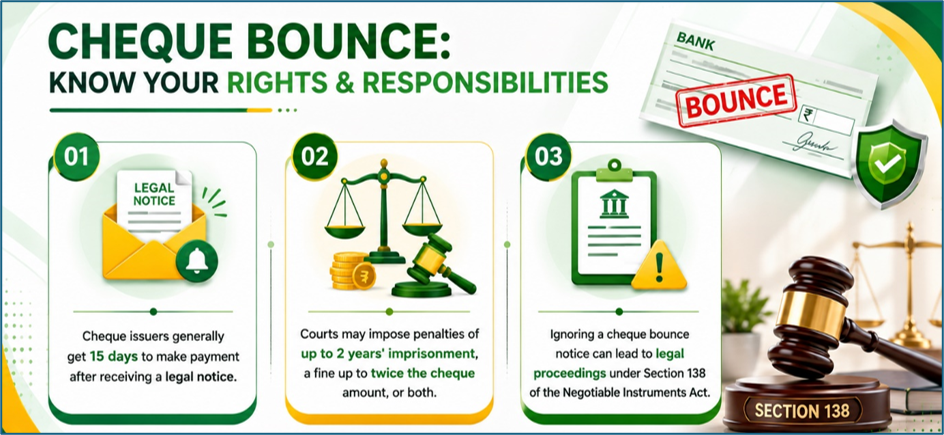
Legal consequences generally arise when the cheque was issued against a legally enforceable debt or liability. If the cheque was issued as repayment for money owed and is subsequently dishonoured, the payee may initiate legal action under Section 138 of the Negotiable Instruments Act.
The Importance of the Legal Notice
The legal process does not begin immediately after a cheque bounces.
After receiving information about the dishonour, the payee must issue a formal demand notice within the prescribed period. The person who issued the cheque is then given an opportunity to make payment within 15 days of receiving the notice.
This stage is often viewed as an opportunity to resolve the matter before court proceedings begin.
What Happens If Payment Is Not Made?
If payment is not made within the stipulated period, the payee may file a complaint before the appropriate court.
Once proceedings commence, the court examines the facts, supporting documents, bank records, and other evidence before determining liability. Failure to respond to notices or court summons can complicate the matter further.
Can Imprisonment Be Ordered?
Under Section 138, courts have the authority to impose imprisonment of up to two years, a fine that may extend to twice the cheque amount, or both, depending on the circumstances of the case.
However, legal experts note that many cheque bounce disputes are resolved through payment settlements before reaching the stage where imprisonment becomes a possibility. Courts frequently encourage resolution where the underlying dues are cleared.
Situations Where Section 138 May Not Apply
Not every dishonoured cheque automatically results in criminal liability.
The cheque must generally relate to a legally enforceable debt or obligation. Courts have held that where the underlying transaction itself is not legally enforceable, the protections available under Section 138 may not apply.
Each dispute is assessed based on its facts, documentation, and the nature of the transaction involved.
Practical Steps After Receiving a Notice
Individuals who receive a cheque bounce notice may consider:
- Reviewing the details of the claim immediately.
- Preserving payment records and supporting documents.
- Responding within applicable timelines.
- Seeking legal guidance where necessary.
- Exploring settlement options if appropriate.
Timely action can often prevent disputes from becoming more complex.
Key Risks
- Ignoring legal notices may lead to court proceedings.
- Non-appearance before court can create additional complications.
- Financial penalties may exceed the original cheque amount.
- Legal disputes can affect personal and business reputation.
Summary
A bounced cheque can have legal consequences if it relates to a valid debt or financial obligation. After dishonour, the payee must issue a notice and provide an opportunity for payment. Failure to comply can lead to court proceedings under Section 138 of the Negotiable Instruments Act. Penalties may include fines, imprisonment, or both, although many disputes are resolved through settlement before final judgment.
FAQs
Q: Does every bounced cheque result in a criminal case?
A: No, criminal proceedings apply only when specific legal conditions under Section 138 are satisfied.
Q: How long does a cheque issuer get to make payment after notice?
A: The issuer generally receives 15 days from notice receipt to clear the outstanding amount.
Q: Can cheque bounce disputes be settled without imprisonment?
A: Yes, many disputes are resolved through payment settlements before reaching final court outcomes.