

Highlights
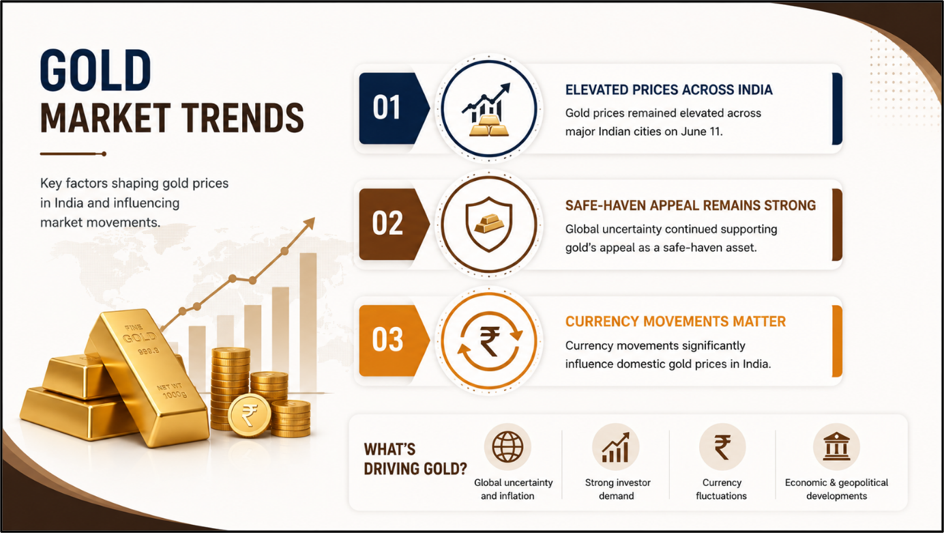
- Gold prices remained elevated across major Indian cities on June 11.
- Silver rates continued to trade at comparatively higher levels nationwide.
- Global market cues and demand trends influenced precious metal prices.
Gold and silver prices continued to attract attention on June 11 as investors monitored domestic and international market developments. Precious metals have remained a preferred asset class for investors seeking diversification, while jewellery demand has also contributed to market activity.
The latest rates indicated that gold prices remained near recent highs across key Indian cities, while silver prices maintained their upward trajectory in several markets.
Gold Rates Across Major Cities
Gold prices generally vary by city due to local taxes, transportation costs, and jeweller-specific charges. Rates for 24-karat and 22-karat gold remained largely aligned with broader market trends, although slight regional variations were visible.
The pricing of 24K gold continued to reflect the premium associated with higher purity levels, while 22K gold remained a preferred choice for jewellery purchases because of its durability and wider acceptance in the retail market.
Consumers planning jewellery purchases closely tracked daily price movements amid elevated bullion valuations.
Source: Analysis by Kalkine
Why Gold Prices Remain Elevated
Several factors have contributed to gold's resilience in recent months. Global economic uncertainty, central bank purchases, geopolitical developments, and expectations regarding interest rates have all played a role in supporting bullion prices.
A softer interest-rate outlook in key global economies can increase the appeal of non-yielding assets such as gold. At the same time, investors often turn to the metal during periods of market volatility and uncertainty.
Currency movements also influence domestic gold prices because India imports a significant portion of its gold requirements.
Silver Continues to Draw Attention
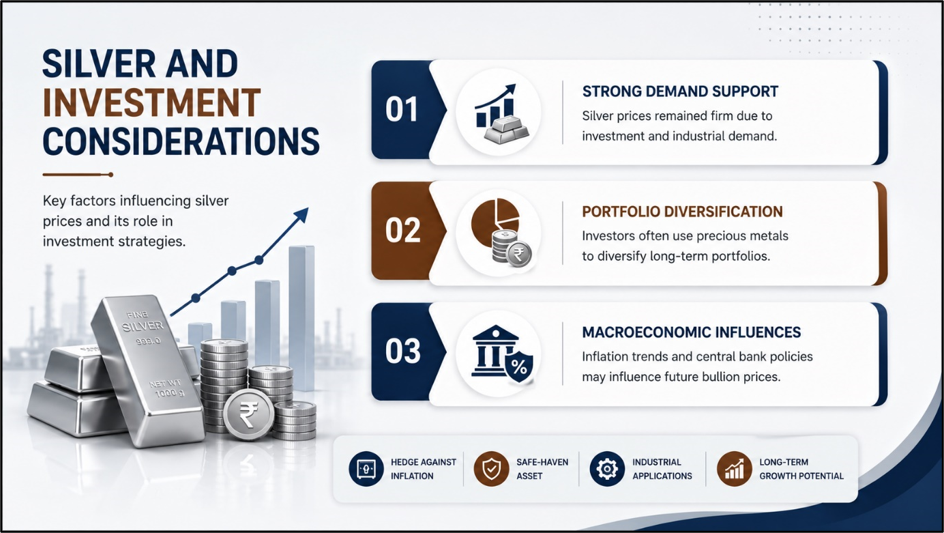
Silver prices remained firm alongside gold, supported by both investment demand and industrial consumption. Unlike gold, silver benefits from its extensive use in industries such as electronics, renewable energy, electric vehicles, and manufacturing.
Growing demand from industrial sectors has helped support silver prices, even as investors continue to view the metal as an alternative store of value.
Market participants are increasingly monitoring silver's dual role as both a precious and industrial metal.
 Source: Analysis by Kalkine
What Buyers Should Consider
Experts generally advise buyers to evaluate their purpose before purchasing precious metals. Jewellery buyers may focus on purity, making charges, and hallmark certification, while investors often compare physical gold with alternatives such as sovereign gold bonds, gold exchange-traded funds, and digital gold platforms.
Timing purchases solely based on short-term price fluctuations can be challenging because bullion markets are influenced by multiple domestic and international factors.
Investors may instead focus on long-term allocation goals and diversification objectives when considering exposure to precious metals.
Global Factors Driving Bullion Markets
International gold and silver prices are closely linked to economic indicators, inflation expectations, central bank policy decisions, and currency movements.
Any changes in interest-rate expectations by major central banks can influence investor sentiment toward precious metals. Additionally, geopolitical tensions and fluctuations in global demand can contribute to price volatility.
As a result, bullion prices may continue to react to developments across global financial markets.
Outlook for Precious Metals
Gold and silver remain among the most closely watched asset classes in India. While daily price movements can fluctuate based on market conditions, both metals continue to benefit from their role as investment assets and stores of value.
Market participants are expected to remain focused on inflation trends, global economic data, and central bank actions that could influence the direction of precious metal prices in the coming months.
Key Risks
- Gold prices may fluctuate due to global economic developments.
- Currency movements can impact domestic bullion prices.
- Industrial demand changes may affect silver valuations.
- Geopolitical events can increase precious metal volatility.
Summary
Gold and silver prices remained elevated on June 11 amid ongoing interest from investors and consumers. Gold continued to benefit from its status as a safe-haven asset, while silver received support from both investment and industrial demand. Market participants are monitoring global economic conditions, inflation trends, interest-rate expectations, and currency movements, all of which remain key drivers of precious metal prices in the near term.
FAQs
Q: Why do gold prices differ between Indian cities?
A: Local taxes, transportation costs, and jeweller-specific charges can create minor price differences across cities.
Q: Why is 24K gold priced higher than 22K gold?
A: 24K gold has higher purity levels, making it more valuable than 22K gold used in jewellery.
Q: What factors influence silver prices in India?
A: Industrial demand, investment interest, global market trends, and currency movements can influence silver prices.