

Highlights
- A corpus of INR 1 crore can generate regular income through fixed-income investments.
- Inflation can gradually reduce the purchasing power of retirement income.
- Experts often favour a mix of income and growth assets for long-term retirement needs.
For many individuals approaching retirement, accumulating INR 1 crore represents a major financial milestone. The next challenge, however, is determining whether that corpus can generate sufficient income throughout retirement while preserving purchasing power.
Fixed deposits (FDs) and debt mutual funds are often preferred by retirees because they offer relatively stable returns and lower volatility compared to equities. However, retirement planning is not solely about generating income today. It is also about ensuring that income remains meaningful over the next 20 to 30 years.
 Source: Analysis by Kalkine
How Much Income Can INR 1 Crore Generate?
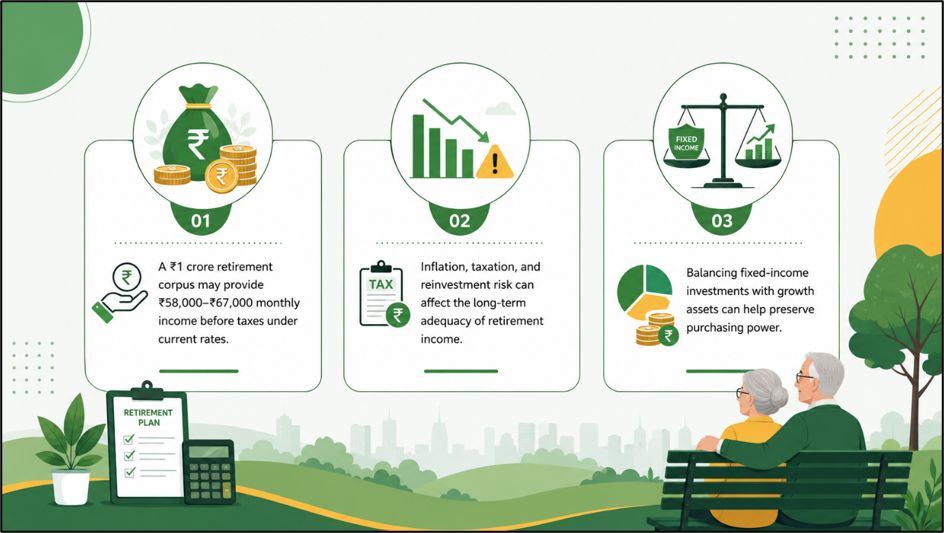
At prevailing interest rates, a retirement corpus of INR 1 crore invested in fixed-income instruments could generate an annual income of roughly INR 7 lakh to INR 8 lakh before taxes, translating to approximately INR 58,000 to INR 67,000 per month. Debt mutual funds may deliver comparable returns, although their performance is market-linked and not guaranteed.
For many retirees, such income may appear adequate initially. The larger question is whether that monthly income will continue to meet living expenses years into retirement.
Inflation: The Challenge Retirees Cannot Ignore
One of the biggest risks facing retirees is inflation. Even moderate inflation can significantly increase living costs over time.
For example, if inflation averages around 5% annually, a monthly expense of INR 50,000 today could rise to more than INR 80,000 within a decade. While expenses continue to increase, income from fixed deposits may remain relatively unchanged unless higher interest rates become available.
As a result, the real value of retirement income may gradually decline despite the stability offered by fixed-income products.
The Limits of a Fixed-Income-Only Strategy
Fixed deposits remain popular because they offer predictable returns and capital protection. However, relying entirely on them introduces certain limitations.
One concern is reinvestment risk. When deposits mature, future interest rates may be lower than current rates, reducing future income. Another concern is that post-tax returns may struggle to consistently exceed inflation over long periods.
Debt mutual funds provide additional flexibility and diversification through investments in government securities, treasury bills, and corporate bonds. However, they are not entirely risk-free and can be affected by interest-rate movements and credit events.
Why Growth Still Matters After Retirement
Many financial planners believe retirement portfolios should not focus exclusively on capital preservation.
A retirement period can easily extend 20 to 30 years or more. During such long horizons, portfolios require some growth component to help offset inflation and rising healthcare costs. Consequently, many advisers recommend maintaining a measured allocation to growth-oriented assets such as equity or hybrid funds even after retirement.
The objective is not aggressive wealth creation but preserving purchasing power and supporting sustainable withdrawals over time.
Balancing Safety and Growth
A diversified retirement portfolio can help address multiple objectives simultaneously.
Fixed deposits, debt funds, government-backed savings schemes, and other income-generating assets may provide stability and regular cash flow. Meanwhile, exposure to growth assets can help the portfolio keep pace with inflation. Many retirement strategies therefore seek a balance between income generation, capital preservation, and long-term growth.
The exact asset allocation will depend on factors such as age, risk tolerance, spending requirements, and overall financial goals.
What Retirees Should Consider
Retirement planning involves more than estimating current income needs. Healthcare expenses, longevity risk, taxation, inflation, and changing market conditions can all influence long-term financial outcomes.
A corpus that appears sufficient today may face increasing pressure over time if income growth does not keep pace with rising costs. This is why retirement strategies often require periodic reviews and adjustments rather than a one-time investment decision.
Key Risks
- Inflation can significantly erode purchasing power over time.
- Falling interest rates may reduce future income generation.
- Debt funds remain exposed to interest-rate and credit risks.
- Fixed-income portfolios may struggle to outpace inflation long term.
Summary
An INR 1 crore retirement corpus invested entirely in fixed deposits and debt funds can generate a meaningful income stream under current market conditions. However, inflation, taxation, and reinvestment risk can reduce the effectiveness of a fixed-income-only strategy over long retirement periods. Many retirement specialists therefore advocate balancing stable income assets with selected growth-oriented investments to help preserve purchasing power and improve long-term financial sustainability.
FAQs
Q: How much monthly income can INR 1 crore generate in retirement?
A: Depending on returns, it may generate approximately INR 58,000 to INR 67,000 monthly before taxes.
Q: Why is inflation a major concern for retirees?
A: Inflation increases living costs over time, reducing the purchasing power of fixed retirement income.
Q: Are fixed deposits alone sufficient for long-term retirement planning?
A: Fixed deposits provide stability but may struggle to consistently outpace inflation over decades.