

Highlights
- Section 87A rebate does not apply to income taxed at special rates.
- Short-term capital gains on listed shares attract separate tax treatment.
- The Income Tax portal may be calculating tax correctly despite lower total income.
Many taxpayers filing Income Tax Returns (ITR) for Assessment Year 2026-27 are puzzled after noticing a tax liability on the Income Tax portal even though their total income is below Rs 12 lakh under the new tax regime.
The confusion largely stems from the belief that all income below the Rs 12 lakh threshold qualifies for complete tax relief under Section 87A. However, the tax rebate is not available for every type of income. Certain categories continue to be taxed separately, which can result in a tax liability even when overall income remains below the threshold.
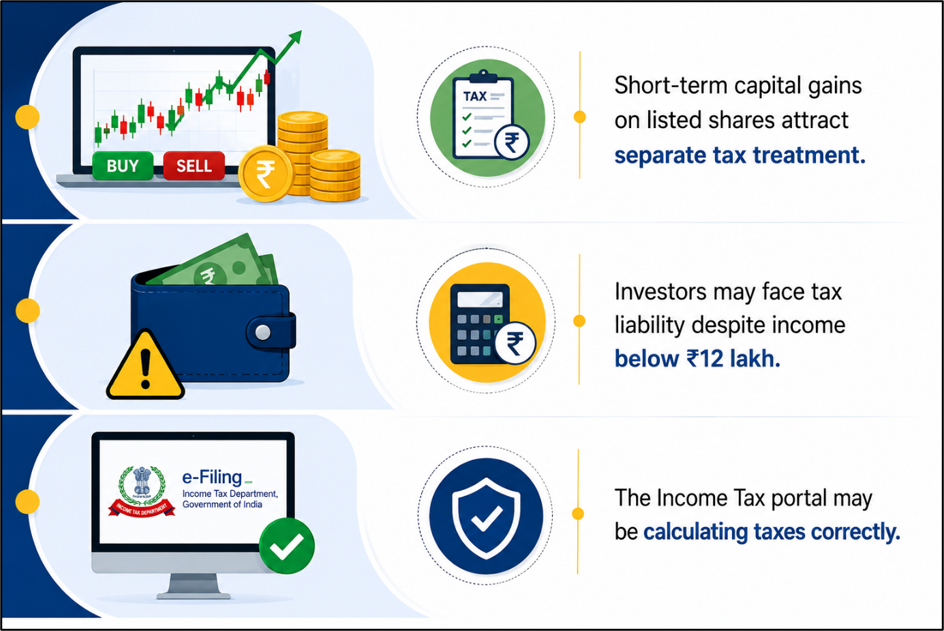 Source: Analysis by Kalkine
Understanding Section 87A Rebate
The revised provisions under Section 87A allow resident individuals opting for the new tax regime to claim a rebate of up to Rs 60,000 if their taxable income does not exceed Rs 12 lakh. This effectively eliminates tax liability on income taxed according to the regular slab rates.
For salaried taxpayers, the standard deduction can further increase the effective tax-free income threshold. However, the rebate applies only to income taxed under normal slab rates and not to income subject to special tax rates.
The Special Rate Income Exception
A key exception under the new tax regime relates to income that is taxed at special rates. These include certain categories such as short-term capital gains (STCG) from listed equity shares and other specified capital gains.
Even if a taxpayer's total income remains below Rs 12 lakh, the rebate under Section 87A cannot be used to offset tax arising from such special-rate income. As a result, taxpayers with significant capital gains may still face a tax liability despite being within the rebate threshold.
Why the Portal May Be Showing 20% Tax
Consider a taxpayer who has only short-term capital gains from listed shares and no salary or other regular income. Since these gains are taxed under specific provisions rather than normal slab rates, the Income Tax portal calculates tax separately on that income.
According to tax experts, this is not a technical error or portal glitch. The portal is applying the tax rules as prescribed under the current provisions governing special-rate income.
Therefore, taxpayers should not assume that a total income below Rs 12 lakh automatically guarantees a zero-tax outcome.
Resident and Non-Resident Tax Treatment
The treatment of capital gains can also vary depending on residential status.
Resident taxpayers may be able to utilize the basic exemption limit in specific situations before calculating tax on certain gains. However, non-resident taxpayers generally do not receive the same adjustment benefits and may face tax on the entire taxable gain amount as per applicable provisions.
Common Misunderstandings Around the Rebate
The phrase "zero tax up to Rs 12 lakh" has led many taxpayers to interpret the rebate as a blanket exemption for all forms of income. Tax professionals have repeatedly clarified that the benefit applies only to income taxed under regular slab rates.
As a result, investors earning capital gains, particularly from equities, often discover that part of their income remains taxable despite falling within the overall income threshold.
What Taxpayers Should Check Before Filing
Before submitting an income tax return, taxpayers should carefully review the nature of their income rather than focusing solely on total income figures.
Income from salary, pension, interest, and other regular sources is generally taxed through slab rates, while capital gains and certain other categories may attract special tax treatment. Understanding this distinction can help avoid surprises during return filing.
Key Risks
- Capital gains may remain taxable despite income below Rs 12 lakh.
- Misinterpreting rebate eligibility can result in incorrect tax estimates.
- Special-rate income receives different tax treatment than salary income.
- Filing without reviewing income classification may create compliance issues.
Summary
The Section 87A rebate under the new tax regime can reduce tax liability to zero for resident individuals with taxable income up to Rs 12 lakh. However, the benefit applies only to income taxed at normal slab rates. Income taxed at special rates, including certain short-term capital gains, remains outside the rebate's scope. Consequently, taxpayers may still see a tax liability on the Income Tax portal despite having total income below Rs 12 lakh.
FAQs
Q: Why is the Income Tax portal showing tax despite income below Rs 12 lakh?
A: Tax may arise if part of the income is taxed at special rates and is ineligible for Section 87A rebate.
Q: Does Section 87A eliminate tax on all income below Rs 12 lakh?
A: No, the rebate generally applies only to income taxed under normal slab rates.
Q: Are short-term capital gains covered by the Section 87A rebate?
A: Under current rules, certain short-term capital gains taxed at special rates are not eligible for the rebate.