

Highlights
- Fixed and floating interest rates offer different advantages depending on market conditions.
- Borrowers should consider repayment capacity and interest rate trends before selecting a loan.
- Loan costs may change over time depending on the type of interest rate chosen.
Interest rates are one of the most important factors influencing the overall cost of a personal loan. Before applying, borrowers usually have the option to choose between a fixed interest rate and a floating interest rate. While both options determine the amount of interest paid during the loan tenure, they function differently and can affect monthly repayments in different ways.
Selecting the appropriate option depends on individual financial circumstances, repayment preferences and expectations regarding future interest rate movements.
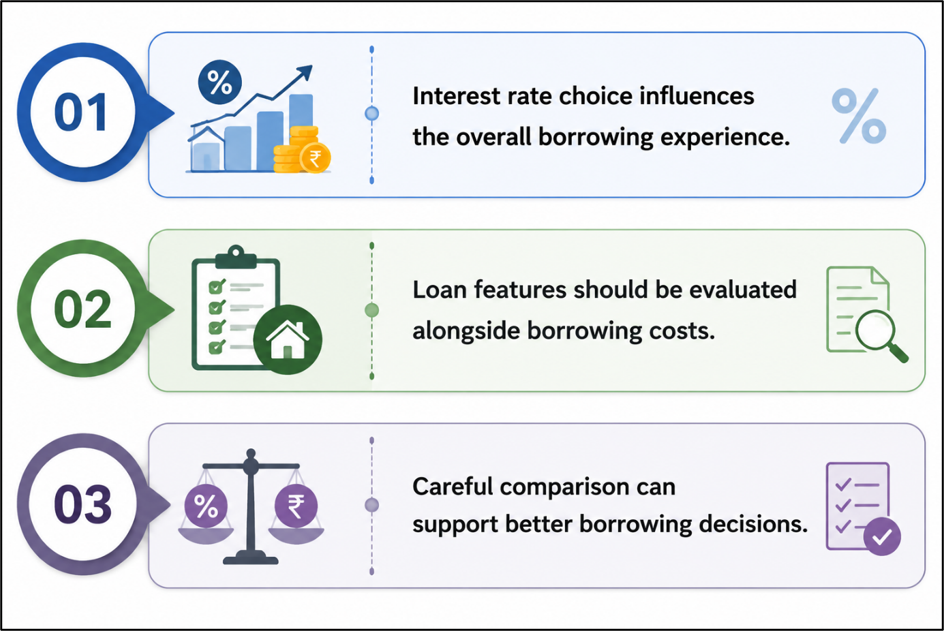
Source: Analysis by Kalkine
What Is a Fixed Interest Rate?
A fixed interest rate remains unchanged throughout the agreed loan tenure unless otherwise specified in the loan agreement.
With this structure, borrowers generally pay the same Equated Monthly Instalment (EMI) every month, making budgeting easier because repayment amounts remain predictable. Individuals who prefer certainty in their monthly financial commitments often consider fixed-rate loans for this reason.
However, if market interest rates decline after the loan is sanctioned, borrowers with fixed-rate loans may not automatically benefit from the lower rates.
What Is a Floating Interest Rate?
A floating interest rate changes periodically based on the benchmark or reference rate used by the lender.
When benchmark rates increase, the borrowing cost may also rise, resulting in higher EMIs or changes in the repayment schedule. Conversely, if benchmark rates decline, borrowers may benefit from lower interest costs depending on the lender's terms and conditions.
Because repayments can change over time, floating-rate loans involve a greater degree of uncertainty than fixed-rate loans.
Factors That Influence Personal Loan Interest Rates
The interest rate offered by a lender depends on several considerations beyond broader market conditions.
Financial institutions typically evaluate factors such as the applicant's credit score, income stability, employment profile, existing debt obligations and repayment history. Loan tenure and the lender's internal credit assessment policies may also influence the final borrowing rate.
As a result, different borrowers may receive different interest rate offers even for similar loan amounts.
Which Option May Suit Different Borrowers?
Borrowers who value stable monthly repayments may find fixed-rate loans easier for financial planning because repayment amounts generally remain constant.
On the other hand, individuals who expect interest rates to soften over time and are comfortable with changing repayment amounts may consider floating-rate loans. Since future interest rate movements cannot be predicted with certainty, neither option can be regarded as universally better than the other.
Comparing both alternatives carefully can help borrowers select the structure that aligns with their financial objectives.
Other Factors to Compare Before Borrowing
Interest rates are only one part of the borrowing decision.
Applicants may also benefit from reviewing processing charges, prepayment conditions, foreclosure fees, repayment flexibility, loan tenure options and the lender's customer service standards before finalising a personal loan.
Evaluating the total borrowing cost rather than focusing solely on the interest rate may provide a more complete understanding of the loan.
Key Risks to Consider
- Floating rates may increase borrowing costs unexpectedly.
- Fixed rates may not benefit from future rate reductions.
- Processing charges can increase the overall loan cost.
- Late repayments may attract additional penalties.
Summary
Choosing between a fixed and floating personal loan interest rate depends on a borrower's financial priorities and comfort with changing repayment obligations. Fixed-rate loans generally provide predictable EMIs, while floating-rate loans may fluctuate as market interest rates change. Since borrowing costs are influenced by both lender policies and economic conditions, comparing loan features carefully before applying can help borrowers make a more informed financial decision.
FAQs
Q: What is the main difference between fixed and floating personal loan interest rates?
A: Fixed rates generally remain unchanged during the loan tenure, while floating rates can vary according to market-linked benchmarks.
Q: Can a floating interest rate reduce my loan cost?
A: It may, if benchmark interest rates decline and the lender passes on the reduction under the loan terms.
Q: Should borrowers compare factors other than interest rates?
A: Yes. Processing fees, repayment flexibility, tenure and other loan conditions should also be considered before selecting a loan.