

Key Highlights
- SIP inflows stood at ₹30,954 crore in May 2026.
- Inflows declined only 0.5% month-on-month.
- New SIP registrations rose to 54.16 lakh.
- SIP stoppage ratio improved to 95.5%.
- Fresh SIP additions exceeded closures for the first time in three months.
- SIP inflows remained above ₹30,000 crore for the seventh consecutive month.
- Retail participation in mutual funds continues to remain strong.
India's mutual fund industry continued to witness strong retail participation in May 2026, with Systematic Investment Plan (SIP) contributions remaining above the ₹30,000-crore mark despite a marginal month-on-month decline. According to data released by the Association of Mutual Funds in India (AMFI), SIP inflows stood at ₹30,954 crore in May, compared with ₹31,115 crore in April, representing a modest decline of 0.5%. However, inflows were still 16% higher than the ₹26,688 crore recorded in May 2025.
The latest figures underscore the resilience of retail investors who continue to use SIPs as a disciplined long-term wealth creation tool despite market volatility and geopolitical uncertainties.
SIP Registrations Outpace Closures for First Time in Three Months
One of the most encouraging developments from the latest AMFI data was the improvement in the SIP ecosystem's churn metrics.
During May 2026, the industry registered 54.16 lakh new SIP accounts, up from 50.71 lakh in April. At the same time, 51.70 lakh SIPs were discontinued or matured, compared with 51.29 lakh in the previous month. As a result, fresh SIP registrations exceeded closures for the first time in three months.
This improvement helped the SIP stoppage ratio decline to 95.5% from 101.1% in April. A ratio below 100% indicates that more investors are starting SIPs than discontinuing them.
SIP Stoppage Ratio Falls Below 100%
The SIP stoppage ratio is a key indicator of investor behaviour and industry health. It measures the number of SIP accounts discontinued relative to fresh registrations.
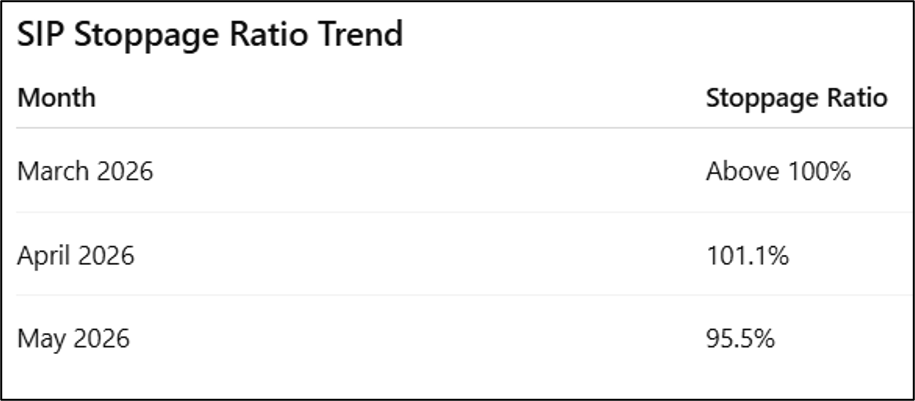
The May data suggests that investor confidence is gradually stabilizing after a period of heightened volatility that had led to elevated SIP closures earlier in the year.
Churn Remains Elevated Despite Improvement
While the stoppage ratio improved, churn within the SIP ecosystem remains relatively high.
Nearly 96 SIPs were discontinued or matured for every 100 new SIPs registered during May. Additionally, SIP discontinuations were 21.2% higher than the levels recorded a year ago. This indicates that while investor participation remains strong, many investors continue to reassess their portfolios amid volatile market conditions.
Industry experts note that elevated discontinuations do not necessarily indicate investor pessimism. Many SIP closures occur because investors switch schemes, complete investment tenures, or achieve specific financial goals.
Retail Investors Continue Long-Term Wealth Creation Journey
Despite short-term fluctuations, SIPs remain one of the most popular investment routes among Indian investors.
Key positives include:
- SIP inflows remained above ₹30,000 crore for the seventh consecutive month.
- Fresh SIP registrations increased sequentially.
- Net SIP additions turned positive after two months of weakness.
- Retail participation continues to expand across smaller cities and towns.
- Investors remain focused on long-term wealth creation despite market volatility.
The sustained inflow trend highlights growing financial awareness and the increasing adoption of systematic investing among Indian households.
Market Volatility Fails to Deter SIP Investors
May was characterized by global uncertainty, volatile equity markets, and concerns over rising crude oil prices. Equity mutual fund inflows declined sharply during the month, but SIP contributions remained largely stable. This demonstrates that retail investors are increasingly viewing SIPs as a long-term commitment rather than reacting to short-term market movements.
Financial advisors continue to advocate SIP investing during volatile periods because market corrections allow investors to accumulate more units through rupee-cost averaging.
Outlook for SIP Investments
The outlook for SIP investments remains constructive.
Several structural factors continue to support long-term growth:
- Rising mutual fund penetration across India
- Increasing financialization of household savings
- Growing awareness of long-term investing
- Digital investment platforms simplifying onboarding
- Strong participation from younger investors
Although short-term volatility may impact monthly registrations and stoppage ratios, the long-term trajectory of SIP investing remains positive.
Frequently Asked Questions (FAQs)
- What were SIP inflows in May 2026?
Mutual fund SIP inflows stood at ₹30,954 crore in May 2026, slightly lower than ₹31,115 crore recorded in April.
- What is the SIP stoppage ratio?
The SIP stoppage ratio measures the number of SIP accounts discontinued relative to fresh SIP registrations. A ratio below 100% indicates more new SIPs are being added than closed.
- What was the SIP stoppage ratio in May 2026?
The SIP stoppage ratio improved to 95.5% in May from 101.1% in April.
- How many new SIP accounts were registered in May?
The mutual fund industry registered 54.16 lakh new SIP accounts during May 2026.
- Why is the improvement in stoppage ratio important?
It indicates strengthening investor participation, as fresh SIP registrations exceeded discontinuations for the first time in three months.
- Are SIPs still a good investment strategy during market volatility?
Many financial experts consider SIPs an effective long-term investment strategy because they help investors benefit from rupee-cost averaging and disciplined investing, regardless of market conditions.
- What is driving long-term SIP growth in India?
Increasing financial literacy, rising retail participation, digital investment platforms, and growing awareness of long-term wealth creation are key drivers supporting SIP growth.