

One of the first decisions investors face when entering the stock market is choosing between small-cap, mid-cap, and large-cap stocks. While all three categories offer wealth creation opportunities, they differ significantly in terms of growth potential, risk levels, volatility, and investment suitability.
Understanding the differences between these market capitalization segments can help investors build portfolios that align with their financial goals, risk tolerance, and investment horizon.
Whether you’re a beginner investor or looking to diversify your portfolio, knowing where each category fits can improve long-term investment decision-making.
What Are Large-Cap, Mid-Cap, and Small-Cap Stocks?
Stocks are generally classified based on their market capitalization, which represents the total market value of a company’s outstanding shares.
Large-Cap Stocks- Large-cap companies are typically among the biggest and most established businesses in the market. These companies often have proven business models, strong brand recognition, and stable earnings.
Examples may include leading banks, IT firms, consumer goods companies, and large industrial businesses.
Mid-Cap Stocks- Mid-cap companies occupy the middle ground between large and small businesses. They are often in a growth phase and may offer a balance between stability and expansion potential.
These companies may become future large-cap businesses if they continue to execute successfully.
Small-Cap Stocks- Small-cap companies are relatively smaller businesses with significant growth potential. Many operate in niche industries or emerging markets and are often at an earlier stage of their growth journey.
While small-cap stocks can generate substantial returns, they generally carry higher risk and volatility.
Understanding the Risk and Return Trade-Off
A key distinction among market capitalization categories is the relationship between risk and potential returns.
Large-Cap Stocks: Stability and Consistency
Large-cap companies often provide:
- Strong business fundamentals
- Established market positions
- Lower volatility
- Greater liquidity
- More predictable earnings
However, because these businesses are already mature, growth rates may be relatively moderate compared to smaller companies.
Large-cap stocks are often favored by conservative investors seeking stability and long-term wealth preservation.
Mid-Cap Stocks: Growth With Moderate Risk
Mid-cap companies often offer:
- Higher growth potential than large caps
- Better financial stability than small caps
- Expanding market opportunities
- Increasing institutional investor interest
Mid-cap stocks can sometimes deliver attractive returns while maintaining manageable levels of risk.
Investors seeking a balance between growth and stability frequently allocate a portion of their portfolios to this segment.
Small-Cap Stocks: High Growth Potential
Small-cap businesses may benefit from:
- Rapid business expansion
- Emerging industry opportunities
- Lower market penetration
- Significant earnings growth potential
However, these companies can also experience:
- Higher price volatility
- Greater business uncertainty
- Lower liquidity
- Increased sensitivity to economic conditions
Small-cap investing generally requires a longer investment horizon and a higher tolerance for risk.
Comparing Large-Cap, Mid-Cap, and Small-Cap Stocks
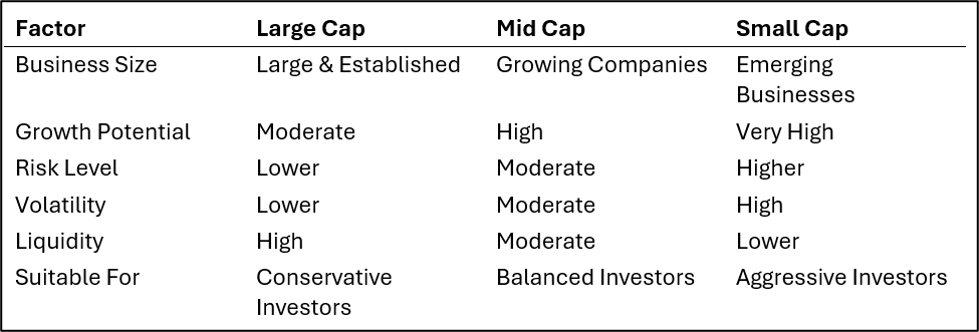
Which Category Fits Your Investment Goals?
For Conservative Investors- Investors prioritizing capital preservation and lower volatility may prefer large-cap stocks.
These companies often provide relatively stable earnings and may perform better during periods of market uncertainty.
For Balanced Investors- Investors seeking both growth and stability may find mid-cap stocks attractive.
Mid-cap businesses often provide opportunities for expansion while maintaining stronger financial foundations than many small-cap companies.
For Aggressive Investors- Investors with long investment horizons and higher risk tolerance may consider allocating a portion of their portfolio to small-cap stocks.
The potential for outsized returns often comes with greater short-term volatility.
Why Diversification Matters
Rather than choosing only one category, many investors build diversified portfolios that combine large-cap, mid-cap, and small-cap stocks.
A diversified approach may help:
- Reduce overall portfolio risk
- Capture growth opportunities across market segments
- Improve long-term return potential
- Enhance portfolio resilience during market cycles
Asset allocation should be aligned with individual financial goals and risk tolerance.
Common Mistakes Investors Should Avoid
Chasing Recent Performance- Many investors buy into segments that have recently outperformed without considering valuations or future risks.
Ignoring Risk Tolerance- Allocating excessive capital to volatile small-cap stocks may create unnecessary stress during market corrections.
Lack of Diversification- Overexposure to a single market-cap segment can increase portfolio concentration risk.
Short-Term Thinking- All three categories may experience periods of underperformance. Long-term investing often requires patience and discipline.
Final Thoughts
There is no universally “best” category among large-cap, mid-cap, and small-cap stocks. The right choice depends on an investor’s financial objectives, risk appetite, and investment horizon.
Large-cap stocks may provide stability, mid-cap stocks can offer a balance of growth and risk, while small-cap stocks may deliver higher growth potential accompanied by greater volatility.
A well-diversified portfolio that combines all three categories can help investors participate in different growth opportunities while managing overall risk more effectively.
Frequently Asked Questions (FAQs)
1. What are large-cap stocks?
Large-cap stocks are shares of well-established companies with large market capitalizations and relatively stable business operations.
2. Are small-cap stocks riskier than large-cap stocks?
Yes. Small-cap stocks generally experience higher volatility and business risk but may offer greater growth potential.
3. Which category offers the highest return potential?
Historically, small-cap stocks have often delivered higher growth potential, although they also carry greater risk.
4. Are mid-cap stocks suitable for long-term investors?
Many investors consider mid-cap stocks attractive for long-term growth due to their balance of expansion opportunities and business stability.
5. Should beginners invest only in large-cap stocks?
Not necessarily. Portfolio allocation should depend on individual risk tolerance, financial goals, and investment horizon.
6. Can investors combine all three categories?
Yes. Many diversified portfolios include a mix of large-cap, mid-cap, and small-cap stocks.
7. How do market conditions affect different categories?
Large-cap stocks may perform relatively better during uncertain periods, while mid-cap and small-cap stocks often benefit during strong economic growth phases.