

Highlights
- A longer investment horizon can significantly lower monthly SIP commitments.
- Compounding can contribute a larger share of wealth over extended periods.
- Early investing may require less capital than delaying financial goals.
Many investors set a target of accumulating INR 1 crore as part of their long-term financial planning. While the target amount remains the same, the path to reaching it can differ considerably depending on when an investor starts and how long they stay invested.
One factor that often receives attention is the monthly contribution required through a Systematic Investment Plan (SIP). However, the role of time is equally important. A longer investment period can influence how much capital an investor needs to commit each month and how much growth comes from investment returns.
Why Investment Duration Matters
When investors contribute regularly through SIPs, the invested amount has an opportunity to generate returns. Those returns may then earn additional returns over time, creating a compounding effect.
As the investment horizon expands, a larger portion of the final corpus can come from accumulated gains rather than fresh capital contributions. This is why investors who begin earlier often face a lower monthly investment burden compared to those pursuing the same target over a shorter period.
Comparing Different Time Horizons
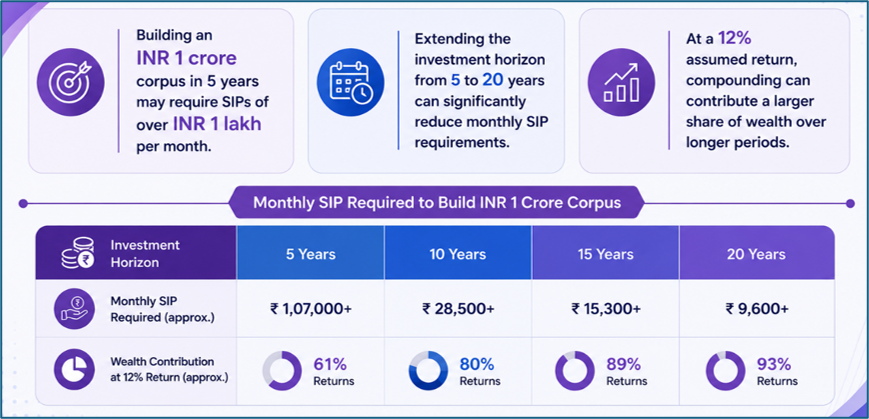
An investor targeting INR 1 crore within five years may need a considerably larger monthly contribution than someone planning over ten or twenty years.
Illustrative calculations based on a 12% annual return assumption indicate that:
- A five-year goal could require monthly investments exceeding INR 1 lakh.
- A ten-year horizon may reduce the required monthly commitment substantially.
- A twenty-year timeline can lower the monthly SIP requirement even further.
These examples highlight the relationship between time and capital allocation rather than guaranteeing future outcomes.
Source: Analysis by Kalkine
How Compounding Changes the Equation
Compounding becomes more visible over longer durations. In the early years of investing, most of the corpus growth may come from investor contributions. As time passes, investment gains can begin contributing a larger share of the total value.
This transition often explains why extending an investment horizon can have a meaningful effect on wealth accumulation goals.
For investors planning major financial milestones such as retirement, children's education, or long-term asset creation, the duration of investing may be as important as the amount invested.
Factors Beyond Return Assumptions
While SIP projections often use assumed return rates, actual investment performance can vary depending on market conditions and asset allocation decisions.
Investors should also consider:
- Financial objectives
- Risk appetite
- Investment tenure
- Inflation expectations
- Portfolio diversification
These factors can influence both the required investment amount and the eventual corpus generated.
Starting Early Versus Investing More Later
One common lesson from SIP projections is that time can be a valuable asset. Investors who start earlier may have the flexibility to contribute smaller amounts while still working toward large financial targets.
Conversely, delaying investments may require significantly higher monthly commitments to achieve the same objective within a shorter timeframe. Although return assumptions and market conditions will vary, the principle remains consistent: extending the investment horizon can improve the effectiveness of compounding.
Key Risks
- Market fluctuations may affect long-term investment returns.
- Inflation can reduce the real value of future wealth.
- Lower-than-expected returns may delay financial targets.
- Irregular SIP contributions can impact corpus accumulation.
Summary
The time available for investing can significantly influence the monthly SIP needed to achieve an INR 1 crore target. Longer investment horizons generally allow compounding to contribute a larger share of wealth accumulation, reducing the dependence on higher monthly contributions. While returns are never guaranteed, starting early and maintaining investment discipline can improve the likelihood of reaching long-term financial goals.
FAQs
Q: Why does a longer SIP tenure reduce monthly investment requirements?
A: Longer durations provide more time for compounding, helping investments grow with relatively lower monthly contributions.
Q: Is INR 1 crore achievable through SIP investing?
A: The outcome depends on contribution amounts, tenure, returns and investment discipline maintained over time.
Q: Should investors focus only on expected returns?
A: No, investors should also consider risk, inflation, financial goals and investment timelines.